

Peru
Context
Material
References
KM: #Click to copy to clipboard235
Numista: #46641
Value
Exchange value: 5 PEH
Bullion value: $351.13
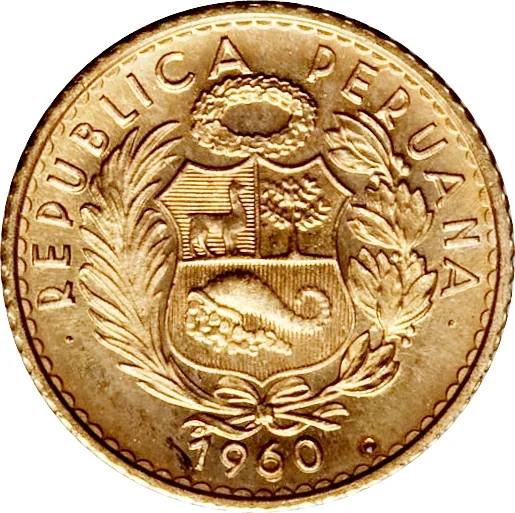
Obverse
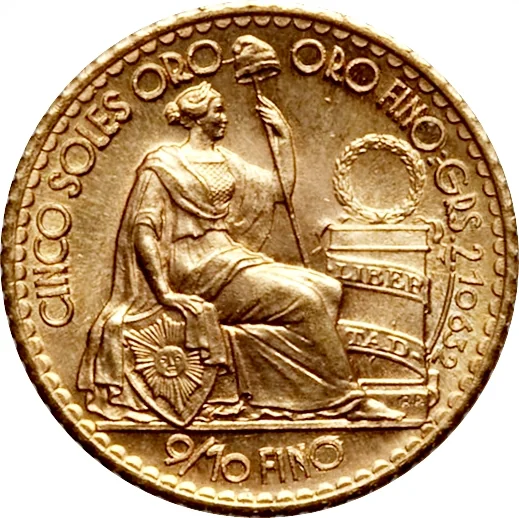
Reverse
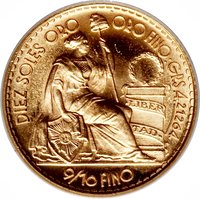
Description:
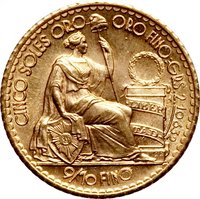
Liberty seated right, holding staff with cap, flanked by shield and column.
Inscription:
CINCO SOLES ORO
ORO FINO:GRS.2.10632
LIBERTAD
9/10 FINO
ORO FINO:GRS.2.10632
LIBERTAD
9/10 FINO
Script: Latin
Edge
Reeded
Categories
| Symbol> Phrygian cap |
Mints
| Name | Mark |
|---|---|
| Lima | — |
Mintings
| Year | Mint Mark | Mintage | Quality | Collection |
|---|---|---|---|---|
| 1956 | — | 4,510 | ||
| 1957 | — | 2,146 | ||
| 1959 | — | 1,536 | ||
| 1960 | — | 8,133 | ||
| 1961 | — | 1,154 | ||
| 1962 | — | 1,550 | ||
| 1963 | — | 3,945 | ||
| 1964 | — | 2,063 | ||
| 1965 | — | 14,000 | ||
| 1966 | — | 4,738 | ||
| 1967 | — | 3,651 | ||
| 1969 | — | 127 |
Historical background
In 1956, Peru's currency situation was characterized by a complex and unstable system of multiple exchange rates, a legacy of the post-World War II era and the economic policies of President Manuel A. Odría (1948-1956). The sol was not freely convertible, and the government maintained a controlled official rate for essential imports and debt servicing, while a parallel, much less favorable "free market" rate existed for other transactions. This system, intended to conserve scarce foreign reserves and control the balance of payments, created significant distortions, encouraged a black market for dollars, and acted as a barrier to foreign investment and trade.
The underlying economic context was one of growing imbalance. While the 1950s had seen a boom driven by high prices for Peru's key exports (like copper, cotton, and sugar), public spending had risen dramatically, fueled by large infrastructure projects. By mid-decade, export prices were falling, and the fiscal deficit was widening, leading to inflationary pressures. The overvalued official exchange rate made imports artificially cheap, discouraging domestic production, while simultaneously making Peruvian exports less competitive abroad, creating a looming crisis in the country's external accounts.
This precarious currency regime set the stage for a major economic challenge for the incoming government of President Manuel Prado, who took office in July 1956. Facing dwindling international reserves and a loss of confidence, his administration was quickly forced to seek stabilization measures. The situation culminated in a significant devaluation in late 1958 and negotiations with the International Monetary Fund (IMF) for a stabilization program, marking the end of the multi-tier exchange system and the beginning of a new, albeit difficult, phase of economic adjustment.
The underlying economic context was one of growing imbalance. While the 1950s had seen a boom driven by high prices for Peru's key exports (like copper, cotton, and sugar), public spending had risen dramatically, fueled by large infrastructure projects. By mid-decade, export prices were falling, and the fiscal deficit was widening, leading to inflationary pressures. The overvalued official exchange rate made imports artificially cheap, discouraging domestic production, while simultaneously making Peruvian exports less competitive abroad, creating a looming crisis in the country's external accounts.
This precarious currency regime set the stage for a major economic challenge for the incoming government of President Manuel Prado, who took office in July 1956. Facing dwindling international reserves and a loss of confidence, his administration was quickly forced to seek stabilization measures. The situation culminated in a significant devaluation in late 1958 and negotiations with the International Monetary Fund (IMF) for a stabilization program, marking the end of the multi-tier exchange system and the beginning of a new, albeit difficult, phase of economic adjustment.
⭐ Rare