

¼ Dollar – United States
Non-circulating coins
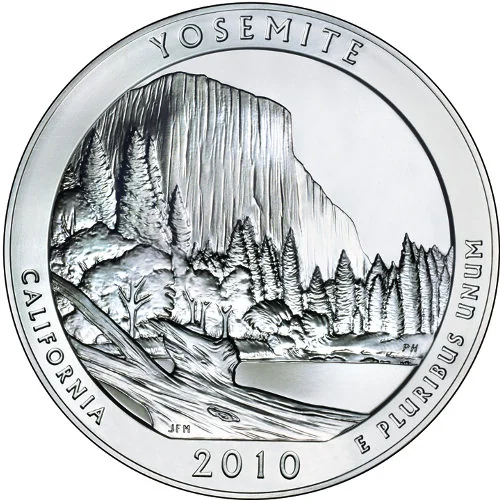
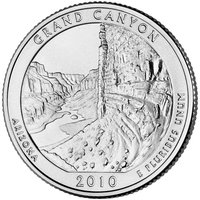
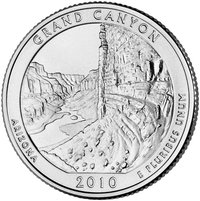
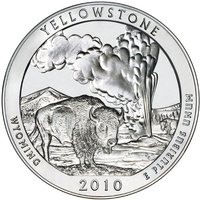
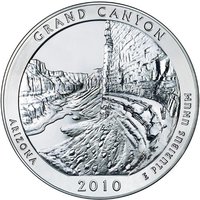
Commemoration: Yosemite National Park
United States
Context
Year: 2010
Issuer: United States 
Period:
(since 1776)
Currency:
(since 1785)
Subdivision: ¼ Dollar = 25 Cents
Total mintage: 59,716
Material
Diameter: 76.2 mm
Weight: 155.5 g
Silver weight: 155.34 g
Thickness: 4.19 mm
Shape: Round
Composition: 99.9% Silver
Standard: Silver 5 ounces
Magnetic: No
Technique: Milled
Alignment: Coin alignment
flip
References
KM: #Click to copy to clipboard491
Numista: #90504
Value
Exchange value: ¼ USD = $0.25
Bullion value: $444.60
Inflation-adjusted value: 0.37 USD
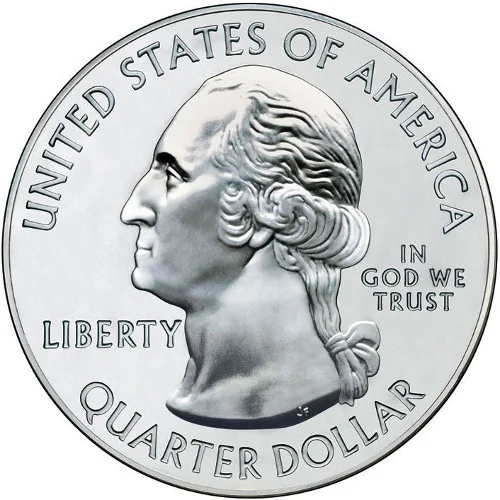
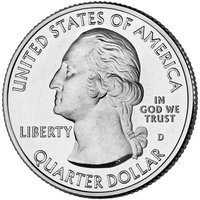
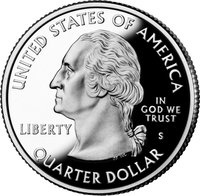
Obverse
Description:
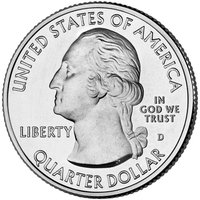
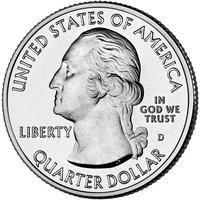
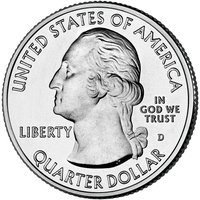
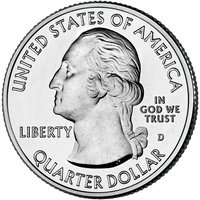
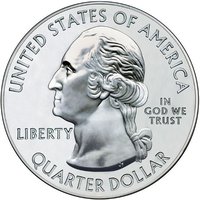
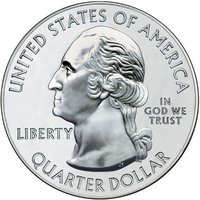
Washington bust left, value below.
Inscription:
UNITED STATES OF AMERICA
IN
GOD WE
TRUST
LIBERTY
P
QUARTER DOLLAR
IN
GOD WE
TRUST
LIBERTY
P
QUARTER DOLLAR
Script: Latin
Reverse
Edge
Smooth with lettering
Legend:
.999 FINE SILVER 5.0 OUNCE
Mintings
| Year | Mint Mark | Mintage | Quality | Collection |
|---|---|---|---|---|
| 2010 | — | 33,000 | ||
| 2010 | P | 26,716 |
Historical background
The United States entered 2010 in a fragile economic recovery from the Great Recession, with its currency policy dominated by the Federal Reserve's unprecedented monetary stimulus. In response to the financial crisis, the Fed had already lowered its benchmark interest rate to near zero in late 2008 and embarked on its first round of Quantitative Easing (QE1), purchasing massive amounts of Treasury and mortgage-backed securities. By 2010, this expansion of the money supply created concerns about potential long-term dollar debasement and inflation, though those pressures were largely muted by weak demand. The primary focus was on stimulating growth and preventing deflation, keeping the dollar relatively weak to support exports.
Internationally, the dollar's status as the world's primary reserve currency faced subtle scrutiny. China, a major holder of U.S. debt, publicly expressed concerns about the safety of its dollar-denominated assets due to the expanding U.S. budget deficit and the Fed's balance sheet growth. This period saw ongoing tensions over currency valuation, with the U.S. accusing China of artificially suppressing the value of the yuan to gain a trade advantage. Despite these frictions, the dollar remained the dominant safe-haven asset, as evidenced by its strengthening during the European sovereign debt crisis in mid-2010, when investors fled the euro.
Domestically, there was little public debate about physical currency, but a significant policy shift occurred with the passage of the Dodd-Frank Act in July 2010. While primarily focused on financial regulation, the Act had lasting implications for digital and alternative currencies. Its provisions on payment systems and the clarification of the regulatory landscape for "value that substitutes for currency" indirectly set the stage for future debates and frameworks surrounding emerging digital payment technologies and, later, cryptocurrencies, which were just beginning to gain attention with the launch of Bitcoin the previous year.
Internationally, the dollar's status as the world's primary reserve currency faced subtle scrutiny. China, a major holder of U.S. debt, publicly expressed concerns about the safety of its dollar-denominated assets due to the expanding U.S. budget deficit and the Fed's balance sheet growth. This period saw ongoing tensions over currency valuation, with the U.S. accusing China of artificially suppressing the value of the yuan to gain a trade advantage. Despite these frictions, the dollar remained the dominant safe-haven asset, as evidenced by its strengthening during the European sovereign debt crisis in mid-2010, when investors fled the euro.
Domestically, there was little public debate about physical currency, but a significant policy shift occurred with the passage of the Dodd-Frank Act in July 2010. While primarily focused on financial regulation, the Act had lasting implications for digital and alternative currencies. Its provisions on payment systems and the clarification of the regulatory landscape for "value that substitutes for currency" indirectly set the stage for future debates and frameworks surrounding emerging digital payment technologies and, later, cryptocurrencies, which were just beginning to gain attention with the launch of Bitcoin the previous year.
💎 Extremely Rare