

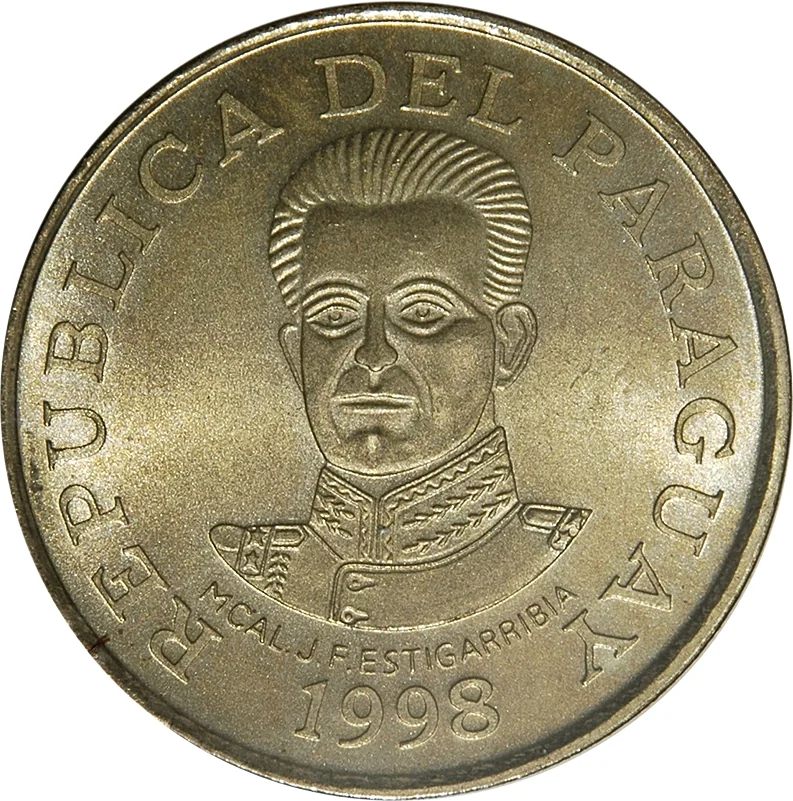
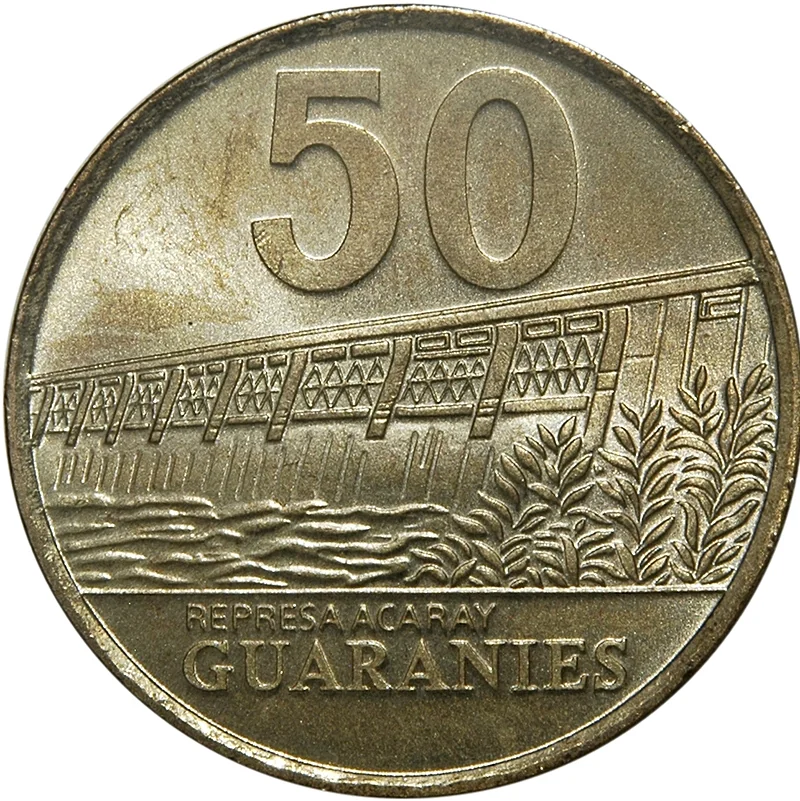
50 guaraníes – Paraguay
Add to wishlist
Paraguay
Context
Years: 1995–2005
Issuer: Paraguay
Issuing organization: Central Bank of Paraguay
Period:
(since 1811)
Currency:
(since 1944)
Demonetization: 17 January 2014
Total mintage: 57,000,000
Material
References
KM: #
Numista: #9050
Value
Exchange value: 50 PYG
Obverse
Reverse
Edge
Reeded
Categories
| Person> Military leader |
| Person> Politician |
Mints
| Name | Mark |
|---|---|
| Casa de Moneda de Chile | — |
| Royal Canadian Mint of Winnipeg | — |
Mintings
| Year | Mint Mark | Mintage | Quality | Collection |
|---|---|---|---|---|
| 1995 | — | 25,000,000 | ||
| 1998 | — | 22,000,000 | ||
| 2005 | — | 10,000,000 |
Historical background
In 1995, Paraguay's currency situation was characterized by relative stability under a managed float, a notable contrast to the hyperinflation and severe instability that had plagued many of its neighbors in previous decades. The national currency, the Guaraní (PYG), had been introduced in 1943 to replace the Paraguayan peso, and by the mid-1990s, it was one of the older and more established currencies in South America. This stability was largely anchored by conservative monetary policy from the Central Bank of Paraguay (BCP) and a predominantly dollarized banking system, where a significant portion of loans and deposits were held in US dollars, which acted as a de facto anchor for confidence.
The economy in 1995 was still navigating the aftermath of the transition from the long Stroessner dictatorship (1954-1989) and the "Tequila Crisis" that shook emerging markets in 1994-95. While Paraguay avoided the worst of that regional financial shock, its economy was vulnerable due to its dependence on agricultural exports (especially soy and cotton) and re-export trade with its larger neighbors, Brazil and Argentina. Inflation, a historical concern, was under control by regional standards, running at approximately 13.4% for the year, but this rate was still considered high and a persistent challenge for monetary authorities.
Overall, the 1995 currency landscape was one of cautious equilibrium. The Guaraní did not experience dramatic devaluation or crisis that year, but underlying structural issues—such as a large informal economy, bouts of political uncertainty, and vulnerability to external shocks from neighboring economic giants—posed ongoing risks to its long-term stability. The period thus represented a fragile calm, with the Central Bank actively managing the exchange rate to balance inflation control with the competitiveness of the country's key export sectors.
The economy in 1995 was still navigating the aftermath of the transition from the long Stroessner dictatorship (1954-1989) and the "Tequila Crisis" that shook emerging markets in 1994-95. While Paraguay avoided the worst of that regional financial shock, its economy was vulnerable due to its dependence on agricultural exports (especially soy and cotton) and re-export trade with its larger neighbors, Brazil and Argentina. Inflation, a historical concern, was under control by regional standards, running at approximately 13.4% for the year, but this rate was still considered high and a persistent challenge for monetary authorities.
Overall, the 1995 currency landscape was one of cautious equilibrium. The Guaraní did not experience dramatic devaluation or crisis that year, but underlying structural issues—such as a large informal economy, bouts of political uncertainty, and vulnerability to external shocks from neighboring economic giants—posed ongoing risks to its long-term stability. The period thus represented a fragile calm, with the Central Bank actively managing the exchange rate to balance inflation control with the competitiveness of the country's key export sectors.
🌱 Very Common