

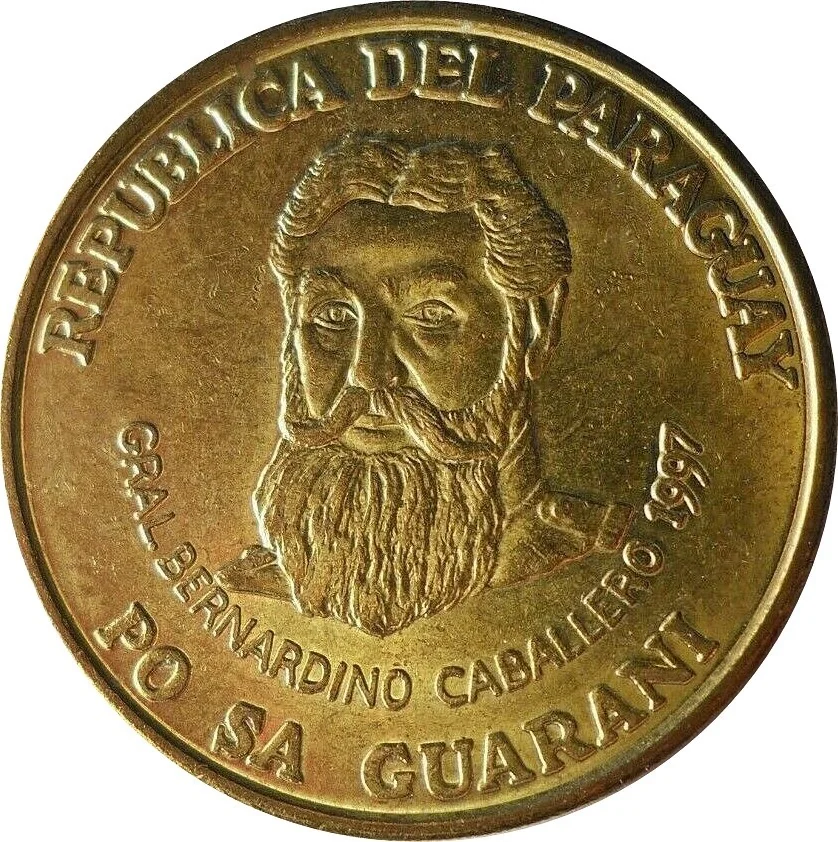
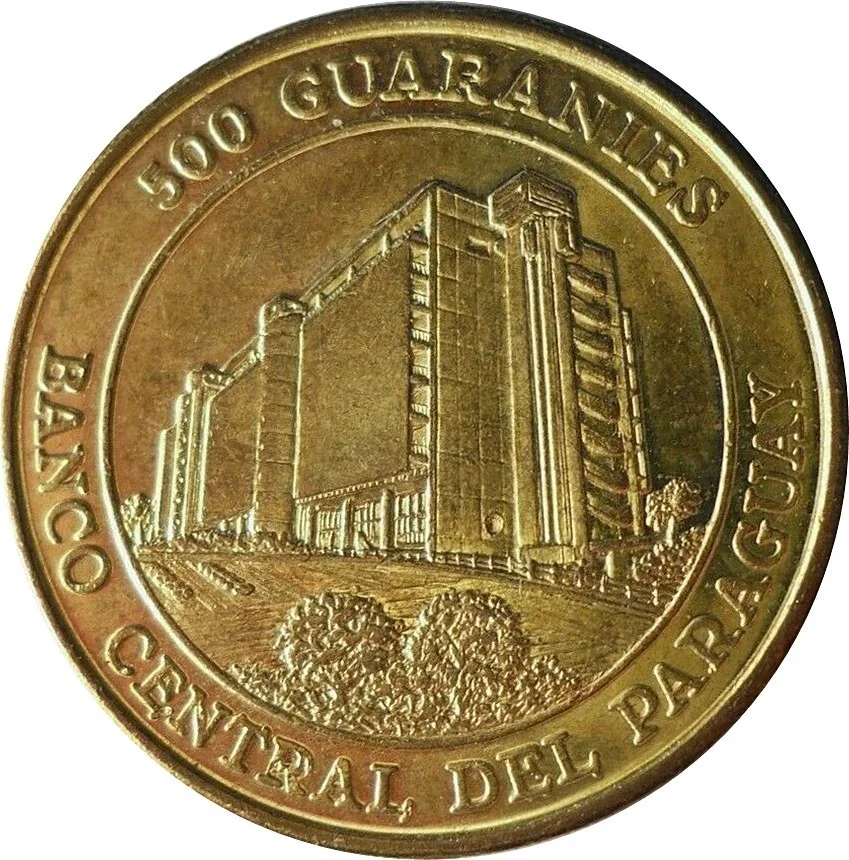
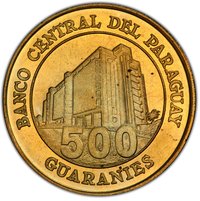
500 Guaraníes – Paraguay
Paraguay
Context
Year: 1997
Issuer: Paraguay 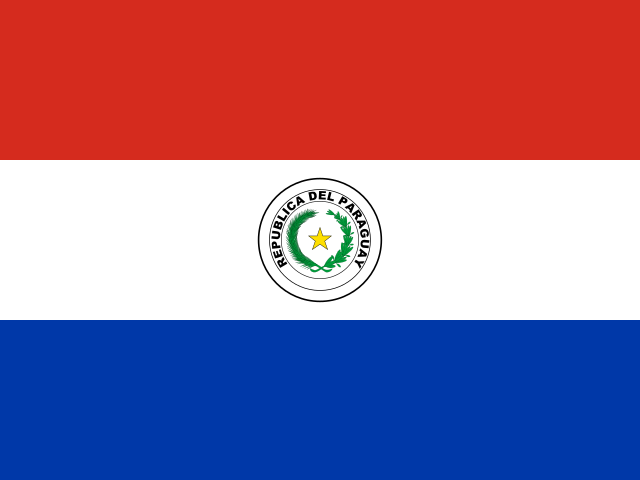
Issuing organization: Central Bank of Paraguay
Period:
(since 1811)
Currency:
(since 1944)
Demonetization: 17 January 2014
Total mintage: 120,000,000
Material
References
KM: #Click to copy to clipboard194
Numista: #9809
Value
Exchange value: 500 PYG
Obverse
Reverse
Edge
Reeded
Categories
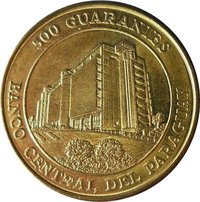
| Building |
| Person> Politician |
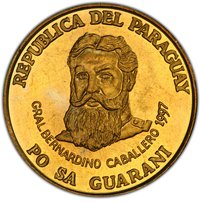
| Person> Military leader |
Mints
| Name | Mark |
|---|---|
| Royal Australian Mint | — |
Mintings
| Year | Mint Mark | Mintage | Quality | Collection |
|---|---|---|---|---|
| 1997 | Royal Australian Mint | 20,000,000 | ||
| 1997 | Royal Australian Mint | 20,000,000 | ||
| 1997 | Royal Australian Mint | 20,000,000 | ||
| 1997 | Royal Australian Mint | 20,000,000 | ||
| 1997 | Royal Australian Mint | 20,000,000 | ||
| 1997 | — | 20,000,000 |
Historical background
In 1997, Paraguay's currency situation was characterized by relative stability under a dual monetary system, but was underpinned by significant vulnerabilities. The official currency was the Guaraní (PYG), which coexisted and circulated widely alongside the US dollar, a practice known as "dollarization." This unofficial dollarization was a legacy of decades of high inflation and economic instability, particularly during the Stroessner dictatorship, which eroded public trust in the local currency for large transactions and savings. The Central Bank of Paraguay (BCP) maintained a managed float exchange rate regime, allowing the Guaraní to fluctuate within an informal band, with interventions aimed at preventing excessive volatility rather than targeting a fixed rate.
The economy in 1997 was still reeling from the profound shock of the 1995 banking crisis, which had exposed severe weaknesses in financial regulation and led to a collapse of several major institutions. While the immediate crisis had passed, the financial sector remained fragile, and the government was under pressure from international bodies like the IMF to implement stricter reforms. Inflation, which had been hyperinflationary in the late 1980s and early 1990s, was brought down to more manageable levels (approximately 6.2% in 1997), but this stability was fragile and heavily dependent on prudent fiscal and monetary policy.
Looking forward, the year 1997 stood at a crossroads. The stability of the Guaraní was not deeply institutionalized and relied on a delicate balance. Persistent issues such as widespread informal economic activity, corruption, and a weak banking system posed constant threats to monetary control. Consequently, while the surface appeared calm, the currency situation was susceptible to shifts in investor confidence, fiscal discipline, or external shocks, setting the stage for the economic challenges that would become more pronounced in the following years.
The economy in 1997 was still reeling from the profound shock of the 1995 banking crisis, which had exposed severe weaknesses in financial regulation and led to a collapse of several major institutions. While the immediate crisis had passed, the financial sector remained fragile, and the government was under pressure from international bodies like the IMF to implement stricter reforms. Inflation, which had been hyperinflationary in the late 1980s and early 1990s, was brought down to more manageable levels (approximately 6.2% in 1997), but this stability was fragile and heavily dependent on prudent fiscal and monetary policy.
Looking forward, the year 1997 stood at a crossroads. The stability of the Guaraní was not deeply institutionalized and relied on a delicate balance. Persistent issues such as widespread informal economic activity, corruption, and a weak banking system posed constant threats to monetary control. Consequently, while the surface appeared calm, the currency situation was susceptible to shifts in investor confidence, fiscal discipline, or external shocks, setting the stage for the economic challenges that would become more pronounced in the following years.
🌱 Common