

50 cents – Australia
Add to wishlist
Australia
Context
Years: 1969–1984
Issuer: Australia
Ruler: Elizabeth II
Currency:
(since 1966)
Total mintage: 226,452,292
Material
Diameter: 31.51 mm
Weight: 15.55 g
Thickness: 3 mm
Shape: Dodecagonal
Standard: Silver half ounce
Technique: Milled
Alignment: Medal alignment
flip
References
KM: #
Numista: #904
Value
Exchange value: 0.50 AUD
Inflation-adjusted value: 7.56 AUD
Obverse
Description:
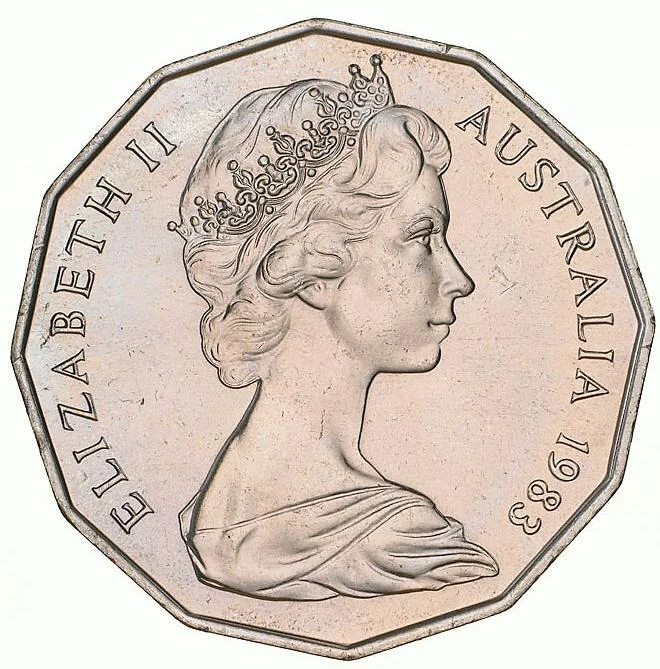
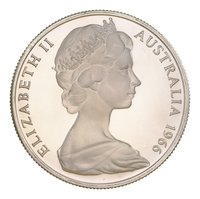
Second portrait of Queen Elizabeth II facing right in the Girls of Great Britain and Ireland Tiara.
Inscription:
ELIZABETH II
AUSTRALIA 1971
AUSTRALIA 1971
Script: Latin
Designer: Arnold Machin
Reverse
Description:
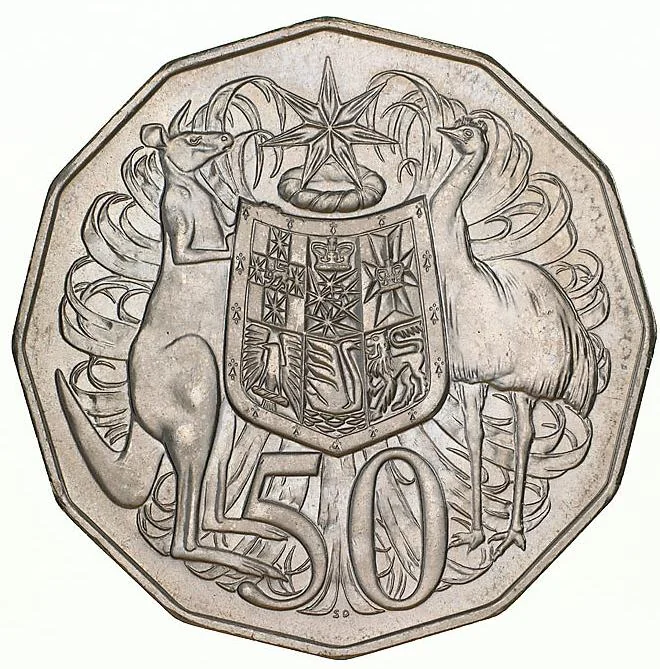
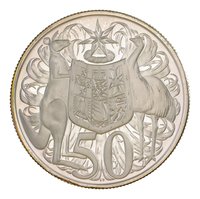
Australian coat of arms (kangaroo and emu) with "50" and designer's mark "SD".
Inscription:
50
SD
SD
Script: Latin
Designer: Stuart Devlin
Edge
12 Sided Smooth
Mints
| Name | Mark |
|---|---|
| Royal Australian Mint | — |
Mintings
| Year | Mint Mark | Mintage | Quality | Collection |
|---|---|---|---|---|
| 1969 | — | 13,056 | Proof | |
| 1969 | — | 14,351 | BU | |
| 1969 | — | 14,015,000 | ||
| 1971 | — | 21,056,000 | ||
| 1971 | — | 10,066 | Proof | |
| 1971 | — | 28,572 | BU | |
| 1972 | — | 39,065 | BU | |
| 1972 | — | 5,586,000 | ||
| 1972 | — | 10,272 | Proof | |
| 1973 | — | 30,928 | BU | |
| 1973 | — | 4,009,000 | ||
| 1973 | — | 10,090 | Proof | |
| 1974 | — | 10,918 | Proof | |
| 1974 | — | 25,475 | BU | |
| 1974 | — | 8,962,000 | ||
| 1975 | — | 30,121 | BU | |
| 1975 | — | 19,064,800 | ||
| 1975 | — | 23,021 | Proof | |
| 1976 | — | 40,004 | BU | |
| 1976 | — | 27,280,000 | ||
| 1976 | — | 21,200 | Proof | |
| 1977 | — | 2 | ||
| 1978 | — | 25,765,000 | ||
| 1978 | — | 70,006 | BU | |
| 1978 | — | 38,519 | Proof | |
| 1979 | — | 70,006 | BU | |
| 1979 | — | — | ||
| 1979 | — | 36,006 | Proof | |
| 1980 | — | 100,000 | BU | |
| 1980 | — | — | ||
| 1980 | — | 68,000 | Proof | |
| 1981 | — | 120,000 | BU | |
| 1981 | — | 24,168,000 | ||
| 1981 | — | 86,100 | Proof | |
| 1983 | — | 48,923,000 | ||
| 1983 | — | 80,000 | Proof | |
| 1983 | — | 155,700 | BU | |
| 1984 | — | 150,014 | BU | |
| 1984 | — | 26,281,000 | ||
| 1984 | — | 61,000 | Proof |
Historical background
In 1969, Australia’s currency system stood on the cusp of a historic transformation, operating under the long-established framework of the Australian pound (£A). This system, inherited from its British colonial past, was a complex imperial currency of pounds, shillings, and pence (20 shillings to the pound, 12 pence to the shilling). However, this structure was increasingly seen as cumbersome and out of step with global trends. Decimalisation—the shift to a currency based on units of ten—had been successfully adopted by other Commonwealth nations like South Africa and New Zealand, and a growing consensus within Australia viewed the imperial system as an inefficient barrier to modern commerce and international trade.
The path to change had been formally set in motion years earlier. In 1963, the government announced its decision to decimalise, and after extensive public consultation, the new currency was named the "royal" in 1965. However, this name proved unpopular, and it was swiftly changed to the "dollar." The year 1969 was therefore one of final preparation and public education in the lead-up to Decimal Day (C-Day), scheduled for 14 February 1966. While the physical changeover had already occurred, 1969 was a period where the new Australian dollar (AUD), divided into 100 cents, was fully bedded down and had firmly replaced the old pounds, shillings, and pence in everyday use.
Economically, the late 1960s was a time of strong growth and low inflation in Australia, providing a stable backdrop for the currency transition. The peg of the new dollar was initially set at two dollars to one pound sterling, and later to the US dollar under the Bretton Woods system. By 1969, the Reserve Bank of Australia, which had taken over note issuance from the private trading banks in 1960, was managing a fully decimalised currency. The successful transition symbolised a nation asserting its modern economic identity, moving away from imperial ties and aligning its financial systems with international decimal standards to facilitate future growth.
The path to change had been formally set in motion years earlier. In 1963, the government announced its decision to decimalise, and after extensive public consultation, the new currency was named the "royal" in 1965. However, this name proved unpopular, and it was swiftly changed to the "dollar." The year 1969 was therefore one of final preparation and public education in the lead-up to Decimal Day (C-Day), scheduled for 14 February 1966. While the physical changeover had already occurred, 1969 was a period where the new Australian dollar (AUD), divided into 100 cents, was fully bedded down and had firmly replaced the old pounds, shillings, and pence in everyday use.
Economically, the late 1960s was a time of strong growth and low inflation in Australia, providing a stable backdrop for the currency transition. The peg of the new dollar was initially set at two dollars to one pound sterling, and later to the US dollar under the Bretton Woods system. By 1969, the Reserve Bank of Australia, which had taken over note issuance from the private trading banks in 1960, was managing a fully decimalised currency. The successful transition symbolised a nation asserting its modern economic identity, moving away from imperial ties and aligning its financial systems with international decimal standards to facilitate future growth.
🌱 Very Common