

5 francs – French Settlements of Oceania
Add to wishlist
France
Context
Year: 1952
Country: France
Issuer: French Settlements of Oceania
Period:
(1946—1957)
Currency:
(since 1945)
Demonetization: 1 December 2022
Total mintage: 2,000,000
Material
References
KM: #
Numista: #903
Value
Exchange value: 5 XPF
Obverse
Description:
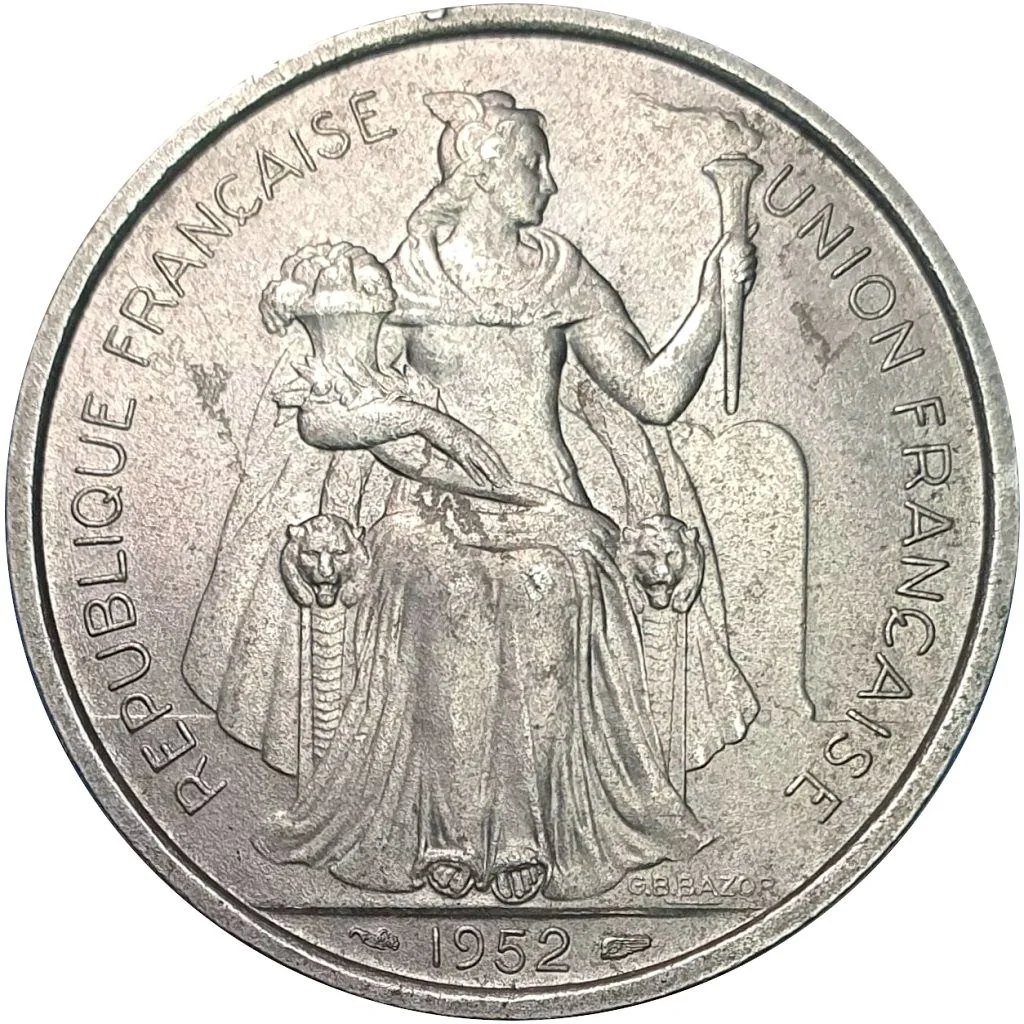
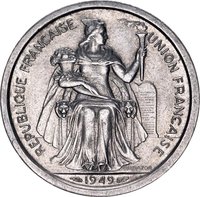
Seated Marianne wears a winged Phrygian cap (symbol of Liberty) and holds a cornucopia of fruits and nuts in her right hand and a lighted torch in her left.
Inscription:
REPUBLIQUE FRANÇAISE UNION FRANÇAISE
G.B.BAZOR
1952
G.B.BAZOR
1952
Translation:
FRENCH REPUBLIC FRENCH UNION
G.B.BAZOR
1952
G.B.BAZOR
1952
Script: Latin
Language: French
Engraver: Lucien Georges Bazor
Reverse
Description:
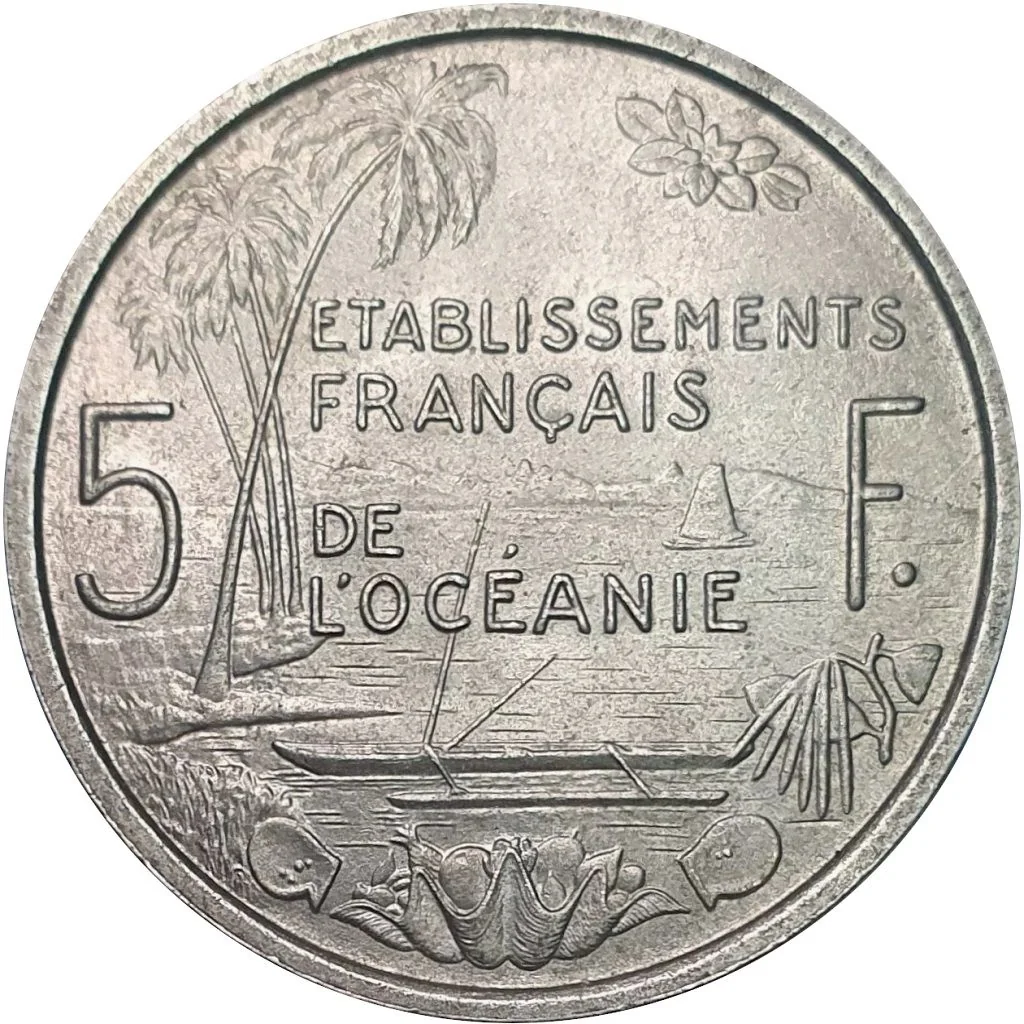
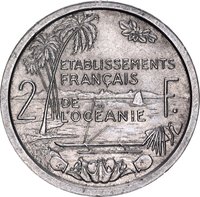
Island with palms, boats, and a fruit bowl with a flower.
Inscription:
ETABLISSEMENTS
FRANÇAIS
5 F.
DE
L'OCÉANIE
FRANÇAIS
5 F.
DE
L'OCÉANIE
Translation:
FRENCH ESTABLISHMENTS
IN
OCEANIA
5 F.
IN
OCEANIA
5 F.
Script: Latin
Language: French
Engraver: Lucien Georges Bazor
Edge
Plain
Categories
| Transportation> Watercraft |
| Symbol> Allegory |
| Plant> Tree |
| Symbol> Cornucopia |
Mints
| Name | Mark |
|---|---|
| Monnaie de Paris | — |
Mintings
| Year | Mint Mark | Mintage | Quality | Collection |
|---|---|---|---|---|
| 1952 | — | 2,000,000 |
Historical background
In 1952, the currency situation in the French Settlements of Oceania (which would become French Polynesia in 1957) was defined by its integration into the Franc Zone and the specific colonial monetary system of France. The official currency was the CFP franc (Franc des Colonies Françaises du Pacifique), created in December 1945 alongside two other distinct CFP francs for New Caledonia and the New Hebrides. Its creation was a direct result of the Bretton Woods agreements, intended to stabilize the currencies of French overseas territories by pegging them to a strong metropolitan currency. Initially linked to the US dollar, the CFP franc was firmly repegged to the French franc in 1949 at a fixed rate of 5.50 French francs to 1 CFP franc, a rate that would remain unchanged for decades.
The economy of the settlements was small, reliant on exports like copra, vanilla, and phosphates, and heavily dependent on French administrative spending and military presence. The fixed exchange rate with the French franc provided crucial monetary stability, shielding the territory from local inflation and facilitating trade and budgetary transfers with metropolitan France. This arrangement effectively made monetary policy for Tahiti and its islands a matter decided in Paris, with the Institut d’Émission d’Outre-Mer (IEOM) overseeing issuance and credit.
However, this stability came with a trade-off. The strong, fixed peg to the French franc did not necessarily reflect the local economic conditions of the islands, potentially making exports less competitive on the global market. Furthermore, the currency system underscored the territory's political and economic dependence on France, a relationship that was being subtly questioned in the post-war era of decolonization. Thus, in 1952, the CFP franc represented both a tool of colonial integration, ensuring financial order and French control, and a symbol of the region's incomplete integration into the global economy on its own terms.
The economy of the settlements was small, reliant on exports like copra, vanilla, and phosphates, and heavily dependent on French administrative spending and military presence. The fixed exchange rate with the French franc provided crucial monetary stability, shielding the territory from local inflation and facilitating trade and budgetary transfers with metropolitan France. This arrangement effectively made monetary policy for Tahiti and its islands a matter decided in Paris, with the Institut d’Émission d’Outre-Mer (IEOM) overseeing issuance and credit.
However, this stability came with a trade-off. The strong, fixed peg to the French franc did not necessarily reflect the local economic conditions of the islands, potentially making exports less competitive on the global market. Furthermore, the currency system underscored the territory's political and economic dependence on France, a relationship that was being subtly questioned in the post-war era of decolonization. Thus, in 1952, the CFP franc represented both a tool of colonial integration, ensuring financial order and French control, and a symbol of the region's incomplete integration into the global economy on its own terms.
🌱 Very Common