

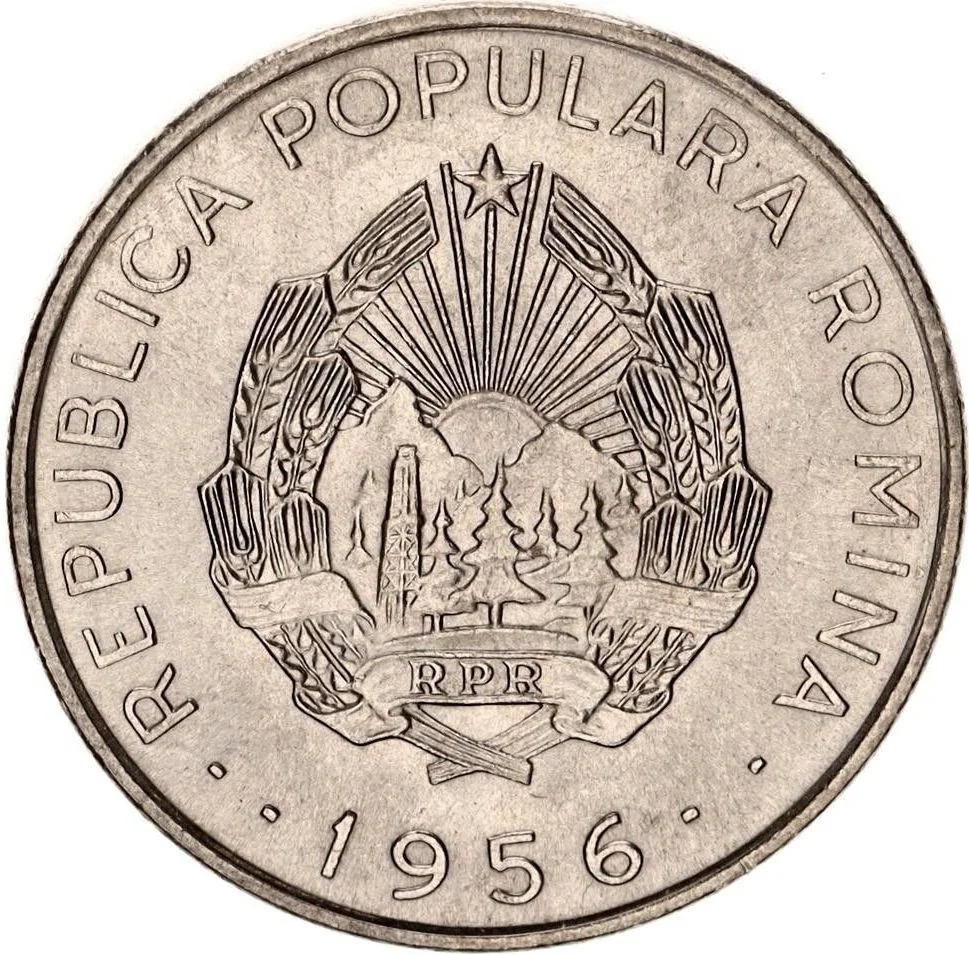
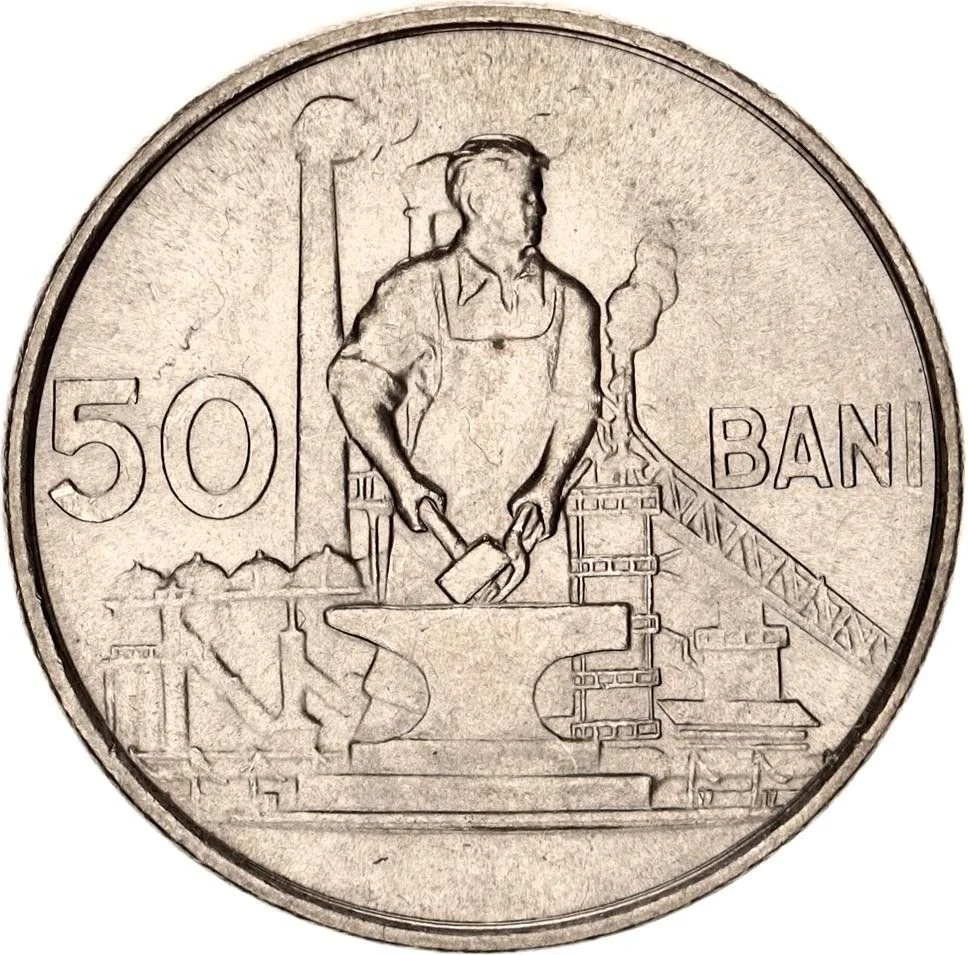
50 bani – Romania
Add to wishlist
Romania
Context
Years: 1955–1956
Issuer: Romania
Period:
(1947—1965)
Currency:
(1952—2005)
Demonetization: 31 December 1996
Total mintage: 28,100,000
Material
Diameter: 25 mm
Weight: 4.55 g
Thickness: 1.3 mm
Shape: Round
Composition: Copper-nickel
Technique: Milled
Alignment: Coin alignment
flip
References
KM: #
Numista: #9023
Value
Exchange value: 0.50 ROL
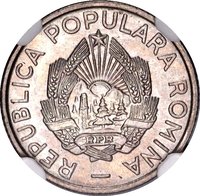
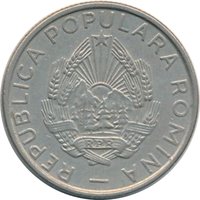
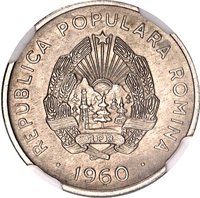
Obverse
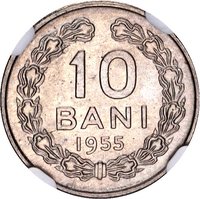
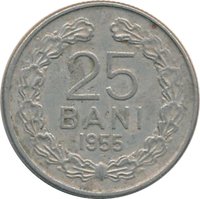
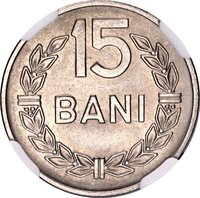
Reverse
Edge
Reeded
Categories
| Symbols> Coat of Arms |
| Industry |
Mints
| Name | Mark |
|---|---|
| State Mint | — |
Mintings
| Year | Mint Mark | Mintage | Quality | Collection |
|---|---|---|---|---|
| 1955 | — | 16,700,000 | ||
| 1956 | — | 11,400,000 |
Historical background
In 1955, Romania's currency situation was firmly embedded within the rigid framework of a Soviet-style command economy, managed by the communist regime under Gheorghe Gheorghiu-Dej. The official currency, the leu, was a non-convertible instrument of state planning, with its value and circulation entirely controlled by the National Bank of the Romanian People's Republic. Its exchange rate was set administratively and bore no relation to market forces, functioning primarily as an accounting unit for the state's centralized allocation of resources and the fulfillment of Five-Year Plan targets.
A critical feature of the era was the existence of a severe dual-currency system. Alongside the domestic leu, the government maintained a separate "hard currency" leu used exclusively for foreign trade accounting with the West. This special rate was vastly overvalued to artificially cheapen imports of vital machinery for industrialization, masking the true cost. Domestically, this period saw the final stages of the 1952 monetary reform, a confiscatory re-denomination designed to wipe out savings and black-market wealth accumulated after World War II, thereby consolidating state control over the economy and eliminating any residual economic independence.
For ordinary citizens, the official currency's stability was a facade. While prices for basic goods were state-fixed and appeared stable, this masked widespread shortages and a thriving black market for desirable goods. The real value of wages was low, and access to quality or imported consumer items was severely limited. Savings in lei had little utility beyond routine transactions, as there were few valuable goods to purchase. Consequently, the economic reality for Romanians in 1955 was one of a controlled, scarcity-driven system where the official currency's function was subordinate to the political goals of rapid industrialization and the suppression of a consumer-oriented market economy.
A critical feature of the era was the existence of a severe dual-currency system. Alongside the domestic leu, the government maintained a separate "hard currency" leu used exclusively for foreign trade accounting with the West. This special rate was vastly overvalued to artificially cheapen imports of vital machinery for industrialization, masking the true cost. Domestically, this period saw the final stages of the 1952 monetary reform, a confiscatory re-denomination designed to wipe out savings and black-market wealth accumulated after World War II, thereby consolidating state control over the economy and eliminating any residual economic independence.
For ordinary citizens, the official currency's stability was a facade. While prices for basic goods were state-fixed and appeared stable, this masked widespread shortages and a thriving black market for desirable goods. The real value of wages was low, and access to quality or imported consumer items was severely limited. Savings in lei had little utility beyond routine transactions, as there were few valuable goods to purchase. Consequently, the economic reality for Romanians in 1955 was one of a controlled, scarcity-driven system where the official currency's function was subordinate to the political goals of rapid industrialization and the suppression of a consumer-oriented market economy.
🌱 Common