

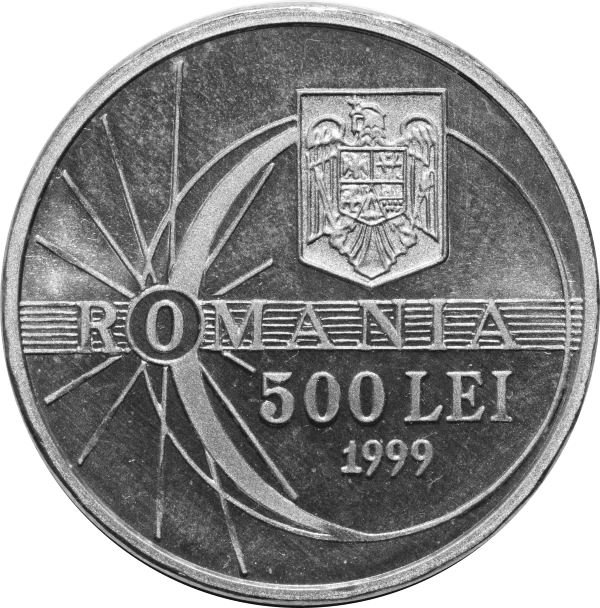

500 Lei – Romania
Circulating commemorative coins
Commemoration: Solar Eclipse
Romania
Context

Material

References
KM: #Click to copy to clipboard146
Numista: #8992
Value
Exchange value: 500 ROL
Inflation-adjusted value: 5856.61 ROL
Obverse
Inscription:
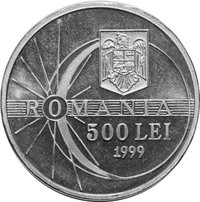
ROMANIA
500 LEI
1999
500 LEI
1999
Script: Latin
Reverse
Description:
Sun blocks moon's shadow.
Inscription:
ECLIPSA TOTALA DE SOARE
'99
11 AUGUST 1999
'99
11 AUGUST 1999
Script: Latin
Edge
Smooth with inscriptions
Legend:
ROMANIA ♦ ROMANIA ♦ ROMANIA ♦
Categories
| Space |
| Science> Natural phenomenon |
Mintings
| Year | Mint Mark | Mintage | Quality | Collection |
|---|---|---|---|---|
| 1999 | — | 4,000,000 | ||
| 1999 | — | 3,000 | Proof |
Historical background
In 1999, Romania was navigating a critical and turbulent phase in its post-communist economic transition, characterized by a severe currency and inflationary crisis. The Romanian leu (ROL) was under intense pressure, having depreciated significantly throughout the late 1990s. This was driven by a combination of factors: a large and unsustainable current account deficit, loss-making state-owned enterprises draining fiscal resources, and a banking sector burdened by non-performing loans. The National Bank of Romania (NBR) was engaged in a difficult balancing act, attempting to stabilize the currency through high interest rates and direct intervention, but these measures were costly and provided only temporary relief.
The situation reached a critical point in late 1999, forcing the government and the NBR to seek external assistance and implement a drastic stabilization program. In August, Romania secured a crucial Stand-By Arrangement with the International Monetary Fund (IMF), which was essential for restoring international credibility and providing foreign exchange reserves. As a cornerstone of this agreement, the NBR abandoned its managed float and adopted a crawling peg exchange rate regime in early 2000. This policy explicitly committed to a pre-announced, gradual depreciation of the leu against a basket of hard currencies, primarily the US dollar and German mark (later euro), aiming to curb inflation expectations and restore stability.
This period set the stage for the profound monetary reform that would follow. The chronic high inflation and the cumbersome nature of transacting in thousands and even millions of lei for basic goods eroded public confidence. The experiences of 1999 directly paved the way for the redenomination of the currency in 2005, when 10,000 "old" lei (ROL) were replaced by one "new" leu (RON). Thus, the crisis of 1999 was the painful culmination of transition failures, but also the catalyst for the disciplined, IMF-anchored policies that eventually brought macroeconomic stability to Romania in the 2000s.
The situation reached a critical point in late 1999, forcing the government and the NBR to seek external assistance and implement a drastic stabilization program. In August, Romania secured a crucial Stand-By Arrangement with the International Monetary Fund (IMF), which was essential for restoring international credibility and providing foreign exchange reserves. As a cornerstone of this agreement, the NBR abandoned its managed float and adopted a crawling peg exchange rate regime in early 2000. This policy explicitly committed to a pre-announced, gradual depreciation of the leu against a basket of hard currencies, primarily the US dollar and German mark (later euro), aiming to curb inflation expectations and restore stability.
This period set the stage for the profound monetary reform that would follow. The chronic high inflation and the cumbersome nature of transacting in thousands and even millions of lei for basic goods eroded public confidence. The experiences of 1999 directly paved the way for the redenomination of the currency in 2005, when 10,000 "old" lei (ROL) were replaced by one "new" leu (RON). Thus, the crisis of 1999 was the painful culmination of transition failures, but also the catalyst for the disciplined, IMF-anchored policies that eventually brought macroeconomic stability to Romania in the 2000s.

🌱 Very Common