

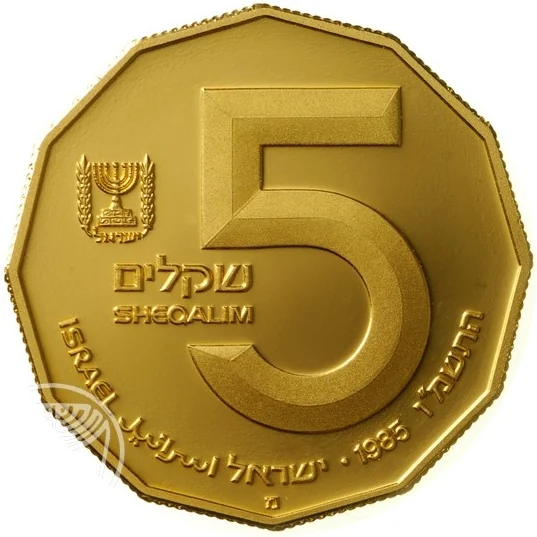
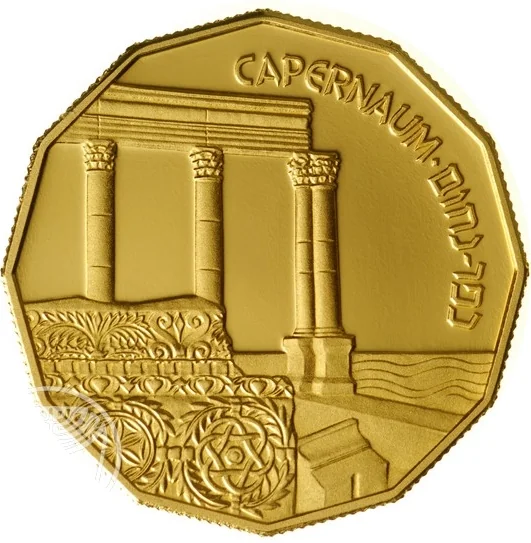
5 Sheqalim – Israel
Israel
Context
Material
Diameter: 22 mm
Weight: 8.63 g
Gold weight: 7.77 g
Shape: Dodecagonal
Composition: 90% Gold
Magnetic: No
Technique: Milled
Alignment: Medal alignment
flip
References
KM: #Click to copy to clipboard154
Numista: #89421
Value
Exchange value: 5 ILR
Bullion value: $1297.62
Inflation-adjusted value: 224.74 ILR
Obverse
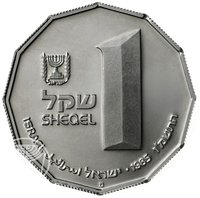
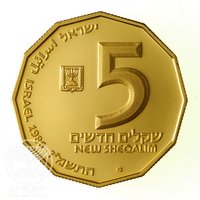
Description:
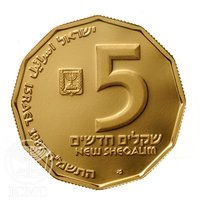
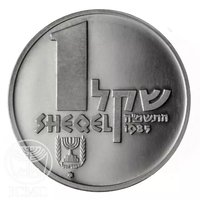
State emblem and "Israel" in Hebrew, English, and Arabic, with face value and mint year.
Inscription:
שקלים
SHEQALIM
5
ISRAEL ישראל اسرائيل ⠂1985 התשמ"ו
מ
SHEQALIM
5
ISRAEL ישראל اسرائيل ⠂1985 התשמ"ו
מ
Translation:
Sheqalim
5
ISRAEL Israel Israel ,1985 5746
5
ISRAEL Israel Israel ,1985 5746
Engraver: Dan Gelbart
Reverse
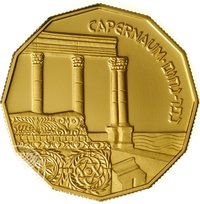
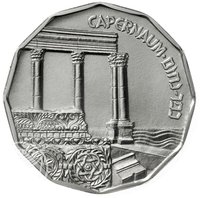
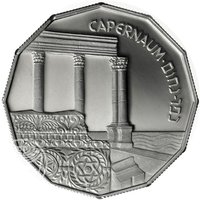
Description:
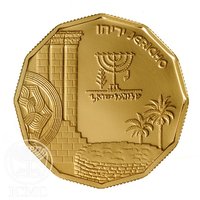
Ancient Capernaum synagogue ruins by Lake Tiberias.
Inscription:
CAPERNAUM ⠂כפר-נחום
Translation:
Capernaum ⠂Kfar Nahum
Engraver: Assaf Berg
Edge
Milled
Mints
| Name | Mark |
|---|---|
| Bern | מ |
Mintings
| Year | Mint Mark | Mintage | Quality | Collection |
|---|---|---|---|---|
| 1985 | — | 2,633 | Proof |
Historical background
In 1985, Israel faced a severe economic crisis characterized by hyperinflation, which had been accelerating since the early 1970s and peaked at an annual rate of nearly 450%. This "inflationary whirlwind" was the result of a deep structural imbalance: massive government deficits, largely financed by printing money, to fund extensive social programs, a large public sector, and military expenditures. Indexation mechanisms in the economy, while protecting wages and savings, had created a vicious cycle where prices and wages chased each other upward, eroding the currency's value and public confidence.
The situation reached a breaking point, compelling the national unity government led by Shimon Peres to implement a drastic and comprehensive stabilization plan in July 1985. Known as the Economic Stabilization Plan, its core measures included a sharp, one-time devaluation of the shekel followed by its pegging to the U.S. dollar, severe cuts to government subsidies and spending, a temporary freeze on wages and prices, and a commitment to cease financing the deficit by printing money. Crucially, the plan was supported by a significant $1.5 billion emergency loan from the United States.
The plan was a painful but resounding success. It abruptly halted hyperinflation, restoring stability to the Israeli shekel and marking a fundamental shift from a government-dominated economy toward greater liberalization and market orientation. The 1985 crisis and its resolution are considered a watershed moment in Israel's economic history, establishing fiscal discipline and laying the foundation for future growth, transforming the shekel from a notoriously weak currency into a stable one.
The situation reached a breaking point, compelling the national unity government led by Shimon Peres to implement a drastic and comprehensive stabilization plan in July 1985. Known as the Economic Stabilization Plan, its core measures included a sharp, one-time devaluation of the shekel followed by its pegging to the U.S. dollar, severe cuts to government subsidies and spending, a temporary freeze on wages and prices, and a commitment to cease financing the deficit by printing money. Crucially, the plan was supported by a significant $1.5 billion emergency loan from the United States.
The plan was a painful but resounding success. It abruptly halted hyperinflation, restoring stability to the Israeli shekel and marking a fundamental shift from a government-dominated economy toward greater liberalization and market orientation. The 1985 crisis and its resolution are considered a watershed moment in Israel's economic history, establishing fiscal discipline and laying the foundation for future growth, transforming the shekel from a notoriously weak currency into a stable one.
Series: Sites in the Holy Land
✨ Legendary