

3 pence – Fiji
Add to wishlist
Fiji
Context
Years: 1955–1967
Issuer: Fiji
Ruler: Elizabeth II
Currency:
(1873—1969)
Demonetization: 30 June 1969
Total mintage: 3,360,000
Material
Diameter: 21.9 mm
Weight: 6.16 g
Thickness: 2.5 mm
Shape: Dodecagonal
Magnetic: No
Technique: Milled
Alignment: Medal alignment
flip
References
KM: #
Numista: #11484
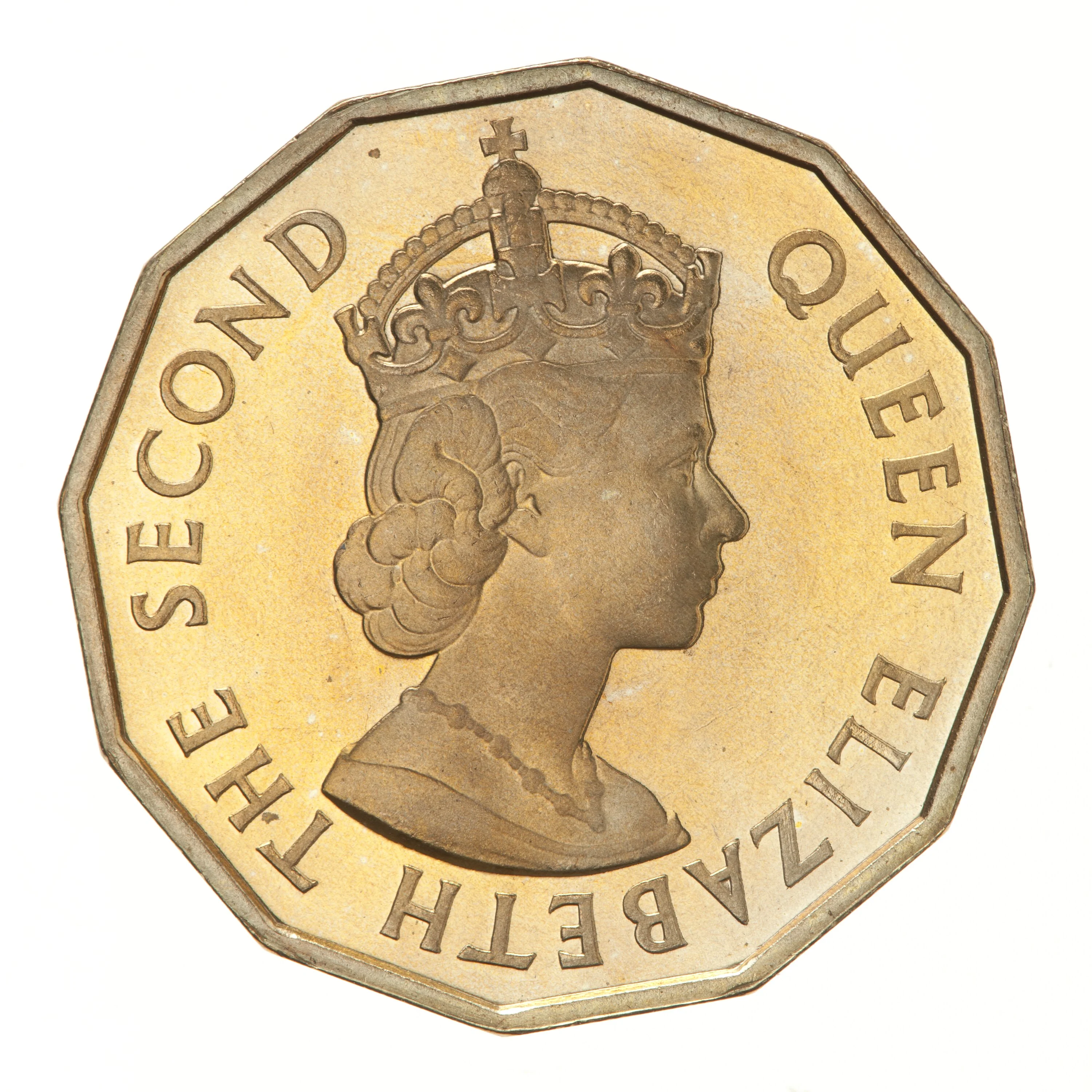
Obverse
Description:
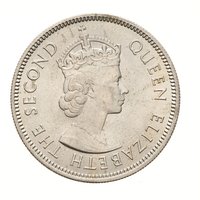
Queen Elizabeth II crowned bust right, encircled by legend.
Inscription:
QUEEN ELIZABETH THE SECOND
Script: Latin
Engraver: Cecil Thomas
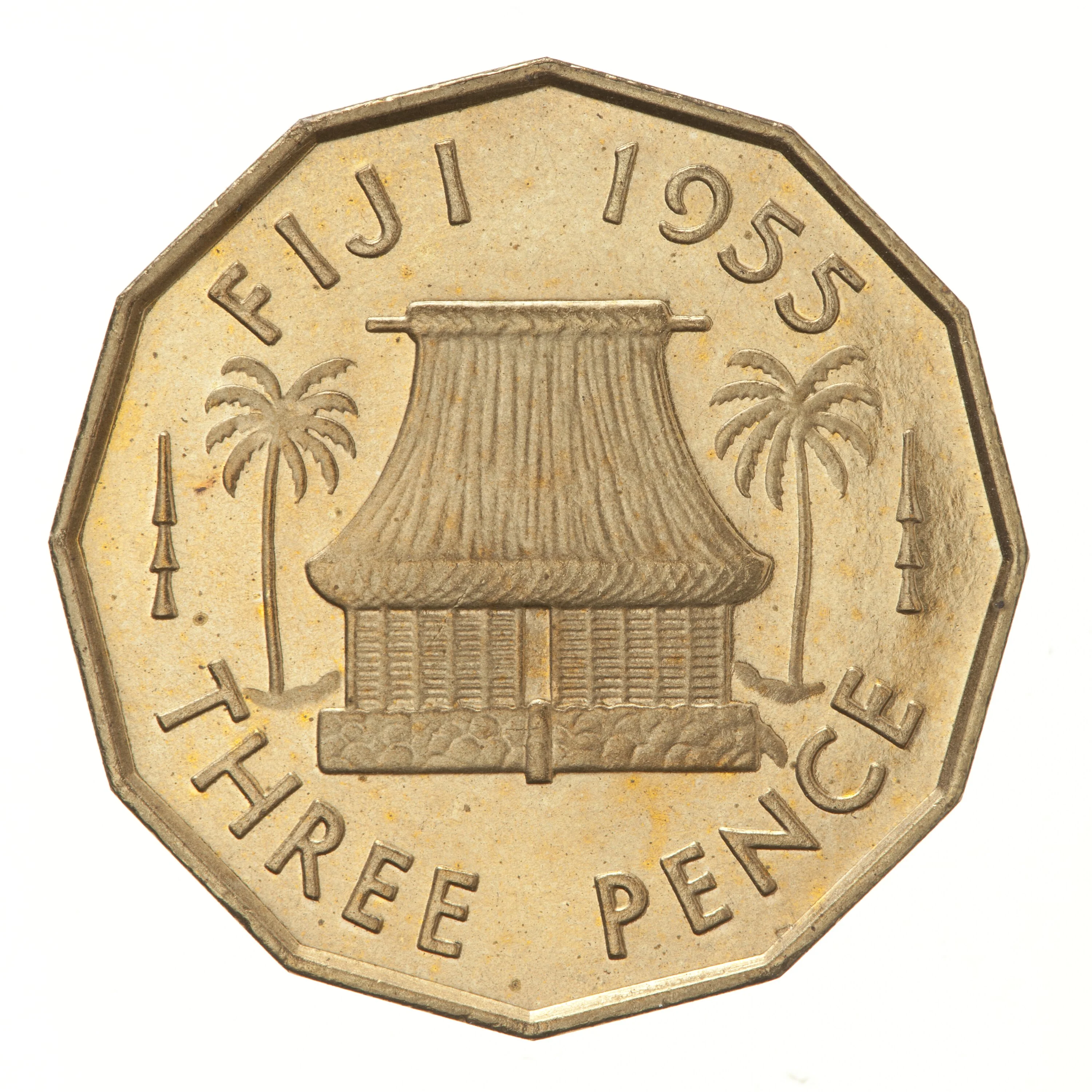
Reverse
Description:
Hut amid palms and spears, framed by date and legend.
Inscription:
FIJI 1961
THREE PENCE
THREE PENCE
Script: Latin
Engraver: George James Berry
Edge
Plain
Mints
| Name | Mark |
|---|---|
| Royal Mint (Tower Hill) | — |
Mintings
| Year | Mint Mark | Mintage | Quality | Collection |
|---|---|---|---|---|
| 1955 | — | 400,000 | ||
| 1955 | — | — | Proof | |
| 1956 | — | 200,000 | ||
| 1956 | — | — | Proof | |
| 1958 | — | 200,000 | ||
| 1958 | — | — | Proof | |
| 1960 | — | 240,000 | ||
| 1960 | — | — | Proof | |
| 1961 | — | — | Proof | |
| 1961 | — | 240,000 | ||
| 1963 | — | 240,000 | ||
| 1963 | — | — | Proof | |
| 1964 | — | 240,000 | ||
| 1965 | — | 800,000 | ||
| 1967 | — | 800,000 |
Historical background
In 1955, Fiji was a British Crown Colony operating under a currency system directly managed by the British government. The official currency was the Fijian pound (FJ£), which was pegged at par to the British pound sterling (GB£). This meant that the colony's monetary policy and currency supply were entirely subordinate to the needs and decisions of the United Kingdom, with no independent central bank. Physical currency in circulation consisted of British coinage and banknotes issued by British overseas banks, alongside distinctive Fijian government coinage that was minted in the United Kingdom and denominated in pounds, shillings, and pence.
The economic context of the mid-1950s was one of post-war growth, heavily reliant on the sugar industry, which was dominated by the Australian-owned Colonial Sugar Refining Company. The currency peg to sterling provided stability for trade and investment, crucial for an export-oriented colony. However, this system also meant Fiji was vulnerable to economic conditions in Britain and had no mechanism to adjust its currency for domestic economic needs. Discussions about decimalisation, which would eventually lead to the introduction of the Fijian dollar in 1969, were still over a decade away, and the imperial monetary system was seen as a natural extension of colonial rule.
Socially, the currency situation reflected the stratified colonial society. The pound/shilling/pence system was complex, and the economy was largely cash-based for the indigenous Fijian and Indo-Fijian populations, many of whom were subsistence farmers or labourers. Meanwhile, the European administrative and business elite integrated seamlessly with the sterling area for international commerce. Thus, the currency of 1955 Fiji was not just a medium of exchange but a symbol of its political and economic ties to the British Empire, ensuring stability but also cementing its dependent colonial status.
The economic context of the mid-1950s was one of post-war growth, heavily reliant on the sugar industry, which was dominated by the Australian-owned Colonial Sugar Refining Company. The currency peg to sterling provided stability for trade and investment, crucial for an export-oriented colony. However, this system also meant Fiji was vulnerable to economic conditions in Britain and had no mechanism to adjust its currency for domestic economic needs. Discussions about decimalisation, which would eventually lead to the introduction of the Fijian dollar in 1969, were still over a decade away, and the imperial monetary system was seen as a natural extension of colonial rule.
Socially, the currency situation reflected the stratified colonial society. The pound/shilling/pence system was complex, and the economy was largely cash-based for the indigenous Fijian and Indo-Fijian populations, many of whom were subsistence farmers or labourers. Meanwhile, the European administrative and business elite integrated seamlessly with the sterling area for international commerce. Thus, the currency of 1955 Fiji was not just a medium of exchange but a symbol of its political and economic ties to the British Empire, ensuring stability but also cementing its dependent colonial status.
🌱 Common