

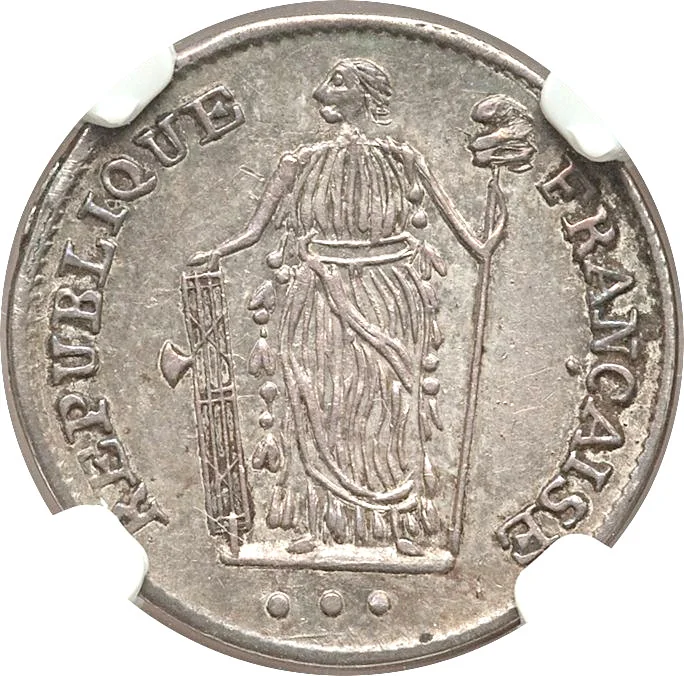
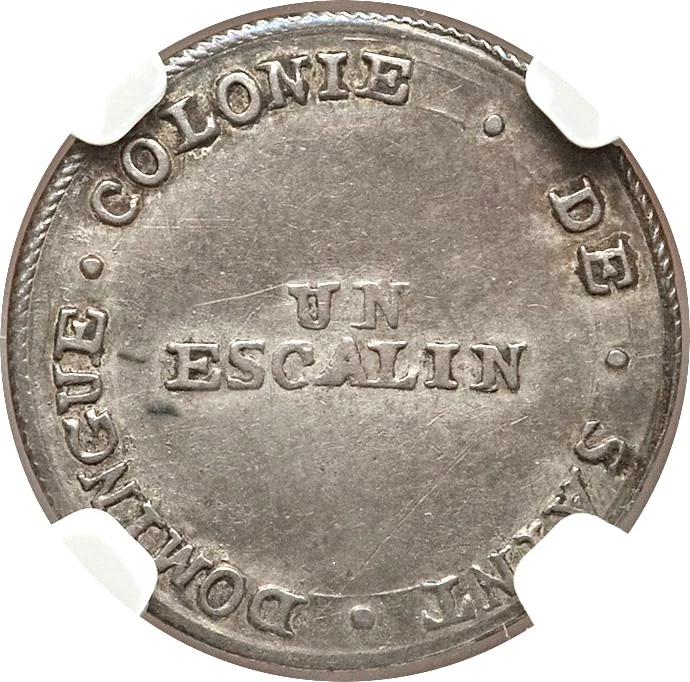
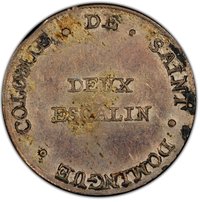
1 Escalin – Saint-Domingue
Haiti
Context
Year: 1802
Country: Haiti 
Issuer: Saint-Domingue
Currency:
(1625—1804)
Subdivision: 1 Escalin = 15 Sous
Demonetized: Yes
Material
References
KM: #Click to copy to clipboard22
Numista: #88863
Value
Bullion value: $4.32
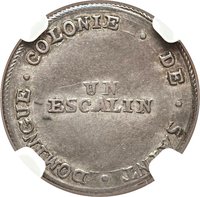
Obverse
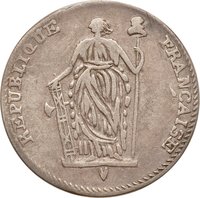
Reverse
Edge
Plain
Mintings
| Year | Mint Mark | Mintage | Quality | Collection |
|---|---|---|---|---|
| 1802 | — | — |
Historical background
By 1802, the currency situation in Saint-Domingue was one of profound chaos and devaluation, mirroring the colony's violent political upheaval. The official currency, the colonial livre, had been rendered nearly worthless by a decade of revolution, war, and economic collapse. The massive slave uprising that began in 1791 had destroyed the plantation system that generated wealth, while the ongoing war between the forces of Toussaint Louverture, French expeditionary troops, and various factions created an environment where stable fiscal policy was impossible. The French government had earlier attempted to finance its wars by printing enormous quantities of assignats (paper money), a policy extended to the colony, leading to catastrophic hyperinflation.
Into this vacuum flowed a confusing multitude of alternative means of exchange. Spanish and American coins, particularly silver pesos and dollars, became the most trusted and stable currencies for significant transactions, circulating alongside a dwindling supply of French specie. More commonly, daily trade relied on a barter system, with commodities like coffee, sugar, and even cartridges serving as de facto currency. Toussaint Louverture, who had established control prior to the French invasion of 1802, had attempted to stabilize the economy by mandating the use of the colonial livre and setting prices, but these measures were only partially successful and were upended by the renewed large-scale warfare.
The arrival of General Charles Leclerc's massive French expedition in early 1802 to reassert control and reinstate slavery further destabilized the monetary environment. While the French brought some hard currency to pay troops and initially purchase supplies, the protracted and brutal campaign exhausted these resources. Leclerc resorted to confiscating property and coercing "loans," further eroding any semblance of economic trust. Ultimately, the currency crisis of 1802 was a direct symptom of a society in existential conflict; the lack of a legitimate and stable monetary system reflected the collapse of colonial authority and the fight for Haiti's future, which would be declared an independent nation just two years later.
Into this vacuum flowed a confusing multitude of alternative means of exchange. Spanish and American coins, particularly silver pesos and dollars, became the most trusted and stable currencies for significant transactions, circulating alongside a dwindling supply of French specie. More commonly, daily trade relied on a barter system, with commodities like coffee, sugar, and even cartridges serving as de facto currency. Toussaint Louverture, who had established control prior to the French invasion of 1802, had attempted to stabilize the economy by mandating the use of the colonial livre and setting prices, but these measures were only partially successful and were upended by the renewed large-scale warfare.
The arrival of General Charles Leclerc's massive French expedition in early 1802 to reassert control and reinstate slavery further destabilized the monetary environment. While the French brought some hard currency to pay troops and initially purchase supplies, the protracted and brutal campaign exhausted these resources. Leclerc resorted to confiscating property and coercing "loans," further eroding any semblance of economic trust. Ultimately, the currency crisis of 1802 was a direct symptom of a society in existential conflict; the lack of a legitimate and stable monetary system reflected the collapse of colonial authority and the fight for Haiti's future, which would be declared an independent nation just two years later.
✨ Legendary