

Obverse
Description:
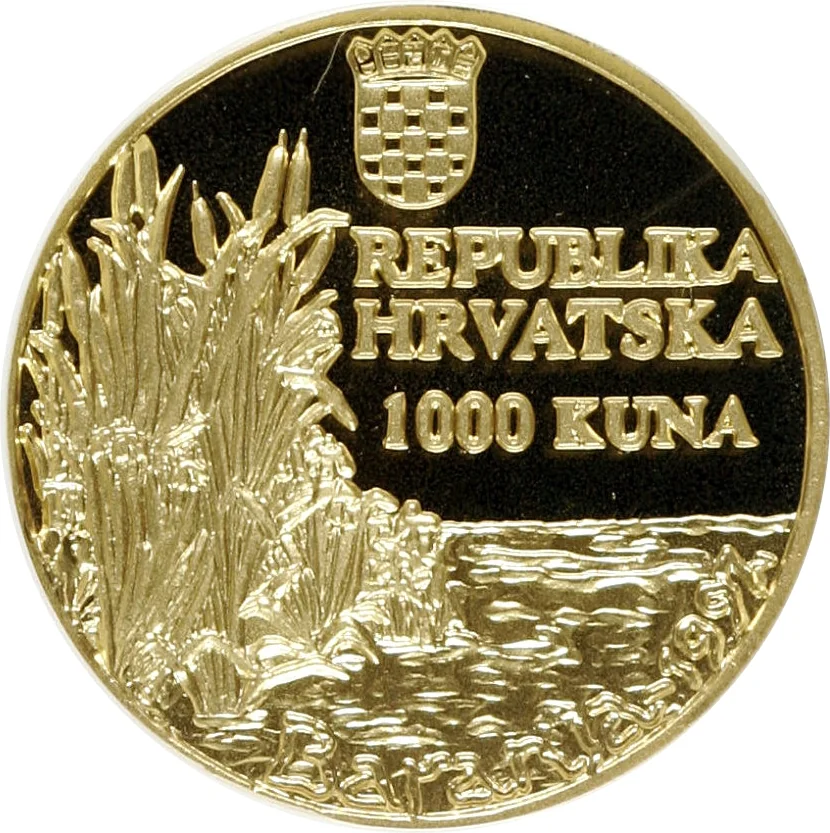
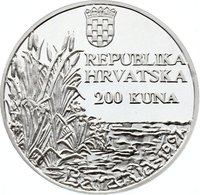
Wildflowers, arms raised, name at right.
Inscription:
REPUBLIKA
HRVATSKA
1000 KUNA
HRVATSKA
1000 KUNA
Translation:
REPUBLIC
OF CROATIA
1000 KUNA
OF CROATIA
1000 KUNA
Script: Latin
Language: Croatian
Designer: Damir Mataušić
Reverse
Description:
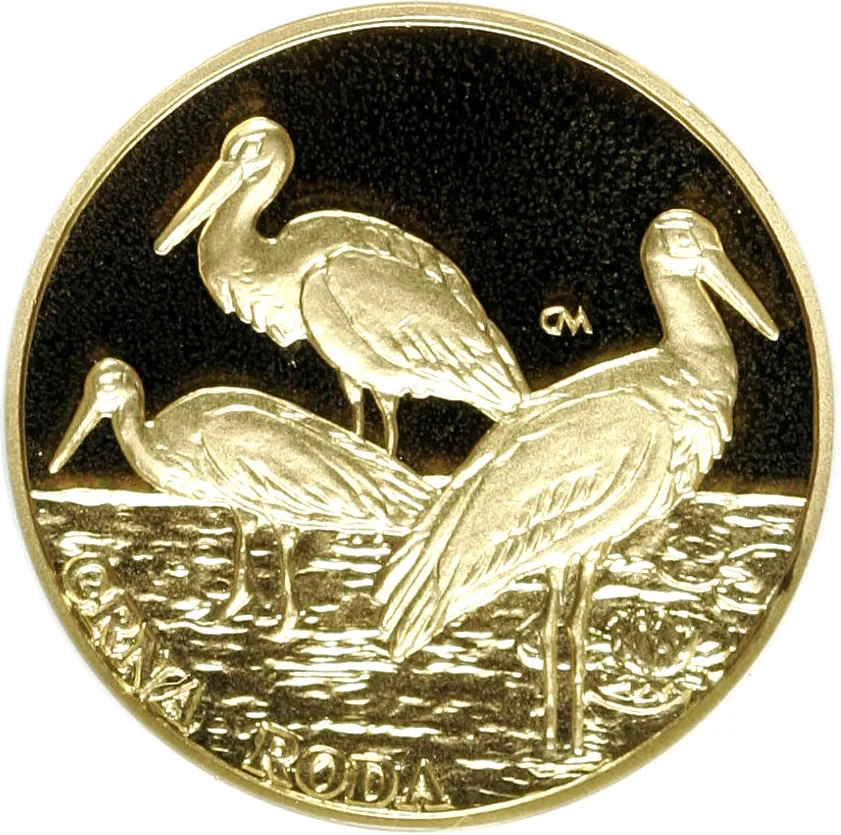
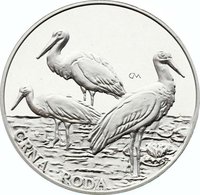
Black Storks
Inscription:
CRNA RODA
Translation:
Black Rook
Script: Latin
Language: Montenegrin
Designer: Damir Mataušić
Edge
Mintings
| Year | Mint Mark | Mintage | Quality | Collection |
|---|---|---|---|---|
| 1997 | — | 1,000 | Proof |
Historical background
In 1997, Croatia was navigating a complex and critical phase in its monetary history, just two years after the end of the Homeland War. The national currency, the Croatian dinar (HRD), which had been introduced in 1991 to replace the Yugoslav dinar, was characterized by instability and relatively high inflation following the turbulent early years of independence. The government, led by President Franjo Tuđman and the Croatian Democratic Union (HDZ), was pursuing a policy of macroeconomic stabilization, with a key pillar being the introduction of a new, stronger currency to build confidence and curb inflation.
This effort culminated in a major monetary reform on May 30, 1994, when the kuna (HRK) replaced the dinar at a rate of 1 kuna for 1,000 dinars. By 1997, the kuna was firmly established and operating under a managed float regime, with the Croatian National Bank (CNB) actively intervening to maintain its stability primarily against the Deutsche Mark, the anchor currency of the era. The period was marked by successful disinflation, with annual inflation falling sharply from hyperinflationary levels to around 4% by 1997, a testament to the tight monetary policy and fiscal discipline enforced by the CNB.
The broader currency situation in 1997 was therefore one of consolidation and preparation. The stability of the kuna was a cornerstone of Croatia's post-war recovery, fostering greater foreign investment and setting the stage for future banking sector reforms. However, the economy still faced significant challenges, including a large external deficit, a growing public debt burden, and the need for structural reforms—all factors that influenced monetary policy as Croatia looked toward deeper European integration, a process that would eventually lead to the adoption of the euro in 2023.
This effort culminated in a major monetary reform on May 30, 1994, when the kuna (HRK) replaced the dinar at a rate of 1 kuna for 1,000 dinars. By 1997, the kuna was firmly established and operating under a managed float regime, with the Croatian National Bank (CNB) actively intervening to maintain its stability primarily against the Deutsche Mark, the anchor currency of the era. The period was marked by successful disinflation, with annual inflation falling sharply from hyperinflationary levels to around 4% by 1997, a testament to the tight monetary policy and fiscal discipline enforced by the CNB.
The broader currency situation in 1997 was therefore one of consolidation and preparation. The stability of the kuna was a cornerstone of Croatia's post-war recovery, fostering greater foreign investment and setting the stage for future banking sector reforms. However, the economy still faced significant challenges, including a large external deficit, a growing public debt burden, and the need for structural reforms—all factors that influenced monetary policy as Croatia looked toward deeper European integration, a process that would eventually lead to the adoption of the euro in 2023.
✨ Legendary