

100 zlotys – Poland
Add to wishlist
Poland
Context
Year: 1988
Issuer: Poland
Period:
(1952—1989)
Currency:
(1949—1994)
Demonetization: 1 January 1995
Total mintage: 2,474,000
Material
Diameter: 29.5 mm
Weight: 10.8 g
Thickness: 2 mm
Shape: Round
Composition: Copper-nickel
Technique: Milled
Alignment: Medal alignment
flip
References
Y: #
Numista: #8814
Value
Exchange value: 100 PLZ
Inflation-adjusted value: 87975.24 PLZ
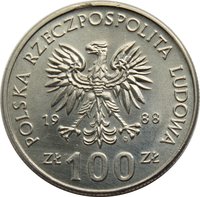
Obverse
Description:
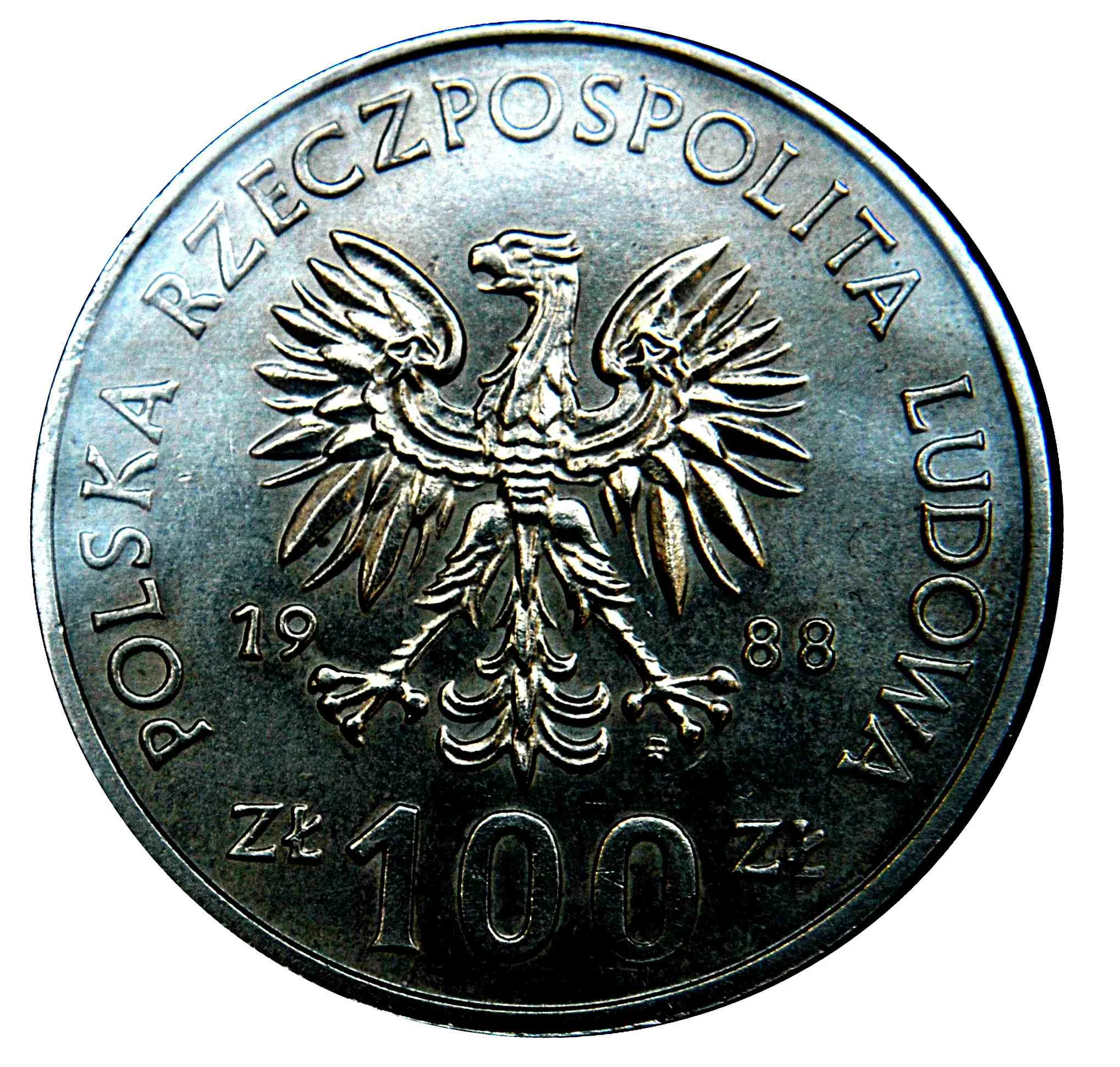
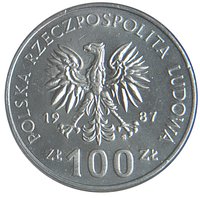
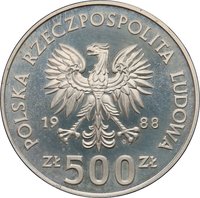
The Polish national coat of arms.
Inscription:
POLSKA RZECZPOSPOLITA LUDOWA
19 88
mw
ZŁ 100 ZŁ
19 88
mw
ZŁ 100 ZŁ
Translation:
Polish People's Republic
19 88
mw
100 ZŁOTYCH 100 ZŁ
19 88
mw
100 ZŁOTYCH 100 ZŁ
Script: Latin
Language: Polish
Designer: Ewa Tyc-Karpińska
Reverse
Description:
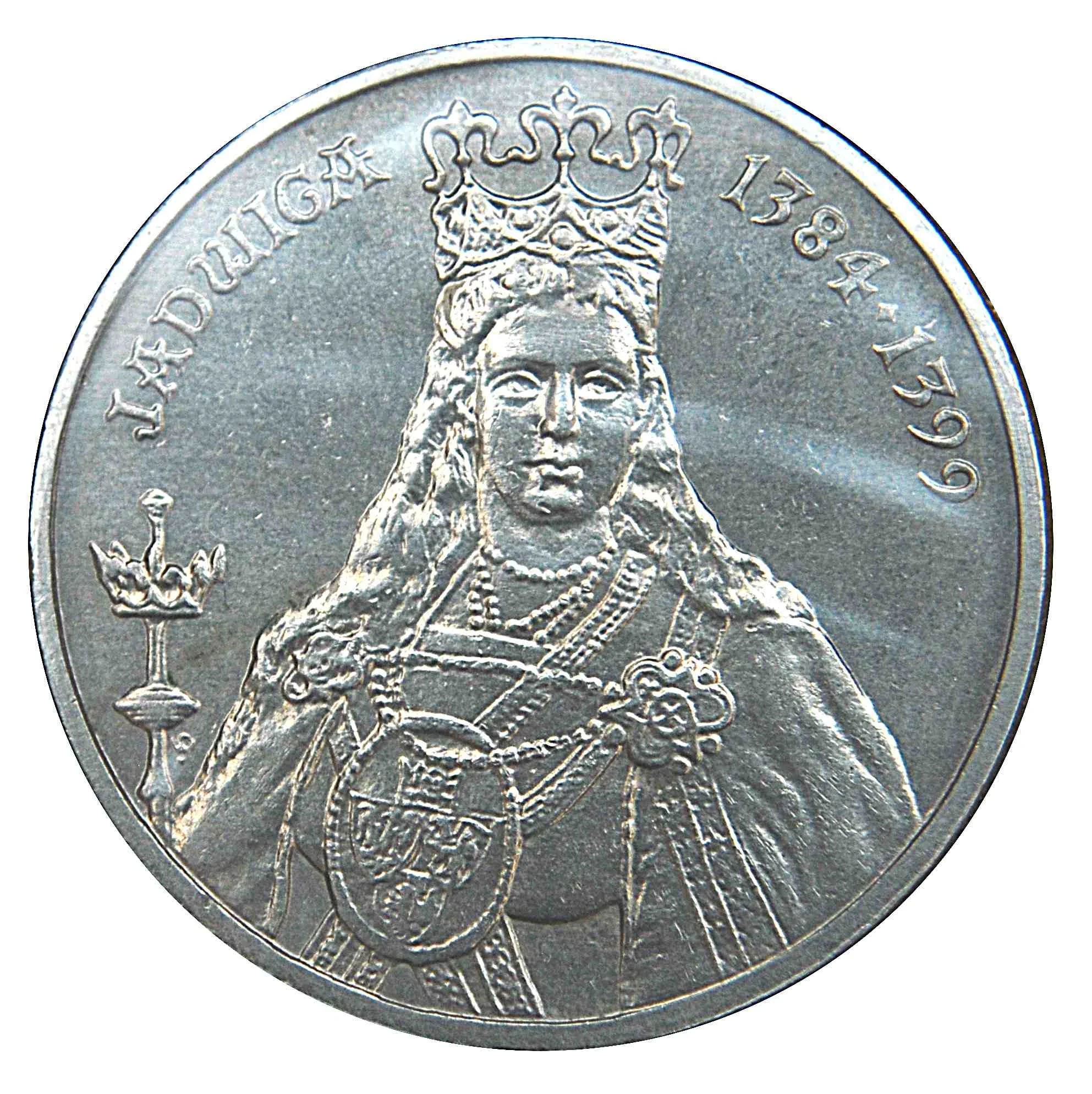
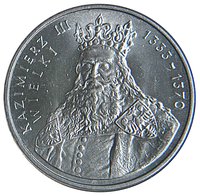
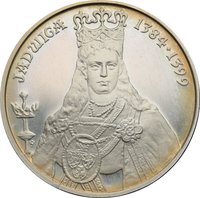
Crowned bust of Queen Jadwiga.
Inscription:
JADWIGA 1384-1399
Script: Latin
Designer: Stanisława Wątróbska-Frindt
Edge
Milled
Mints
| Name | Mark |
|---|---|
| Mint of Poland | (MW) |
Mintings
| Year | Mint Mark | Mintage | Quality | Collection |
|---|---|---|---|---|
| 1988 | MW | 2,469,000 | ||
| 1988 | MW | 5,000 | Proof |
Historical background
By 1988, Poland's currency situation was a critical symptom of its collapsing command economy. The Polish złoty (PLN) was officially pegged at an artificially high rate by the communist government, but this bore little relation to reality. A vast and tolerated black market for foreign currency, primarily US dollars, operated openly, with exchange rates several times higher than the official one. This "dollarization" of the economy meant that key goods, services, and even apartments were often only accessible with hard currency, undermining the złoty's basic function as a medium of exchange and store of value.
The root causes were decades of economic mismanagement, including printing money to cover massive budget deficits, chronic shortages of consumer goods, and an unsustainable foreign debt burden. Hyperinflation was taking hold, with prices skyrocketing by 60% in 1988 alone, effectively wiping out savings and wages. The government's attempts at reform, including a limited legalization of private enterprise, were too little and too late to stabilize the currency, as public confidence in both the złoty and the state's economic competence had evaporated.
This monetary chaos created a paradoxical dual economy: one for those with access to dollars or Western goods, and one of empty shelves and worthless złoty for everyone else. The currency crisis fueled widespread social unrest, most visibly through the waves of strikes led by the Solidarity trade union in 1988. These strikes directly pressured the government into the Round Table Talks of 1989, which would lead to the end of communist rule and set the stage for the radical "shock therapy" economic reforms, including a new złoty, in the early 1990s.
The root causes were decades of economic mismanagement, including printing money to cover massive budget deficits, chronic shortages of consumer goods, and an unsustainable foreign debt burden. Hyperinflation was taking hold, with prices skyrocketing by 60% in 1988 alone, effectively wiping out savings and wages. The government's attempts at reform, including a limited legalization of private enterprise, were too little and too late to stabilize the currency, as public confidence in both the złoty and the state's economic competence had evaporated.
This monetary chaos created a paradoxical dual economy: one for those with access to dollars or Western goods, and one of empty shelves and worthless złoty for everyone else. The currency crisis fueled widespread social unrest, most visibly through the waves of strikes led by the Solidarity trade union in 1988. These strikes directly pressured the government into the Round Table Talks of 1989, which would lead to the end of communist rule and set the stage for the radical "shock therapy" economic reforms, including a new złoty, in the early 1990s.
Series: Polish Rulers
🌱 Common