

1 dollar – United States
Add to wishlist
United States
Context
Years: 1840–1866
Issuer: United States
Period:
(since 1776)
Currency:
(since 1785)
Total mintage: 2,895,918
Material
References
KM: #
Numista: #11472
Value
Exchange value: 1 USD = $1.00
Bullion value: $60.04
Obverse
Description:
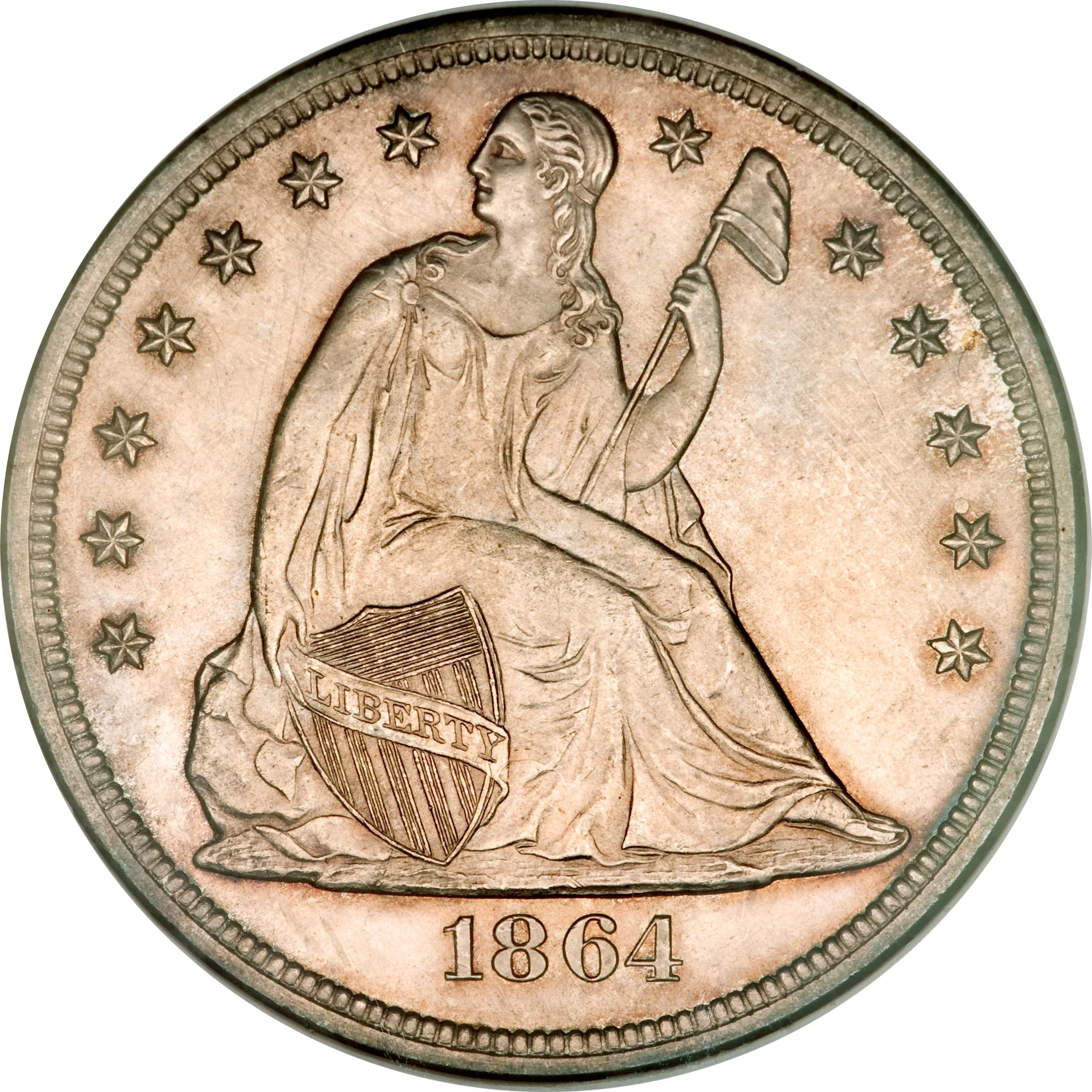
Seated Liberty facing right, holding cap on staff and shield, surrounded by 13 stars.
Inscription:
LIBERTY
1864
1864
Script: Latin
Engraver: Christian Gobrecht
Reverse
Description:
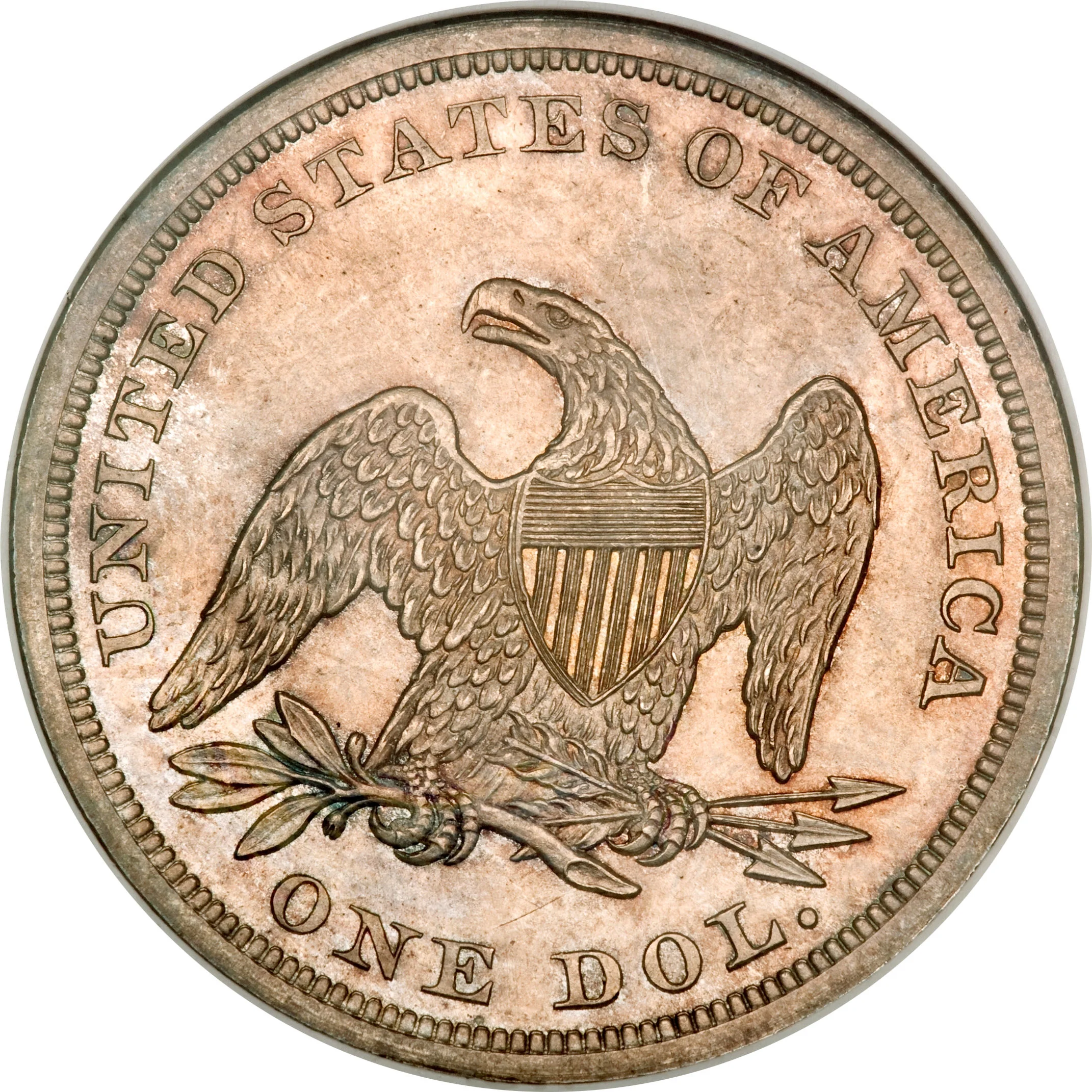
Eagle clutching arrows and an olive branch.
Inscription:
UNITED STATES OF AMERICA
ONE DOL.
ONE DOL.
Script: Latin
Engraver: Christian Gobrecht
Edge
Reeded
Categories
| Symbol> Allegory |
| Object> Cold weapons |
| Symbol> Phrygian cap |
| Animal> Bird> Eagle |
Mints
| Name | Mark |
|---|---|
| United States Mint of Philadelphia | — |
| United States Mint of New Orleans | O |
| United States Mint of San Francisco | S |
Mintings
| Year | Mint Mark | Mintage | Quality | Collection |
|---|---|---|---|---|
| 1840 | — | 61,005 | ||
| 1840 | — | — | Proof | |
| 1841 | — | 173,000 | ||
| 1842 | — | 184,618 | ||
| 1842 | — | — | Proof | |
| 1843 | — | 165,100 | ||
| 1844 | — | 20,000 | ||
| 1845 | — | 24,500 | ||
| 1845 | — | — | Proof | |
| 1846 | — | — | Proof | |
| 1846 | O | 59,000 | ||
| 1846 | — | 110,600 | ||
| 1847 | — | 140,750 | ||
| 1847 | — | — | Proof | |
| 1848 | — | 15,000 | ||
| 1848 | — | — | Proof | |
| 1849 | — | 62,600 | ||
| 1849 | — | — | Proof | |
| 1850 | — | 7,500 | ||
| 1850 | — | — | Proof | |
| 1850 | O | 40,000 | ||
| 1851 | — | 1,300 | ||
| 1851 | — | 35 | Proof | |
| 1852 | — | — | Proof | |
| 1852 | — | 1,100 | ||
| 1853 | — | 46,110 | ||
| 1853 | — | — | Proof | |
| 1854 | — | 33,140 | ||
| 1854 | — | — | Proof | |
| 1855 | — | 26,000 | ||
| 1855 | — | — | Proof | |
| 1856 | — | 63,500 | ||
| 1856 | — | — | Proof | |
| 1857 | — | 94,000 | ||
| 1857 | — | — | Proof | |
| 1858 | — | 210 | Proof | |
| 1859 | — | 255,700 | ||
| 1859 | — | 800 | Proof | |
| 1859 | O | 360,000 | ||
| 1859 | S | 20,000 | ||
| 1860 | — | 217,600 | ||
| 1860 | — | 1,330 | Proof | |
| 1860 | O | 515,000 | ||
| 1861 | — | 77,500 | ||
| 1861 | — | 1,000 | Proof | |
| 1862 | — | 11,540 | ||
| 1862 | — | 550 | Proof | |
| 1863 | — | 460 | Proof | |
| 1863 | — | 27,200 | ||
| 1864 | — | 30,700 | ||
| 1864 | — | 470 | Proof | |
| 1865 | — | 46,500 | ||
| 1865 | — | 500 | Proof | |
| 1866 | — | — |
Historical background
In the 1840s, the United States lacked a uniform national currency, creating a complex and often chaotic financial landscape. The official money of the federal government was gold and silver coin, but these "specie" pieces were in short supply, especially on the frontier. To conduct everyday business, Americans primarily relied on a vast array of paper banknotes issued by hundreds of state-chartered private banks. The value and acceptability of these notes were highly uncertain, as they were only as sound as the bank that issued them. Notes from distant or shaky banks traded at a steep discount, leading to widespread confusion and fraud, and making interstate commerce difficult.
This instability was a direct legacy of the "Bank War" of the 1830s, when President Andrew Jackson vetoed the recharter of the Second Bank of the United States. By distributing federal deposits to favored state banks (dubbed "pet banks") and insisting on specie for land purchases, Jackson's policies contributed to a speculative boom and then a devastating panic in 1837. The subsequent depression, which stretched into the early 1840s, saw widespread bank failures and a collapse in public confidence in paper money. The federal government itself faced fiscal crises, with President John Tyler's veto of two bills to create a new national bank in 1841 leaving the nation without any central banking authority to regulate currency or credit.
The era's political debates were dominated by these monetary issues, crystallizing into the defining struggle between "Hard Money" and "Soft Money" factions. Hard Money advocates, including Jacksonian Democrats, distrusted all paper and believed only gold and silver constituted real money, seeking to restrict banknote issuance. Soft Money supporters, often in the commercial North and West, argued that controlled paper credit was essential for economic growth. This contentious environment would eventually lead to the 1846 Independent Treasury Act, which divorced the federal government from private banks by mandating that it hold its own specie in separate vaults, but it did nothing to solve the problem of everyday currency for the citizenry.
This instability was a direct legacy of the "Bank War" of the 1830s, when President Andrew Jackson vetoed the recharter of the Second Bank of the United States. By distributing federal deposits to favored state banks (dubbed "pet banks") and insisting on specie for land purchases, Jackson's policies contributed to a speculative boom and then a devastating panic in 1837. The subsequent depression, which stretched into the early 1840s, saw widespread bank failures and a collapse in public confidence in paper money. The federal government itself faced fiscal crises, with President John Tyler's veto of two bills to create a new national bank in 1841 leaving the nation without any central banking authority to regulate currency or credit.
The era's political debates were dominated by these monetary issues, crystallizing into the defining struggle between "Hard Money" and "Soft Money" factions. Hard Money advocates, including Jacksonian Democrats, distrusted all paper and believed only gold and silver constituted real money, seeking to restrict banknote issuance. Soft Money supporters, often in the commercial North and West, argued that controlled paper credit was essential for economic growth. This contentious environment would eventually lead to the 1846 Independent Treasury Act, which divorced the federal government from private banks by mandating that it hold its own specie in separate vaults, but it did nothing to solve the problem of everyday currency for the citizenry.
🌱 Fairly Common