

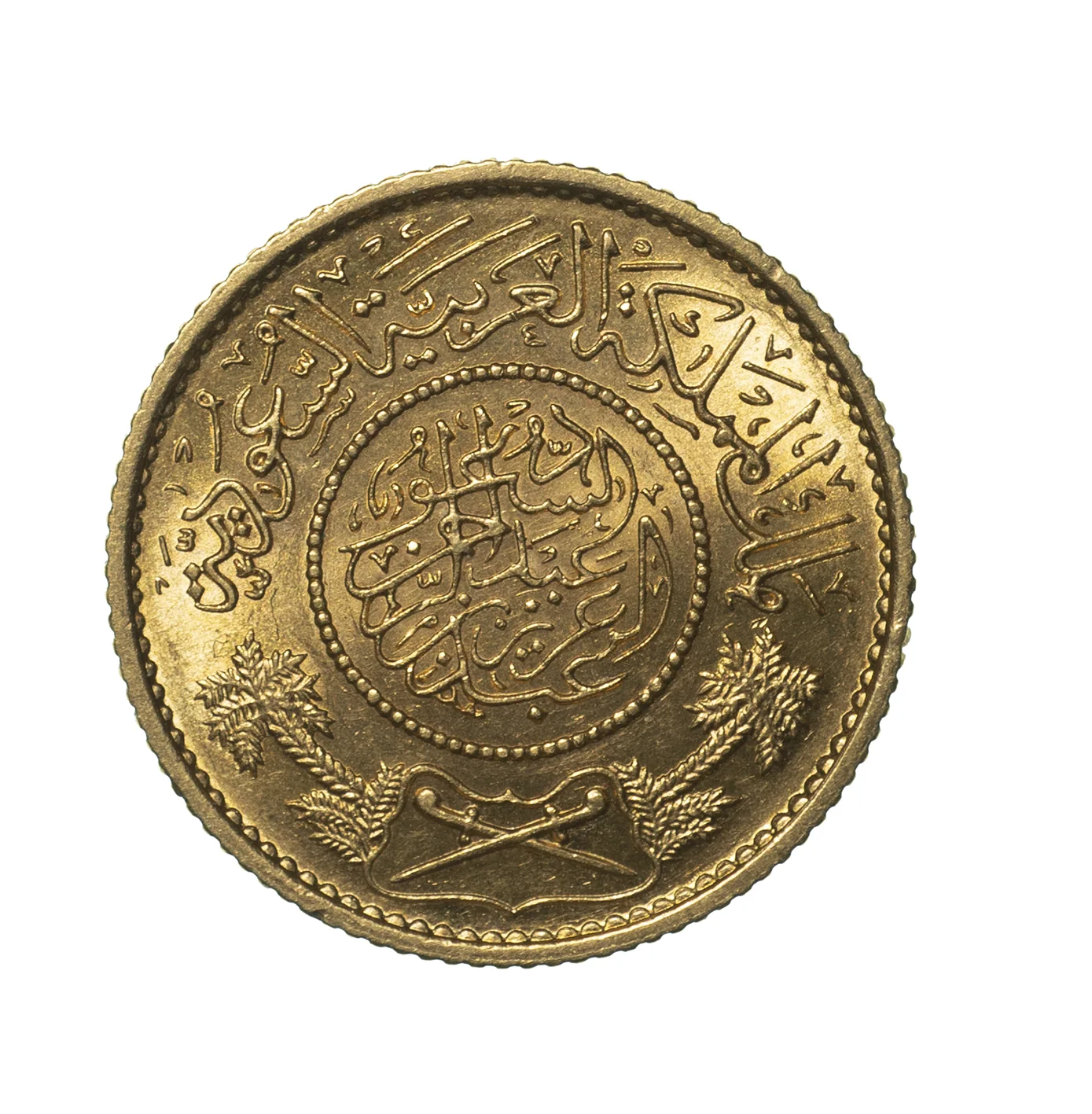
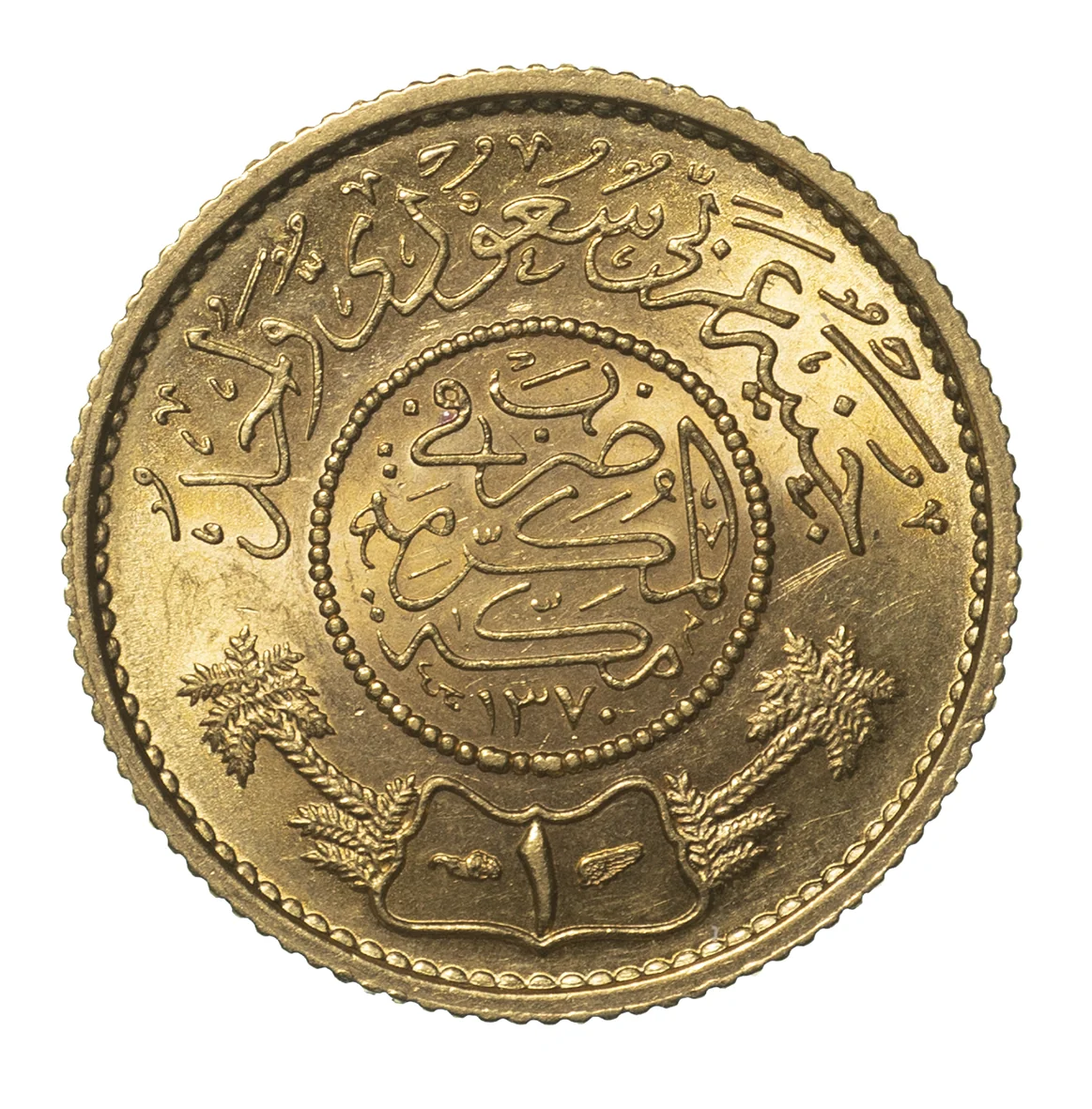
1 gunayh – Saudi Arabia
Add to wishlist
Saudi Arabia
Context
Year: 1951
Islamic (Hijri) Year:: 1370
Issuer: Saudi Arabia
Ruler: Abdulaziz bin Abdulrahman
Currency:
(1925—1960)
Demonetized: Yes
Total mintage: 2,000,000
Material
References
KM: #
Numista: #11470
Value
Bullion value: $1134.61
Obverse
Reverse
Edge
Reeded
Categories
| Object> Cold weapons |
| Plant> Tree |
Mintings
| Year | Mint Mark | Mintage | Quality | Collection |
|---|---|---|---|---|
| 1951 | — | 2,000,000 |
Historical background
In 1951, the currency situation in Saudi Arabia was defined by a complex and transitional monetary system, heavily reliant on silver. The official currency was the Saudi Riyal, a silver coin first minted in 1935, but the kingdom lacked a central bank and a unified paper currency. Consequently, foreign gold and silver coins, particularly the British gold sovereign and the Austrian Maria Theresa thaler, circulated widely alongside the Riyal, especially in the Hijaz region and for larger transactions. This created a de facto bimetallic system where exchange rates between gold, silver, and the Riyal fluctuated based on bullion markets and local demand, leading to inherent instability and complexity in commerce.
The system faced significant external pressure due to the kingdom's rapidly growing oil revenues, managed by the Arabian American Oil Company (ARAMCO). Oil payments were made in U.S. dollars, which were then converted into gold sovereigns purchased on the London market to fund government expenditures. This process was cumbersome and exposed the economy to the volatility of international gold prices. Furthermore, a global shortage of silver in the early 1950s, driven by high demand from the Korean War, caused the metal's market value to threaten to exceed the face value of the silver Riyal coins, raising the alarming prospect of coins being melted down for bullion and leaving the kingdom without a circulating medium.
Recognizing these critical vulnerabilities, the Saudi government was already laying the groundwork for a major monetary reform. In 1951, plans were advanced to establish a central monetary authority, which would materialize the following year as the Saudi Arabian Monetary Agency (SAMA) in 1952. The primary goals were to stabilize the currency, introduce regulated paper money (pilgrim receipts were a precursor), and unify the monetary system under a single, managed standard, moving decisively away from the reliance on physical silver and the circulation of foreign coins. Thus, 1951 represents the final year of an archaic, precious-metal-based system on the brink of a transformative institutional overhaul driven by the new wealth and administrative needs of the oil era.
The system faced significant external pressure due to the kingdom's rapidly growing oil revenues, managed by the Arabian American Oil Company (ARAMCO). Oil payments were made in U.S. dollars, which were then converted into gold sovereigns purchased on the London market to fund government expenditures. This process was cumbersome and exposed the economy to the volatility of international gold prices. Furthermore, a global shortage of silver in the early 1950s, driven by high demand from the Korean War, caused the metal's market value to threaten to exceed the face value of the silver Riyal coins, raising the alarming prospect of coins being melted down for bullion and leaving the kingdom without a circulating medium.
Recognizing these critical vulnerabilities, the Saudi government was already laying the groundwork for a major monetary reform. In 1951, plans were advanced to establish a central monetary authority, which would materialize the following year as the Saudi Arabian Monetary Agency (SAMA) in 1952. The primary goals were to stabilize the currency, introduce regulated paper money (pilgrim receipts were a precursor), and unify the monetary system under a single, managed standard, moving decisively away from the reliance on physical silver and the circulation of foreign coins. Thus, 1951 represents the final year of an archaic, precious-metal-based system on the brink of a transformative institutional overhaul driven by the new wealth and administrative needs of the oil era.
🌟 Limited