

1 real – Costa Rica
Add to wishlist
Costa Rica
Context
Years: 1849–1850
Issuer: Costa Rica
Period:
(1848—1948)
Currency:
(1841—1864)
Demonetized: Yes
Total mintage: 277,433
Material
References
KM: #
Numista: #8747
Value
Bullion value: $5.43
Obverse
Description:
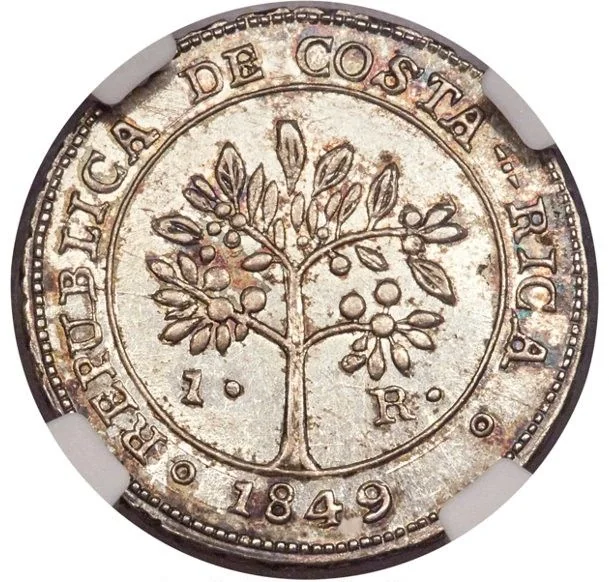
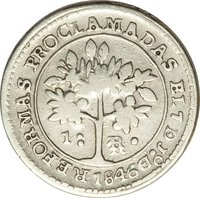
Central coffee tree flanked by value, encircled by legend and date.
Inscription:
REPUBLICA DE COSTA-RICA
1 • R •
⸰ 1849 ⸰
1 • R •
⸰ 1849 ⸰
Translation:
REPUBLIC OF COSTA RICA
1 • R •
⸰ 1849 ⸰
1 • R •
⸰ 1849 ⸰
Script: Latin
Language: Spanish
Engraver: Juan Barth
Reverse
Description:
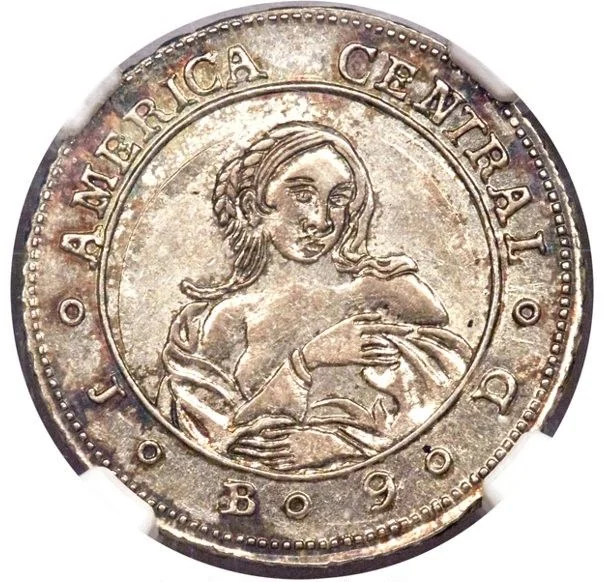
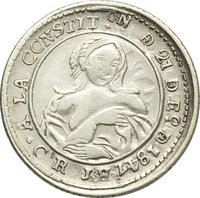
Female bust in central circle, legend around. Assayer initial and fineness below.
Inscription:
⸰ AMERICA CENTRAL ⸰
J ⸰ B ⸰ 9 ⸰ D
J ⸰ B ⸰ 9 ⸰ D
Translation:
Central America
J. B. 9 D.
J. B. 9 D.
Script: Latin
Language: Spanish
Engraver: Juan Barth
Edge
Mints
| Name | Mark |
|---|---|
| Casa Nacional de Moneda de Costa Rica | — |
Mintings
| Year | Mint Mark | Mintage | Quality | Collection |
|---|---|---|---|---|
| 1849 | — | 234,426 | ||
| 1850 | — | 43,007 |
Historical background
In 1849, Costa Rica's currency situation was characterized by chronic scarcity and significant complexity, a legacy of its colonial past and early independence. The nation lacked a unified, state-issued currency. Instead, the economy operated on a multi-currency system where foreign coins, primarily from Peru, Bolivia, Colombia, and Mexico, circulated alongside a limited number of locally minted coins. The most common unit was the peso, but its value was not fixed, fluctuating based on the metal content and origin of each specific coin. This created a confusing and inefficient commercial environment, hindering both domestic trade and international transactions.
The scarcity of physical money was a persistent problem, stifling economic growth and government finance. To facilitate larger transactions, merchants and wealthy individuals often used gold onzas (ounce coins), while everyday commerce relied heavily on fractional silver coins, which were frequently in short supply. This shortage led to the widespread use of vales (promissory notes or IOUs) issued by private merchants, haciendas, and municipal governments. While these notes provided necessary liquidity, they were unreliable, as their value was only as good as the credibility of the issuer, leading to frequent disputes and a lack of standardized value.
Recognizing these systemic issues, the government of President Juan Rafael Mora Porras was actively moving toward reform. The Ley de Moneda (Coinage Law) of 1849 was a pivotal step, authorizing the establishment of a national mint. Although the first Costa Rican coins would not be struck until 1850, this law laid the crucial legal foundation for replacing the chaotic patchwork of foreign and private currencies with a uniform, state-guaranteed national currency, marking the beginning of the end for the monetary anarchy of the early republic.
The scarcity of physical money was a persistent problem, stifling economic growth and government finance. To facilitate larger transactions, merchants and wealthy individuals often used gold onzas (ounce coins), while everyday commerce relied heavily on fractional silver coins, which were frequently in short supply. This shortage led to the widespread use of vales (promissory notes or IOUs) issued by private merchants, haciendas, and municipal governments. While these notes provided necessary liquidity, they were unreliable, as their value was only as good as the credibility of the issuer, leading to frequent disputes and a lack of standardized value.
Recognizing these systemic issues, the government of President Juan Rafael Mora Porras was actively moving toward reform. The Ley de Moneda (Coinage Law) of 1849 was a pivotal step, authorizing the establishment of a national mint. Although the first Costa Rican coins would not be struck until 1850, this law laid the crucial legal foundation for replacing the chaotic patchwork of foreign and private currencies with a uniform, state-guaranteed national currency, marking the beginning of the end for the monetary anarchy of the early republic.
⭐ Rare