

1 real – Costa Rica
Add to wishlist
Costa Rica
Context
Year: 1847
Issuer: Costa Rica
Period:
(1838—1847)
Currency:
(1841—1864)
Demonetized: Yes
Total mintage: 5,665
Material
References
KM: #
Numista: #41416
Value
Bullion value: $6.53
Obverse
Description:
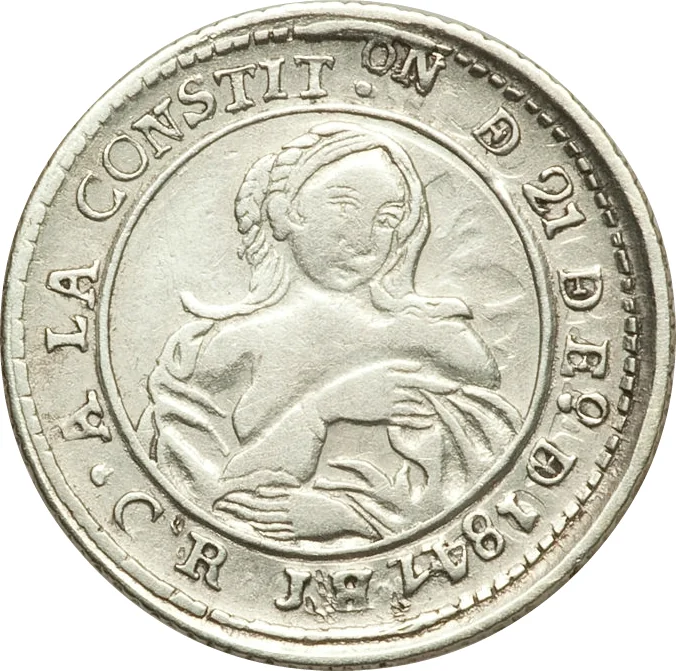
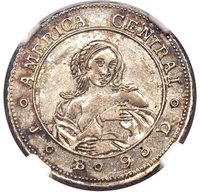
Female bust centered. Legend, mint, and assayer's initials encircling.
Inscription:
A LA COSTIT.ON DE 21 DE Eo. D 1847 JB
C R
C R
Translation:
To the Constitution of 21 of Eo. D 1847 JB
C R
C R
Script: Latin
Language: Spanish
Engraver: Juan Barth
Reverse
Description:
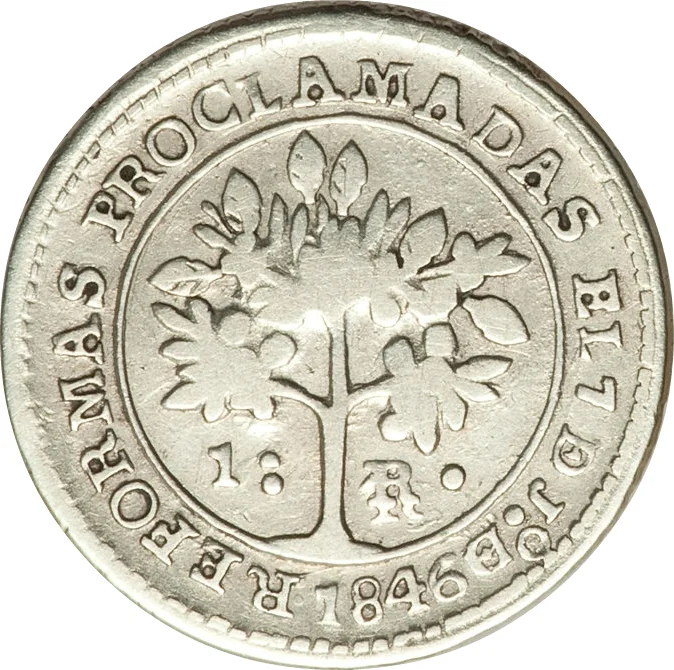
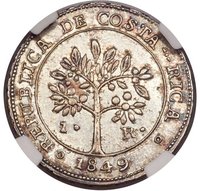
Coffee tree divides value, surrounded by legend.
Inscription:
REFORMAS PROCLAMADAS EL 7 DE Jo. DE 1846
1: R•
1: R•
Translation:
Proclaimed Reforms on the 7th of June of 1846
1: R•
1: R•
Script: Latin
Language: Spanish
Engraver: Juan Barth
Edge
Mints
| Name | Mark |
|---|---|
| Casa Nacional de Moneda de Costa Rica | CR |
Mintings
| Year | Mint Mark | Mintage | Quality | Collection |
|---|---|---|---|---|
| 1847 | CR | 5,665 |
Historical background
In 1847, Costa Rica's currency situation was characterized by a chaotic and fragmented system, a direct legacy of its colonial past and the economic realities of a young, agrarian republic. Following independence from Spain in 1821, the country lacked a unified national coinage. The most prevalent and trusted currency in daily commerce was the Spanish colonial silver real, particularly the Peruvian and Guatemalan issues, alongside a limited circulation of coins from other Latin American nations and even French francs. This reliance on foreign silver created chronic instability, as the supply was inconsistent and vulnerable to external economic shifts.
The government, under the administration of President José María Castro Madriz, recognized that this monetary anarchy hindered economic development and national sovereignty. A significant step was taken on April 24, 1847, with the founding of the Casa de Moneda de Costa Rica, the first national mint. Located in the capital, San José, its establishment was a landmark act aimed at asserting financial autonomy. However, the mint's initial output in 1847 was minimal, focusing on small-denomination copper coins (cuartillos and medios cuartillos) to address the severe shortage of fractional currency needed for everyday market transactions.
Thus, 1847 stands as a year of transition—a point where the old, disordered system of circulating foreign silver was officially challenged by the new state's institutional response. While the familiar Spanish real remained the de facto standard for larger transactions, the first, modest coins bearing the nation's name entered circulation. This set the stage for the more comprehensive monetary reforms that would follow in the 1850s, ultimately leading to the introduction of the Costa Rican peso as the official national currency, a crucial step in consolidating the nation's economic identity.
The government, under the administration of President José María Castro Madriz, recognized that this monetary anarchy hindered economic development and national sovereignty. A significant step was taken on April 24, 1847, with the founding of the Casa de Moneda de Costa Rica, the first national mint. Located in the capital, San José, its establishment was a landmark act aimed at asserting financial autonomy. However, the mint's initial output in 1847 was minimal, focusing on small-denomination copper coins (cuartillos and medios cuartillos) to address the severe shortage of fractional currency needed for everyday market transactions.
Thus, 1847 stands as a year of transition—a point where the old, disordered system of circulating foreign silver was officially challenged by the new state's institutional response. While the familiar Spanish real remained the de facto standard for larger transactions, the first, modest coins bearing the nation's name entered circulation. This set the stage for the more comprehensive monetary reforms that would follow in the 1850s, ultimately leading to the introduction of the Costa Rican peso as the official national currency, a crucial step in consolidating the nation's economic identity.
💎 Extremely Rare