

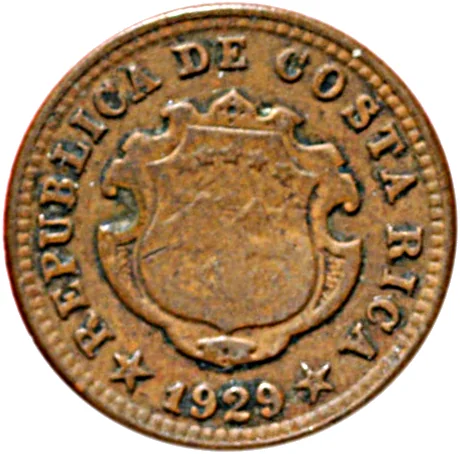
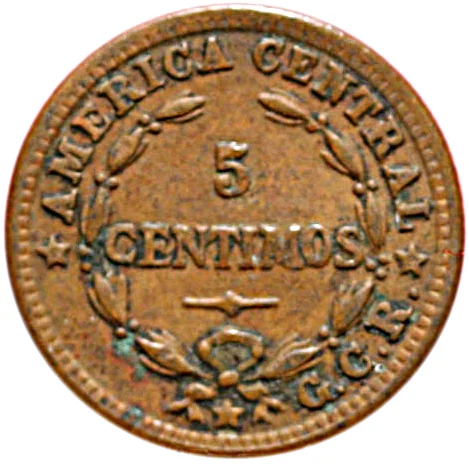
5 centimos – Costa Rica
Add to wishlist
Costa Rica
Context
Year: 1929
Issuer: Costa Rica
Issuing organization: Government of Costa Rica
Period:
(1848—1948)
Currency:
(since 1896)
Demonetized: Yes
Total mintage: 1,500,000
Material
References
KM: #
Numista: #8739
Value
Exchange value: 0.05 CRC
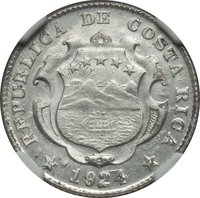
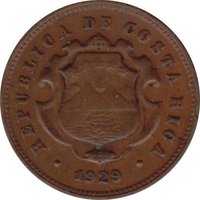
Obverse
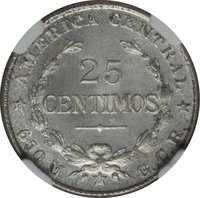
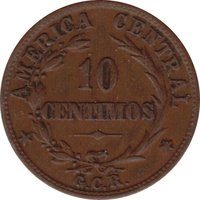
Reverse
Edge
Categories
| Symbols> Coat of Arms |
| Symbol> Wreath |
Mints
| Name | Mark |
|---|---|
| United States Mint of Philadelphia | — |
Mintings
| Year | Mint Mark | Mintage | Quality | Collection |
|---|---|---|---|---|
| 1929 | GCR | 1,500,000 |
Historical background
In 1929, Costa Rica's currency situation was defined by its adherence to the gold standard, a system it had officially adopted in 1896. The national currency, the colón, was pegged to and fully convertible into gold, with its value fixed at approximately one colón to 0.75 grams of fine gold. This link provided a degree of monetary stability and facilitated international trade, primarily in coffee and bananas, by offering predictable exchange rates with major trading partners like the United States and the United Kingdom. The system was managed by three private banks of issue—the Banco Internacional de Costa Rica, the Banco Anglo-Costarricense, and the Banco de Costa Rica—which held the exclusive right to issue banknotes backed by gold reserves.
However, this stability was increasingly fragile. The Costa Rican economy was heavily dependent on a few agricultural exports, making it vulnerable to global commodity price swings. Furthermore, the government's fiscal position was weak, characterized by chronic budget deficits and a growing public debt. These underlying weaknesses meant that the country's gold reserves, crucial for maintaining the currency peg, were under constant pressure. The monetary system was also criticized for its inflexibility and for concentrating financial power in the hands of the private issuing banks, limiting the state's ability to respond to economic shocks.
The Wall Street Crash of October 1929 and the ensuing global economic crisis would therefore act as a severe catalyst. As world trade collapsed, demand and prices for Costa Rican exports plummeted, causing a sharp decline in foreign exchange earnings. This immediately triggered a gold outflow as the country needed to settle its international obligations. By the end of the year, the strains were acute, setting the stage for the imminent abandonment of the gold standard in the early 1930s, a profound banking crisis, and a major reorganization of the country's entire financial system.
However, this stability was increasingly fragile. The Costa Rican economy was heavily dependent on a few agricultural exports, making it vulnerable to global commodity price swings. Furthermore, the government's fiscal position was weak, characterized by chronic budget deficits and a growing public debt. These underlying weaknesses meant that the country's gold reserves, crucial for maintaining the currency peg, were under constant pressure. The monetary system was also criticized for its inflexibility and for concentrating financial power in the hands of the private issuing banks, limiting the state's ability to respond to economic shocks.
The Wall Street Crash of October 1929 and the ensuing global economic crisis would therefore act as a severe catalyst. As world trade collapsed, demand and prices for Costa Rican exports plummeted, causing a sharp decline in foreign exchange earnings. This immediately triggered a gold outflow as the country needed to settle its international obligations. By the end of the year, the strains were acute, setting the stage for the imminent abandonment of the gold standard in the early 1930s, a profound banking crisis, and a major reorganization of the country's entire financial system.
🌟 Limited