

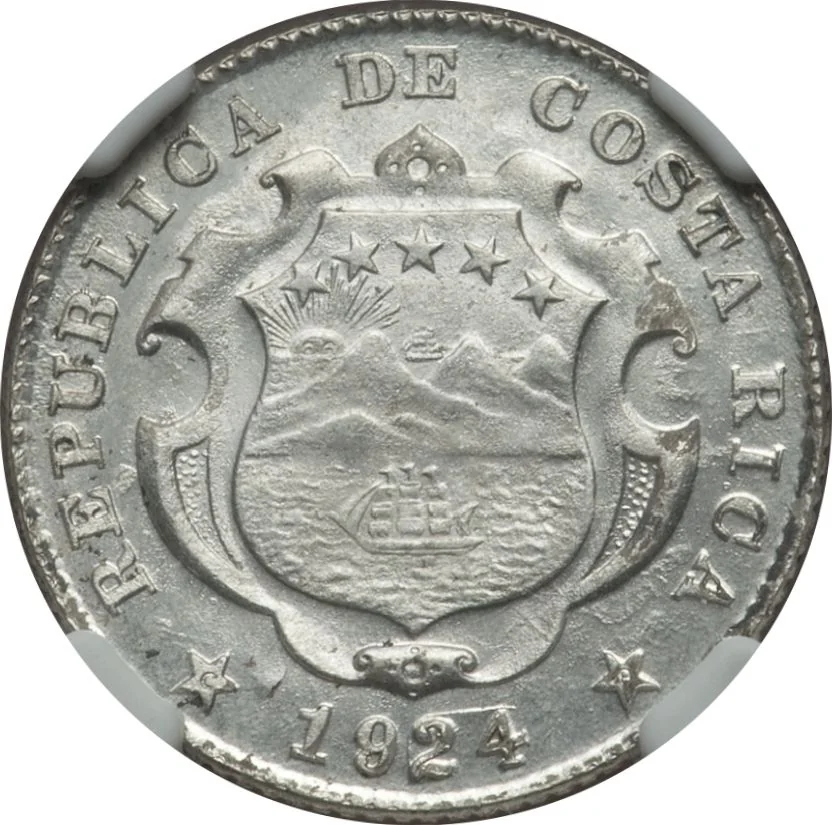
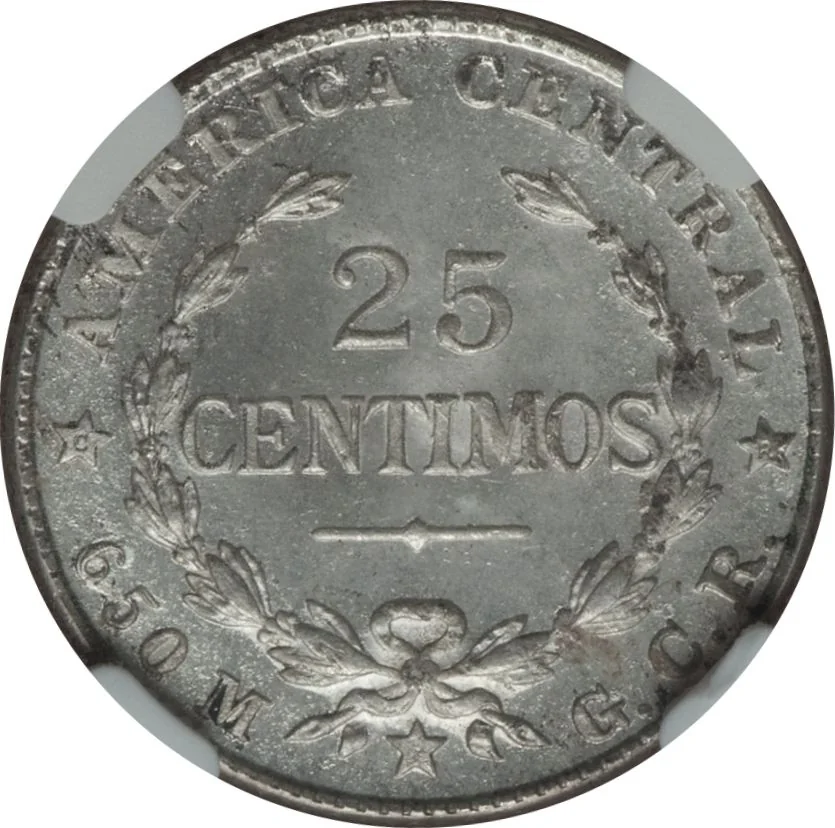
25 centimos – Costa Rica
Add to wishlist
Costa Rica
Context
Year: 1924
Issuer: Costa Rica
Issuing organization: Government of Costa Rica
Period:
(1848—1948)
Currency:
(since 1896)
Demonetized: Yes
Total mintage: 1,867,309
Material
References
KM: #
Numista: #5100
Value
Exchange value: 0.25 CRC
Bullion value: $5.63
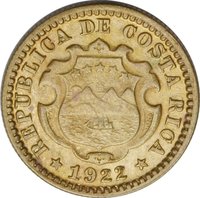
Obverse
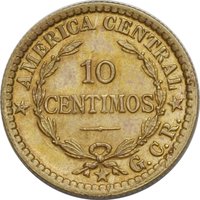
Reverse
Edge
Reeded
Categories
| Symbols> Coat of Arms |
| Symbol> Wreath |
Mints
| Name | Mark |
|---|---|
| Casa Nacional de Moneda de Costa Rica | — |
Mintings
| Year | Mint Mark | Mintage | Quality | Collection |
|---|---|---|---|---|
| 1924 | GCR | 1,867,309 |
Historical background
In 1924, Costa Rica's currency system was in a state of transition and vulnerability, still grappling with the legacy of the 19th-century "free banking" era. During that period, private banks had issued their own paper notes, leading to a fragmented and often unstable monetary supply. While the government had taken steps toward centralization, including the establishment of the International Bank of Costa Rica in 1914 with exclusive note-issuing rights, the system remained largely based on a silver standard. The primary circulating coin was the silver colón, introduced in 1896, but its value was tied to the volatile global price of silver, causing exchange rate instability against gold-backed currencies like the US dollar and the British pound.
This instability presented significant challenges for a country deeply integrated into the global economy through coffee and banana exports. International transactions were typically conducted in gold-standard currencies, and the fluctuating value of the silver colón created uncertainty for exporters and foreign investors. Furthermore, the money in circulation was a complex mix of coins from various Latin American nations and the notes of the International Bank, which themselves were not always fully trusted or universally accepted throughout the national territory. This lack of a uniform, strong national currency hindered domestic commerce and complicated government finance.
Consequently, by 1924, there was a growing consensus among political and economic elites on the urgent need for profound monetary reform. The year served as a pivotal prelude to the major change that would come in 1925: the official transition to a gold exchange standard. This reform, embodied in the Monetary Law of 1924 (effective 1925), created a new gold colón, stabilized the exchange rate, and paved the way for the establishment of a true central bank. Therefore, the currency situation in 1924 was characterized by the final pressures of an outdated system, setting the stage for a transformative shift toward a modern, centralized, and gold-backed monetary regime.
This instability presented significant challenges for a country deeply integrated into the global economy through coffee and banana exports. International transactions were typically conducted in gold-standard currencies, and the fluctuating value of the silver colón created uncertainty for exporters and foreign investors. Furthermore, the money in circulation was a complex mix of coins from various Latin American nations and the notes of the International Bank, which themselves were not always fully trusted or universally accepted throughout the national territory. This lack of a uniform, strong national currency hindered domestic commerce and complicated government finance.
Consequently, by 1924, there was a growing consensus among political and economic elites on the urgent need for profound monetary reform. The year served as a pivotal prelude to the major change that would come in 1925: the official transition to a gold exchange standard. This reform, embodied in the Monetary Law of 1924 (effective 1925), created a new gold colón, stabilized the exchange rate, and paved the way for the establishment of a true central bank. Therefore, the currency situation in 1924 was characterized by the final pressures of an outdated system, setting the stage for a transformative shift toward a modern, centralized, and gold-backed monetary regime.
🌱 Fairly Common