

5 centimos – Costa Rica
Add to wishlist
Costa Rica
Context
Years: 1920–1941
Issuer: Costa Rica
Issuing organization: Government of Costa Rica
Period:
(1848—1948)
Currency:
(since 1896)
Demonetized: Yes
Total mintage: 6,300,000
Material
References
KM: #
Numista: #8737
Value
Exchange value: 0.05 CRC
Obverse
Description:
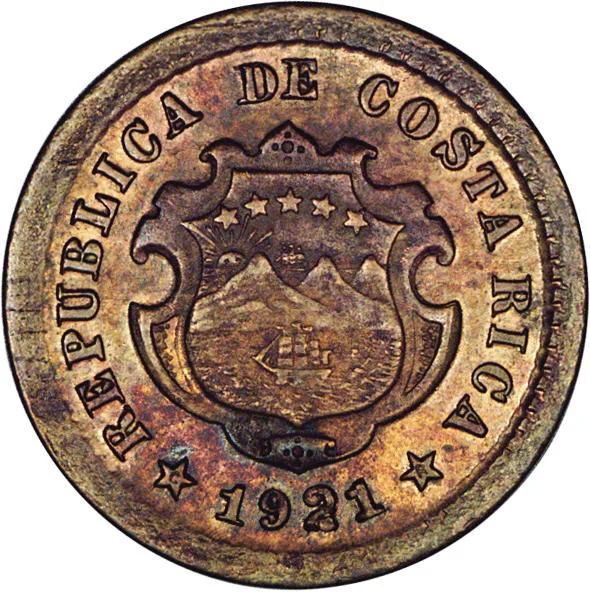
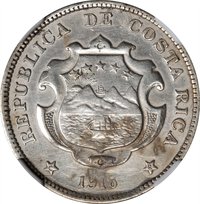
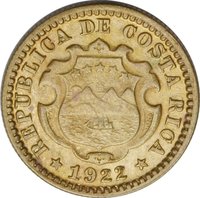
Costa Rican coat of arms: five stars for its provinces, three volcanoes for its mountain ranges, two ships for its position between oceans, and a sunrise. The stars contain the letters "C" and "R".
Inscription:
* REPUBLICA DE COSTA RICA *
C 1921 R
C 1921 R
Translation:
REPUBLIC OF COSTA RICA
C 1921 R
C 1921 R
Script: Latin
Reverse
Edge
Plain
Categories
| Symbols> Coat of Arms |
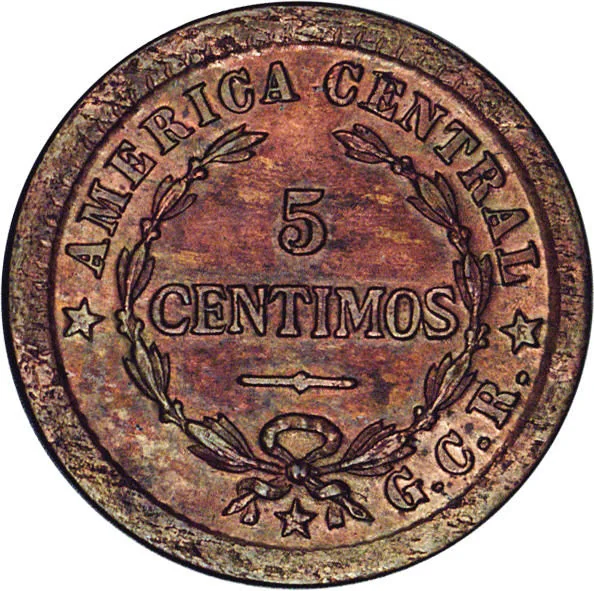
| Symbol> Wreath |
Mints
| Name | Mark |
|---|---|
| Casa Nacional de Moneda de Costa Rica | — |
Mintings
| Year | Mint Mark | Mintage | Quality | Collection |
|---|---|---|---|---|
| 1920 | GCR | 500,000 | ||
| 1921 | GCR | 500,000 | ||
| 1922 | GCR | 500,000 | ||
| 1936 | GCR | 1,500,000 | ||
| 1938 | GCR | 1,000,000 | ||
| 1940 | GCR | 1,300,000 | ||
| 1941 | GCR | 1,000,000 |
Historical background
In 1920, Costa Rica's currency system was in a state of transition and instability, still grappling with the legacy of the 19th century. The official currency was the silver colón, introduced in 1896 to replace the Costa Rican peso and named after Christopher Columbus (Cristóbal Colón). However, its adoption was not yet complete or uniform. A significant practical challenge was the severe shortage of physical coins and banknotes in circulation, a problem exacerbated by the disruptions of World War I to global trade and metal supplies. This scarcity led to a reliance on older currencies and even barter in some rural areas, hindering commercial transactions and economic planning.
The period was marked by a de facto bimetallic system with a fixed exchange rate between gold and silver, but this was under immense strain. Internationally, the price of silver was highly volatile, and Costa Rica's peg became unsustainable. The country's currency was effectively tied to the British pound sterling through the use of gold-backed "Costa Rican Gold" for international trade and debt payments, while the silver colón was used domestically. This created a complex and vulnerable monetary environment where the value of the everyday currency could be influenced by distant commodity markets and foreign exchange flows.
Consequently, the early 1920s were a prelude to major reform. The economic pressures culminated in a severe devaluation of the silver colón in 1921, which finally broke the artificial gold-silver parity. This crisis directly prompted the creation of the International Bank of Costa Rica in 1914 (operational later) and paved the way for the establishment of the Central Bank of Costa Rica (BCCR) in 1950. Thus, the currency situation of 1920 represents a critical juncture, highlighting the end of an outdated metallic system and the growing recognition of the need for a centralized, managed national currency to achieve financial stability.
The period was marked by a de facto bimetallic system with a fixed exchange rate between gold and silver, but this was under immense strain. Internationally, the price of silver was highly volatile, and Costa Rica's peg became unsustainable. The country's currency was effectively tied to the British pound sterling through the use of gold-backed "Costa Rican Gold" for international trade and debt payments, while the silver colón was used domestically. This created a complex and vulnerable monetary environment where the value of the everyday currency could be influenced by distant commodity markets and foreign exchange flows.
Consequently, the early 1920s were a prelude to major reform. The economic pressures culminated in a severe devaluation of the silver colón in 1921, which finally broke the artificial gold-silver parity. This crisis directly prompted the creation of the International Bank of Costa Rica in 1914 (operational later) and paved the way for the establishment of the Central Bank of Costa Rica (BCCR) in 1950. Thus, the currency situation of 1920 represents a critical juncture, highlighting the end of an outdated metallic system and the growing recognition of the need for a centralized, managed national currency to achieve financial stability.
🌱 Fairly Common