

10 Francs Guinéens – Guinea
Guinea
Obverse
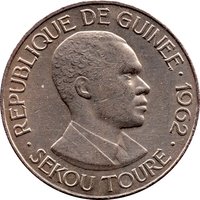
Description:
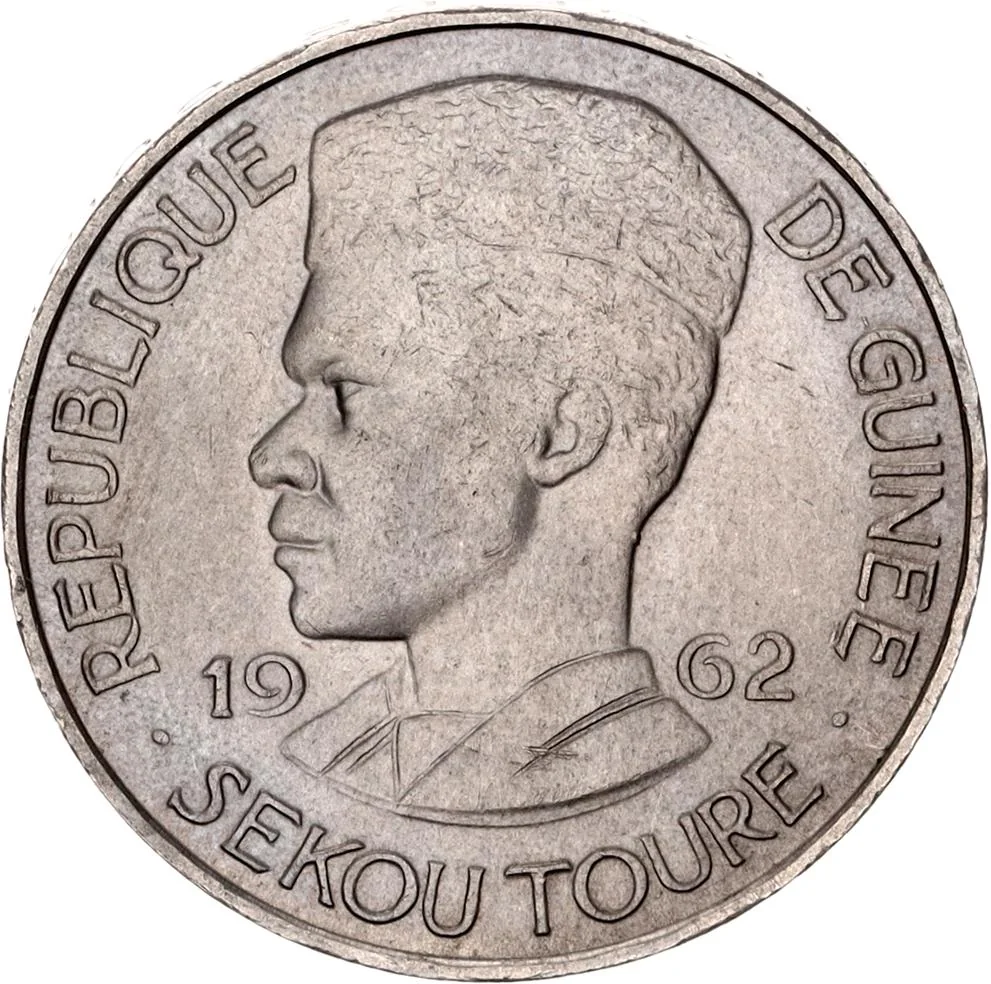
Sekou Toure bust, left profile.
Inscription:
REPUBLIQUE DE GUINEE
1962
· SEKOU TOURE ·
1962
· SEKOU TOURE ·
Translation:
REPUBLIC OF GUINEA
1962
· SEKOU TOURE ·
1962
· SEKOU TOURE ·
Script: Latin
Language: French
Engraver: Paul Vincze
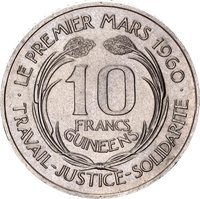
Reverse
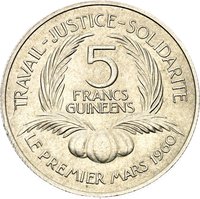
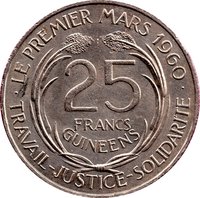
Description:
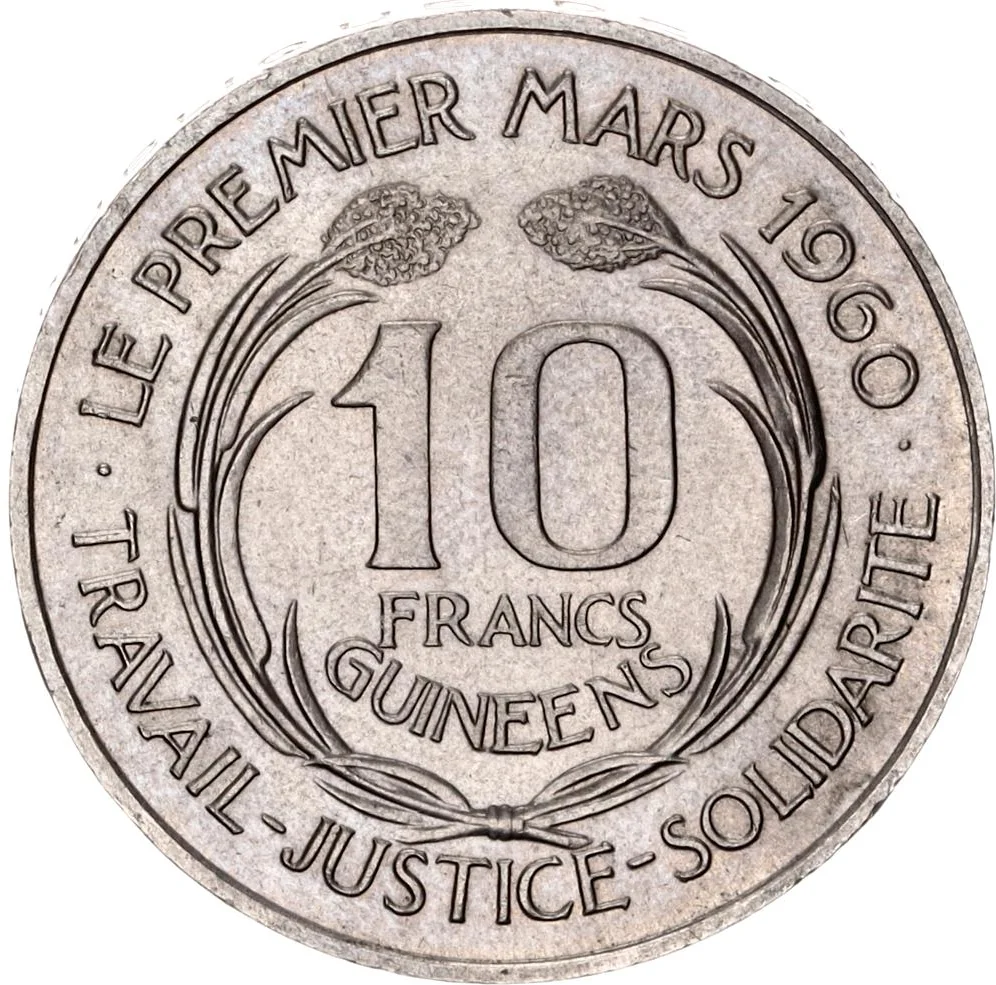
Wreath denomination
Inscription:
LE PREMIER MARS 1960
10 FRANCS GUINEENS
· TRAVAIL-JUSTICE-SOLIDARITE ·
10 FRANCS GUINEENS
· TRAVAIL-JUSTICE-SOLIDARITE ·
Translation:
The First of March 1960
10 Guinean Francs
· Work-Justice-Solidarity ·
10 Guinean Francs
· Work-Justice-Solidarity ·
Script: Latin
Language: French
Engraver: Paul Vincze
Edge
Mints
| Name | Mark |
|---|---|
| Royal Mint (Tower Hill) | — |
Mintings
| Year | Mint Mark | Mintage | Quality | Collection |
|---|---|---|---|---|
| 1962 | — | — | Proof | |
| 1962 | — | 12,000,000 |
Historical background
In 1962, Guinea's currency situation was defined by its bold and politically charged break from the CFA franc zone. Following its historic "No" vote for independence from France in 1958, the new republic under President Ahmed Sékou Touré immediately faced severe economic retaliation, including the withdrawal of all French administrative personnel and assets. In response, Guinea left the Franc Zone in March 1960 and created its own national currency, the Guinean franc (GNF), to assert its monetary sovereignty and control its economy free from French influence.
The immediate consequences were challenging. The new currency, initially pegged to the French franc, struggled with international recognition and convertibility. Guinea lacked the foreign reserves, central banking expertise, and printing facilities to manage the currency effectively, leading to early issues with confidence and valuation. To finance development, the government increasingly resorted to money creation, sowing the seeds for inflation. Furthermore, the economy remained heavily dependent on exporting a single commodity—aluminum ore from the Friguia bauxite complex—whose revenues were crucial for supporting the fledgling currency.
By 1962, the Guinean franc was operating within a strictly controlled, state-directed economy. It was a non-convertible currency, with its exchange rate set by government decree rather than market forces. This isolation from the international financial system, combined with a growing budget deficit and inflationary pressures, began to reveal the economic costs of political independence. Thus, the currency situation in 1962 reflected a nation navigating the difficult trade-offs between sovereign autonomy and economic stability, setting a precedent for the financially insulated and challenging path ahead under Touré's revolutionary regime.
The immediate consequences were challenging. The new currency, initially pegged to the French franc, struggled with international recognition and convertibility. Guinea lacked the foreign reserves, central banking expertise, and printing facilities to manage the currency effectively, leading to early issues with confidence and valuation. To finance development, the government increasingly resorted to money creation, sowing the seeds for inflation. Furthermore, the economy remained heavily dependent on exporting a single commodity—aluminum ore from the Friguia bauxite complex—whose revenues were crucial for supporting the fledgling currency.
By 1962, the Guinean franc was operating within a strictly controlled, state-directed economy. It was a non-convertible currency, with its exchange rate set by government decree rather than market forces. This isolation from the international financial system, combined with a growing budget deficit and inflationary pressures, began to reveal the economic costs of political independence. Thus, the currency situation in 1962 reflected a nation navigating the difficult trade-offs between sovereign autonomy and economic stability, setting a precedent for the financially insulated and challenging path ahead under Touré's revolutionary regime.
Series: 1962 Guinea circulation coins
🌱 Common