


100 Francs – France
Non-circulating coins
Commemoration: 1992 Paralympics, Albertville
France

Obverse
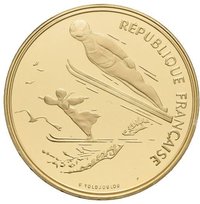
Description:
Circular legend: "VES JEUX PARALYMPIQUES TIGNES - ALBERTVILLE". Center: Folon's Bird. Right exergue: signature "FOLON".
Inscription:
TIGNES - ALBERTVILLE
Ves JEUX PARALYMPIQUES FOLON
Ves JEUX PARALYMPIQUES FOLON
Script: Latin
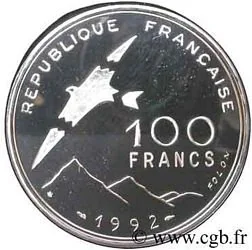
Reverse
Description:
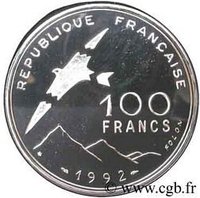
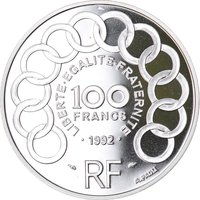
"REPUBLIQUE FRANÇAISE" encircles Folon's bird flying over mountains. The value is on two lines at right, above the year. The exergue bears the signature "FOLON".
Inscription:
REPUBLIQUE FRANÇAISE
100
FRANCS
1992 FOLON
100
FRANCS
1992 FOLON
Translation:
REPUBLIC OF FRANCE
100
FRANCS
1992 FOLON
100
FRANCS
1992 FOLON
Script: Latin
Language: French
Edge
Embossed edge
Legend:
LIBERTE EGALITE FRATERNITE
Translation:
Liberty Equality Fraternity
Language: French
Categories
| Sport> Winter Olympic Games |
| Geography> Mountain |
Mintings
| Year | Mint Mark | Mintage | Quality | Collection |
|---|---|---|---|---|
| 1992 | — | 5,000 | Proof |
Historical background
In 1992, France's currency situation was defined by its pivotal role within the European Exchange Rate Mechanism (ERM), the system designed to stabilize currencies ahead of the planned single currency, the euro. The French franc was a cornerstone of this mechanism, tightly pegged to the German Deutsche Mark within narrow fluctuation bands. This alignment was a conscious political and economic choice, symbolizing France's commitment to European monetary integration and providing a discipline of low inflation, often referred to as the "franc fort" (strong franc) policy. However, this stability came at a significant cost, as it required French monetary policy to essentially follow the lead of the German Bundesbank.
The situation grew increasingly tense in 1992 due to profound economic asymmetry. While Germany raised interest rates aggressively to combat inflation following reunification, France and other ERM members were mired in recession and needed lower rates to stimulate growth. This conflict placed the franc under severe speculative pressure. Currency traders, most notably George Soros, famously bet against the sustainability of these fixed parities, believing the high-interest rates needed to defend the franc were politically untenable for France. The crisis peaked in September 1992 when Britain and Italy were forced to withdraw their currencies from the ERM, but France, with Germany's crucial support, mounted a determined defense.
The franc's survival in 1992 was a testament to a fierce political commitment. The French government and the Bundesbank engaged in massive coordinated interventions, buying francs to uphold the parity. Crucially, a referendum on the Maastricht Treaty in September 1992, which narrowly approved the treaty and the future euro, became a de facto vote of confidence in the franc's ERM peg. Despite the intense pressure, France held the line, avoiding devaluation. This successful defense cemented the franc's position and was a decisive step toward monetary union, but it also prolonged France's recession, highlighting the harsh trade-offs of the pre-euro stability framework.
The situation grew increasingly tense in 1992 due to profound economic asymmetry. While Germany raised interest rates aggressively to combat inflation following reunification, France and other ERM members were mired in recession and needed lower rates to stimulate growth. This conflict placed the franc under severe speculative pressure. Currency traders, most notably George Soros, famously bet against the sustainability of these fixed parities, believing the high-interest rates needed to defend the franc were politically untenable for France. The crisis peaked in September 1992 when Britain and Italy were forced to withdraw their currencies from the ERM, but France, with Germany's crucial support, mounted a determined defense.
The franc's survival in 1992 was a testament to a fierce political commitment. The French government and the Bundesbank engaged in massive coordinated interventions, buying francs to uphold the parity. Crucially, a referendum on the Maastricht Treaty in September 1992, which narrowly approved the treaty and the future euro, became a de facto vote of confidence in the franc's ERM peg. Despite the intense pressure, France held the line, avoiding devaluation. This successful defense cemented the franc's position and was a decisive step toward monetary union, but it also prolonged France's recession, highlighting the harsh trade-offs of the pre-euro stability framework.













💎 Extremely Rare