

100 euro – Slovakia
Add to wishlist
Non-circulating coins
Commemoration: Primeval Beech Forests of the Carpathians
Series: UNESCO World Heritage
Slovakia
Context
Material
References
KM: #
Numista: #86905
Value
Exchange value: 100 EUR
Bullion value: $1313.53
Inflation-adjusted value: 147.23 EUR
Obverse
Description:
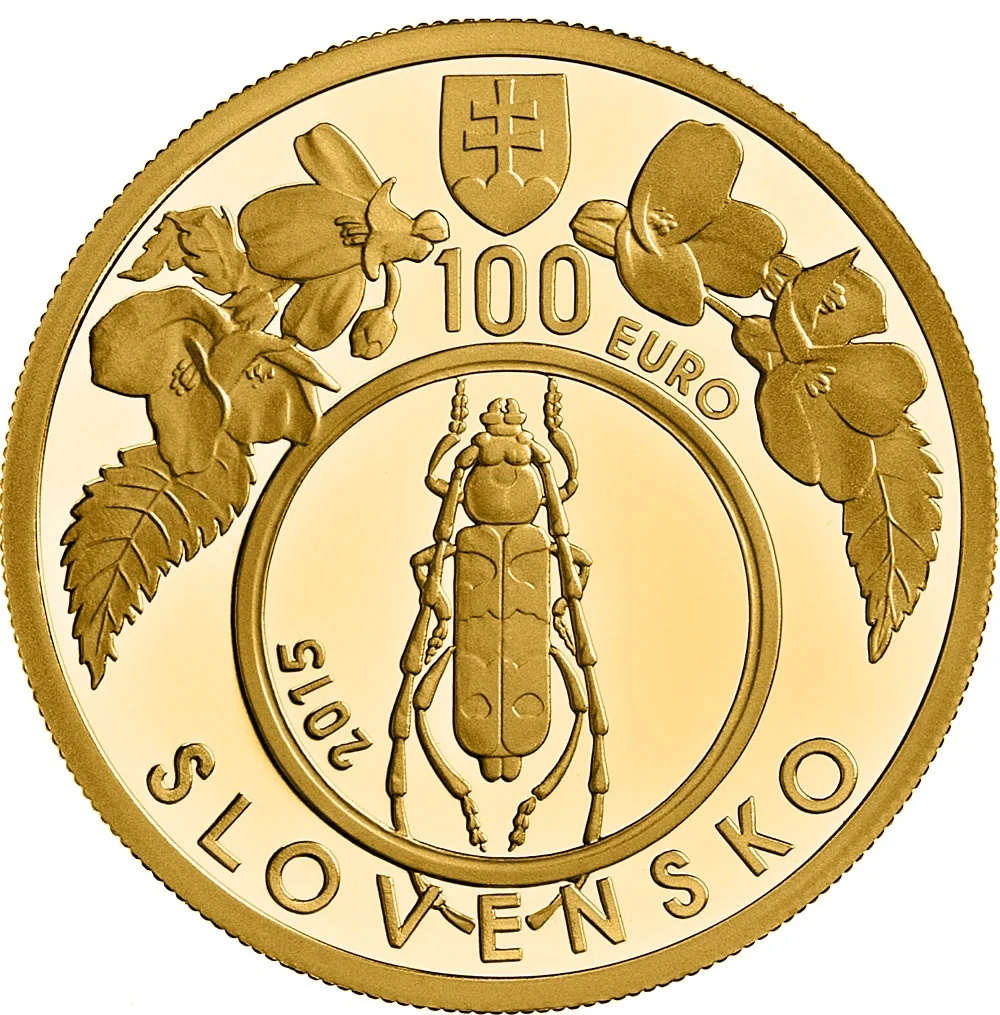
The obverse features the Rosalia longicorn, a species of Carpathian beech forests, with Carpathian tooth wort flowers and leaves above. The Slovak Republic coat of arms is at the top.
Inscription:
100 EURO
SLOVENSKO
2015.
SLOVENSKO
2015.
Translation:
Slovakia
2015
2015
Script: Latin
Engraver: Mária Poldaufová
Designer: Dalibor Schmidt
Reverse
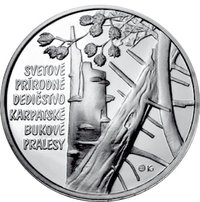
Description:
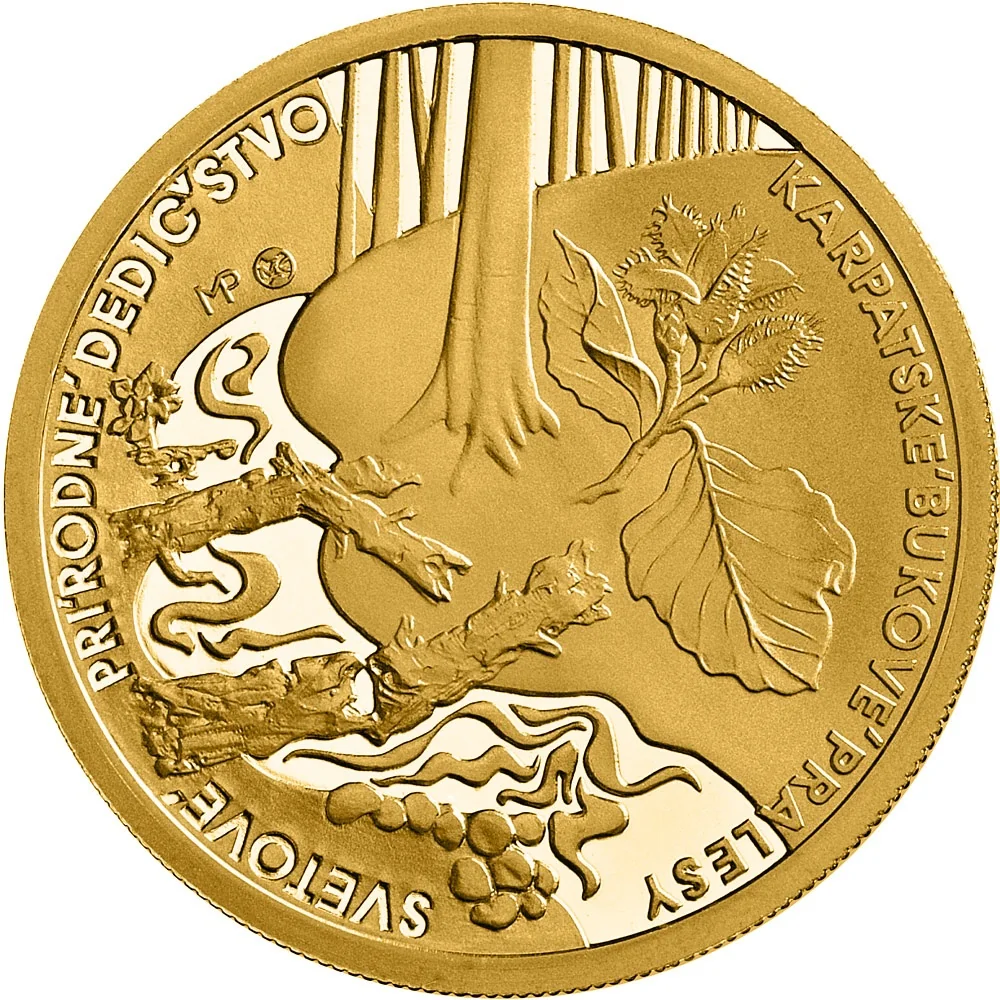
The reverse depicts a primeval beech forest habitat, with beech leaves and nuts to the right. The designer's initials "MP" and the Kremnica Mint mark "MK" are in the upper left.
Inscription:
SVETOVÉ PRÍRODNÉ DEDIČSTVO
KARPATSKÉ BUKOVÉ PRALESY
MP
MK
KARPATSKÉ BUKOVÉ PRALESY
MP
MK
Translation:
World Natural Heritage
Carpathian Beech Primeval Forests
MP
MK
Carpathian Beech Primeval Forests
MP
MK
Script: Latin
Language: Slovak
Engraver: Mária Poldaufová
Designer: Dalibor Schmidt
Edge
Reeded
Categories
| Animal> Insect |
| Organization> UNESCO |
| Symbols> Coat of Arms |
| Plants> Flower |
Mints
| Name | Mark |
|---|---|
| Kremnica | (MK) |
Mintings
| Year | Mint Mark | Mintage | Quality | Collection |
|---|---|---|---|---|
| 2015 | MK | 4,100 | Proof |
Historical background
In 2015, Slovakia was a well-established member of the Eurozone, having adopted the euro as its official currency on January 1, 2009. This move replaced the Slovak koruna (SKK) and integrated the country more deeply into the core of the European Union's economic and monetary framework. By 2015, the euro was a familiar and stable feature of daily life, with the initial transition period long complete and public opinion generally supportive of the currency. Slovakia's membership provided macroeconomic stability, eliminated exchange rate risk with its key trading partners, and solidified its position within the single market.
The primary currency-related discussions in Slovakia during 2015 were not about the euro itself, but rather about its management at the European level and the country's fiscal policies within the Eurozone's rules. The year was dominated by the ongoing European sovereign debt crisis and the Greek government-debt crisis, which peaked in the summer of 2015 with the threat of a "Grexit." Slovakia, as a fiscally conservative member, was involved in contentious negotiations over further bailout packages for Greece, with its government and public expressing strong reluctance to shoulder the financial burden of what were seen as another country's fiscal irresponsibilities.
Domestically, the currency situation was stable, but the economy faced challenges that were influenced by its Eurozone membership. While the euro provided stability, it also meant Slovakia had no independent monetary policy to address specific national issues, such as a brief period of deflation in 2015. Economic policy focus was therefore on fiscal measures and competitiveness. The government, led by Prime Minister Robert Fico, maintained a focus on industrial production and export growth, leveraging the euro's advantages for trade while navigating the strict budgetary constraints enforced by the EU's Stability and Growth Pact.
The primary currency-related discussions in Slovakia during 2015 were not about the euro itself, but rather about its management at the European level and the country's fiscal policies within the Eurozone's rules. The year was dominated by the ongoing European sovereign debt crisis and the Greek government-debt crisis, which peaked in the summer of 2015 with the threat of a "Grexit." Slovakia, as a fiscally conservative member, was involved in contentious negotiations over further bailout packages for Greece, with its government and public expressing strong reluctance to shoulder the financial burden of what were seen as another country's fiscal irresponsibilities.
Domestically, the currency situation was stable, but the economy faced challenges that were influenced by its Eurozone membership. While the euro provided stability, it also meant Slovakia had no independent monetary policy to address specific national issues, such as a brief period of deflation in 2015. Economic policy focus was therefore on fiscal measures and competitiveness. The government, led by Prime Minister Robert Fico, maintained a focus on industrial production and export growth, leveraging the euro's advantages for trade while navigating the strict budgetary constraints enforced by the EU's Stability and Growth Pact.
Series: UNESCO World Heritage
✨ Legendary