

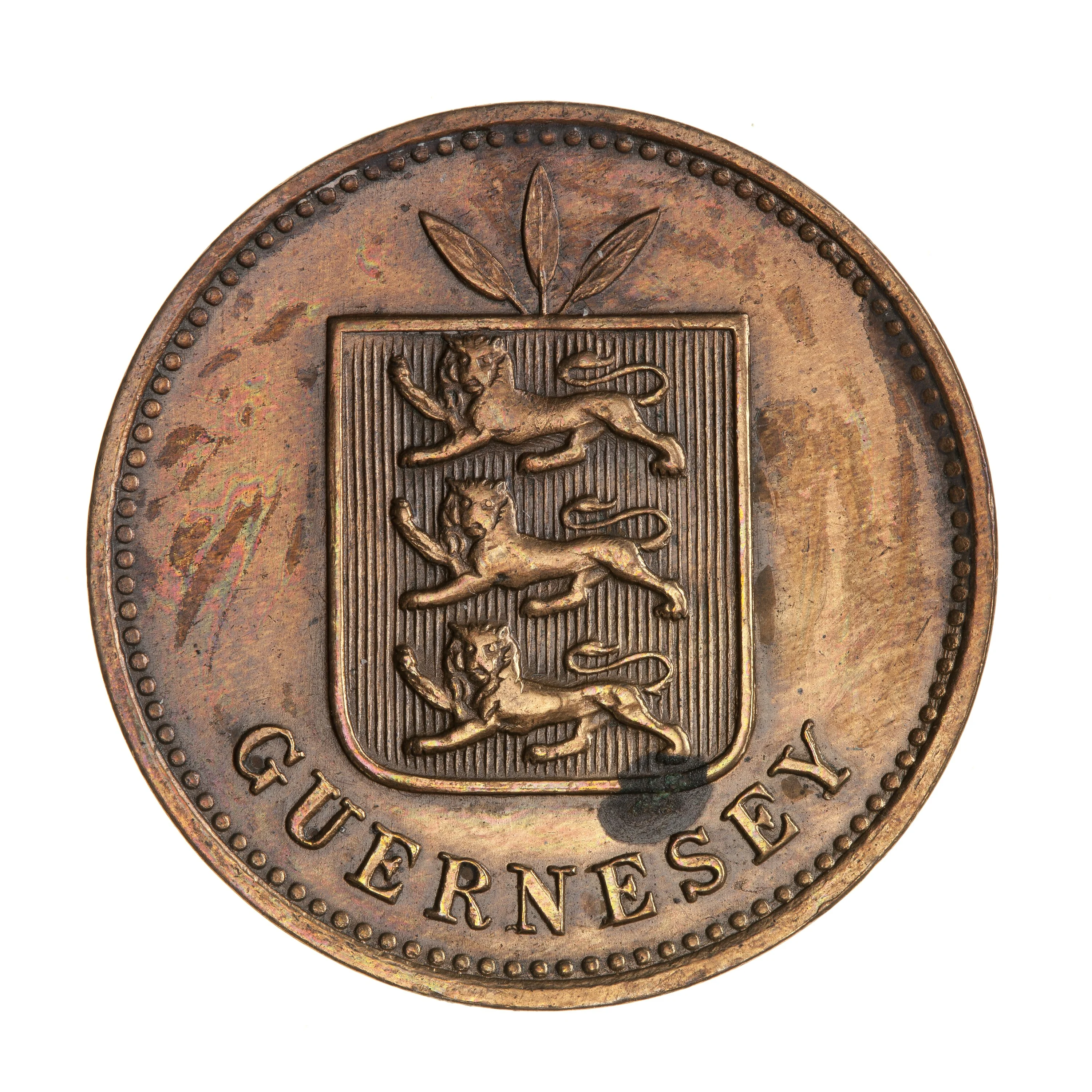
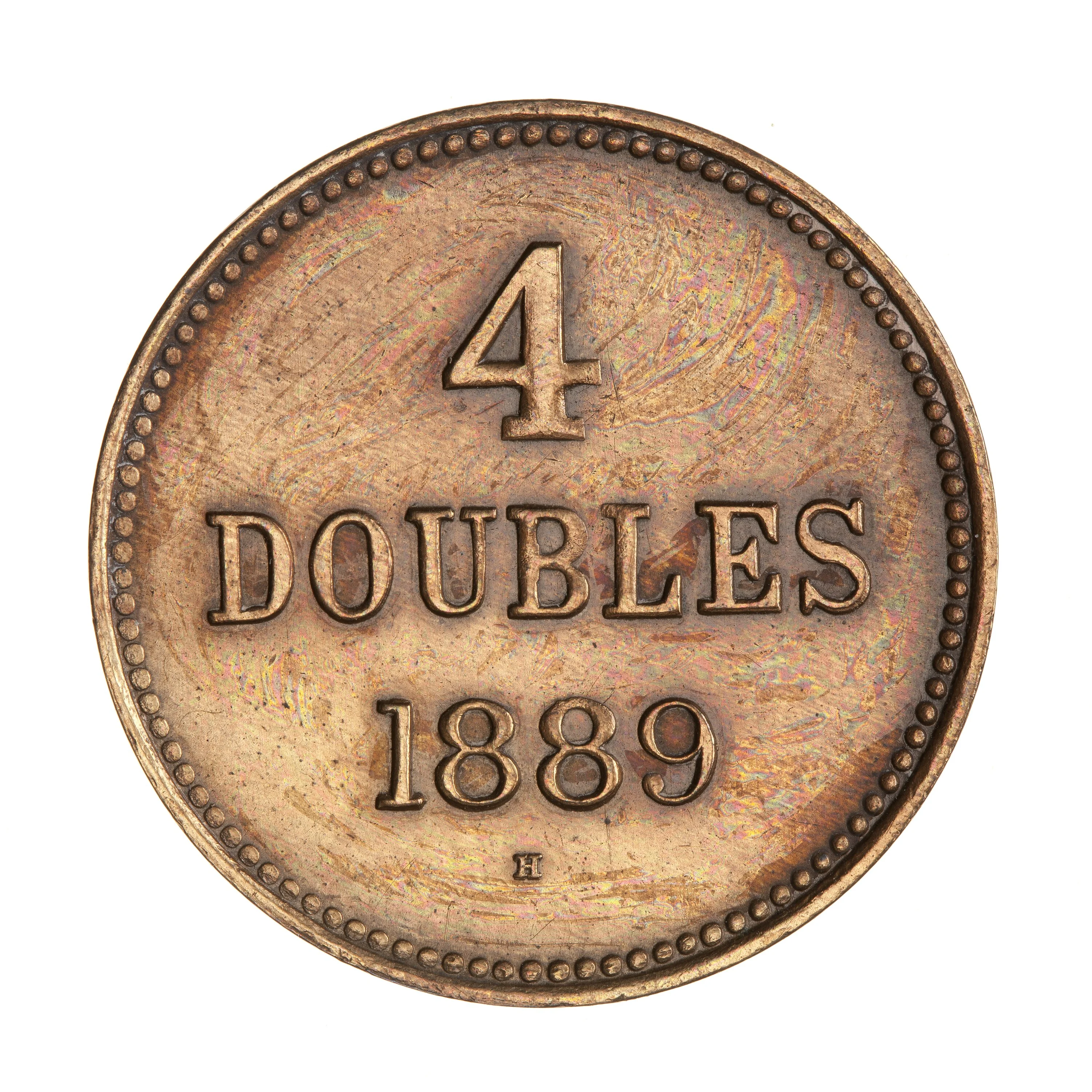
4 Doubles – Guernsey
Context
Years: 1864–1911
Country: British Crown dependencies
Issuer: Guernsey
Ruler: Edward VII
Currency:
(1808—1971)
Demonetized: Yes
Total mintage: 835,000
Material
References
KM: #Click to copy to clipboard5
Numista: #8682
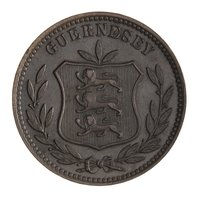
Obverse
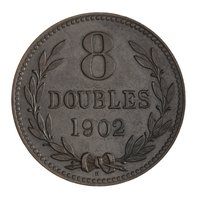
Reverse
Edge
Plain
Mints
| Name | Mark |
|---|---|
| Heaton and Sons / The Mint Birmingham | H |
Mintings
Historical background
In 1864, Guernsey's currency situation was a complex and locally managed system, distinct from the mainland United Kingdom. The island operated on a dual-currency basis, where British sterling coins circulated alongside an issue of local paper notes. These notes, first introduced in the 1820s to fund public works, were not legal tender in Britain but were fully accepted on the island. They were essentially interest-free loans from the public to the States of Guernsey, backed not by gold but by the credibility of the state treasury, and were crucial for local infrastructure projects.
This system arose from necessity. Following the Napoleonic Wars, a shortage of specie (coin) crippled the island's economy. The States' innovative response—issuing its own paper currency to fund essential projects like sea walls and markets—proved highly successful. By 1864, this practice was well-established, with the local notes facilitating everyday commerce and representing a remarkable example of community-financed development. The island's trading links with France also meant that French gold coins, such as the Napoleon, were commonly used for larger transactions, adding a third element to the monetary environment.
Consequently, in the mid-19th century, Guernsey presented a unique monetary landscape. While formally part of the British monetary area, the island effectively self-regulated its currency through the disciplined issuance of its own notes, which coexisted with British copper, silver, and gold coinage, as well as French gold. This arrangement demonstrated a high degree of practical autonomy and financial pragmatism, allowing Guernsey to maintain economic stability and fund its progress independently, long before the concept of local currency regained popularity in modern times.
This system arose from necessity. Following the Napoleonic Wars, a shortage of specie (coin) crippled the island's economy. The States' innovative response—issuing its own paper currency to fund essential projects like sea walls and markets—proved highly successful. By 1864, this practice was well-established, with the local notes facilitating everyday commerce and representing a remarkable example of community-financed development. The island's trading links with France also meant that French gold coins, such as the Napoleon, were commonly used for larger transactions, adding a third element to the monetary environment.
Consequently, in the mid-19th century, Guernsey presented a unique monetary landscape. While formally part of the British monetary area, the island effectively self-regulated its currency through the disciplined issuance of its own notes, which coexisted with British copper, silver, and gold coinage, as well as French gold. This arrangement demonstrated a high degree of practical autonomy and financial pragmatism, allowing Guernsey to maintain economic stability and fund its progress independently, long before the concept of local currency regained popularity in modern times.
🌱 Common