

1 Peso (UNICEF) – Argentina
Circulating commemorative coins
Commemoration: 50th Anniversary of UNICEF
Argentina
Context
Material
References
KM: #Click to copy to clipboard120
Numista: #8597
Value
Exchange value: 1 ARS
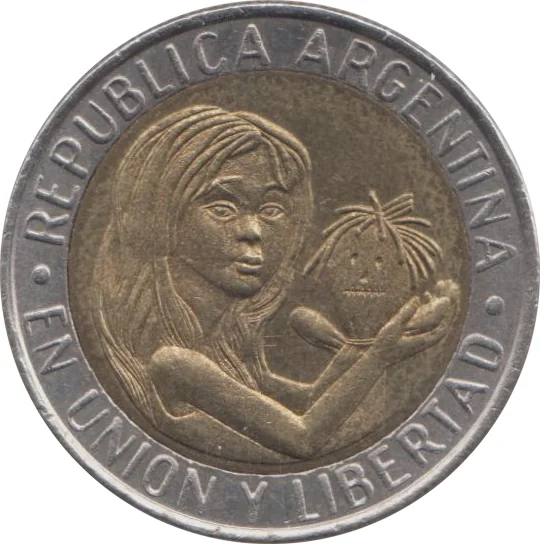
Obverse
Description:
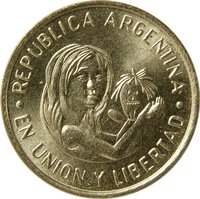
Girl holding rag doll
Inscription:
REPUBLICA ARGENTINA
·EN UNION Y LIBERTAD·
·EN UNION Y LIBERTAD·
Translation:
REPUBLIC OF ARGENTINA
·IN UNION AND LIBERTY·
·IN UNION AND LIBERTY·
Script: Latin
Language: Spanish
Engraver: Carlos Pedro Rodríguez Dufour
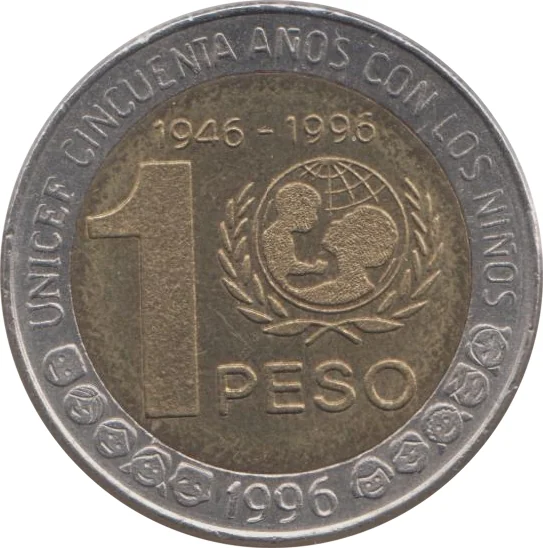
Reverse
Description:
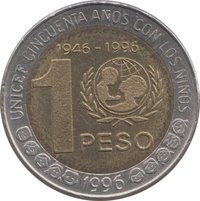
UNICEF logo above value.
Inscription:
UNICEF CINCUENTA AÑOS CON LOS NIÑOS
1946-1996
1 PESO
1996
1946-1996
1 PESO
1996
Translation:
UNICEF FIFTY YEARS WITH THE CHILDREN
1946-1996
1 PESO
1996
1946-1996
1 PESO
1996
Script: Latin
Language: Spanish
Engraver: Carlos Pedro Rodríguez Dufour
Edge
Reeded
Categories
| Organization> UNICEF |
| Symbol> Wreath |
Mints
| Name | Mark |
|---|---|
| Buenos Aires | — |
Mintings
| Year | Mint Mark | Mintage | Quality | Collection |
|---|---|---|---|---|
| 1996 | — | 1,000,000 |
Historical background
In 1996, Argentina was in the midst of the "Convertibility Plan," a monetary regime established in 1991 to end hyperinflation. Under this plan, the Argentine peso was legally fixed at a one-to-one parity with the U.S. dollar, and the Central Bank was required to hold dollar reserves to back the entire monetary base. This radical policy, engineered by Economy Minister Domingo Cavallo, successfully tamed inflation, which plummeted from over 2,000% annually to single digits, restoring price stability and fostering a period of significant economic growth and foreign investment in the early 1990s.
However, by 1996, the first significant cracks in the system were becoming apparent. The fixed exchange rate made Argentine exports increasingly uncompetitive as the U.S. dollar appreciated globally, while Brazil's 1994 "Plano Real" and subsequent devaluation further eroded Argentina's trade position. The economy entered a recession in 1995 following the "Tequilazo" crisis, and while a recovery was underway in 1996, it was fragile and dependent on capital inflows. The rigidity of the currency board prevented the use of monetary policy or exchange rate adjustments to stimulate the economy, locking the country into a high-cost structure.
Consequently, Argentina's fiscal health began to deteriorate. Persistent government deficits were financed by borrowing, leading to a rapid accumulation of public debt, much of it denominated in dollars. The combination of a rigid currency peg, loss of competitiveness, and growing debt burden created a vulnerable and inflexible economic model. While 1996 was not a year of acute crisis, it represented a precarious midpoint—the initial success of convertibility was fading, and the structural imbalances that would culminate in the catastrophic economic collapse of 2001-2002 were steadily deepening.
However, by 1996, the first significant cracks in the system were becoming apparent. The fixed exchange rate made Argentine exports increasingly uncompetitive as the U.S. dollar appreciated globally, while Brazil's 1994 "Plano Real" and subsequent devaluation further eroded Argentina's trade position. The economy entered a recession in 1995 following the "Tequilazo" crisis, and while a recovery was underway in 1996, it was fragile and dependent on capital inflows. The rigidity of the currency board prevented the use of monetary policy or exchange rate adjustments to stimulate the economy, locking the country into a high-cost structure.
Consequently, Argentina's fiscal health began to deteriorate. Persistent government deficits were financed by borrowing, leading to a rapid accumulation of public debt, much of it denominated in dollars. The combination of a rigid currency peg, loss of competitiveness, and growing debt burden created a vulnerable and inflexible economic model. While 1996 was not a year of acute crisis, it represented a precarious midpoint—the initial success of convertibility was fading, and the structural imbalances that would culminate in the catastrophic economic collapse of 2001-2002 were steadily deepening.
🌱 Common