

50 centavos (Women's Right to Vote) – Argentina
Add to wishlist
Circulating commemorative coins
Commemoration: 50th Anniversary of Women's Right to Vote
Argentina
Context
Material
Diameter: 25.2 mm
Weight: 5.8 g
Thickness: 1.8 mm
Shape: Round
Composition: Aluminium bronze
Magnetic: No
Technique: Milled
Alignment: Medal alignment
flip
References
KM: #
Numista: #8596
Value
Exchange value: 0.50 ARS
Obverse
Description:
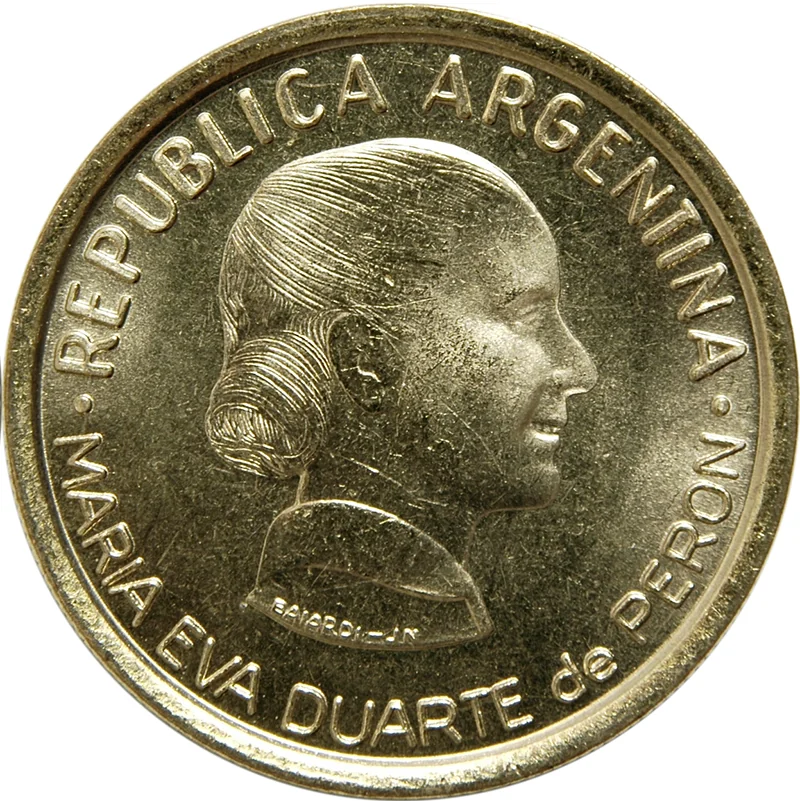
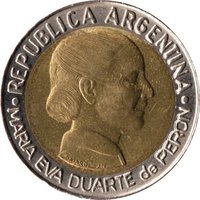
Portrait of Eva Perón.
Inscription:
REPUBLICA ARGENTINA .
MARIA EVA DUARTE de PERON .
MARIA EVA DUARTE de PERON .
Translation:
Argentine Republic
Maria Eva Duarte de Peron
Maria Eva Duarte de Peron
Script: Latin
Engraver: Mario Baiardi
Reverse
Description:
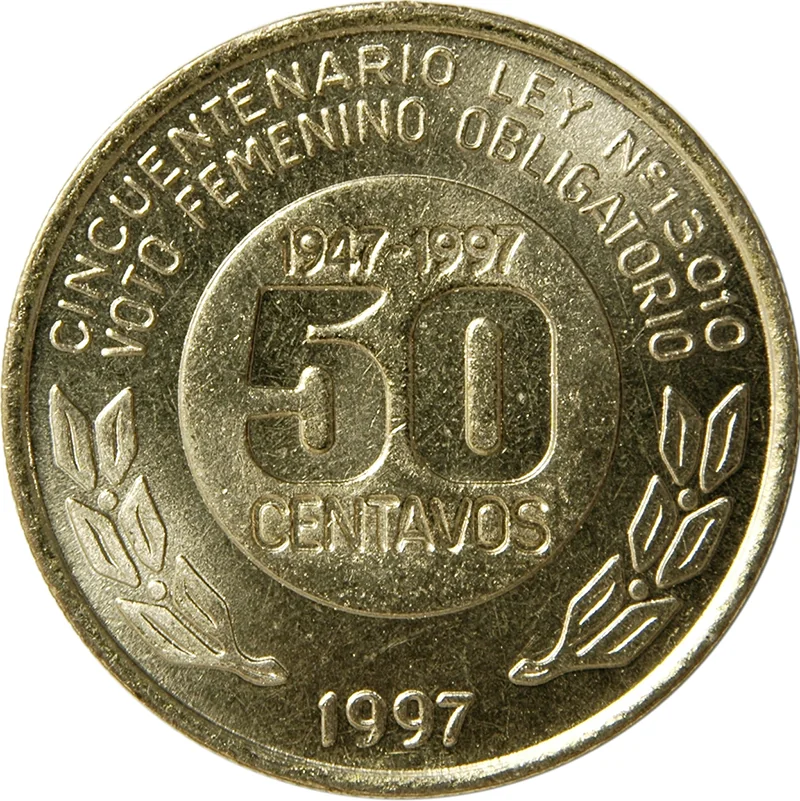
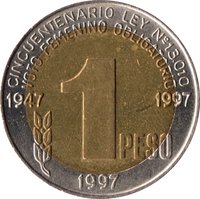
Value & Wreath
Inscription:
CINCUENTENARIO LEY N° 13.010
VOTO FEMENINO OBLIGATORIO
1947-1997
50
CENTAVOS
1997
VOTO FEMENINO OBLIGATORIO
1947-1997
50
CENTAVOS
1997
Script: Latin
Engraver: Carlos Pedro Rodríguez Dufour
Edge
Reeded.
Categories
| Person> Politician |
| History> Feminism |
Mintings
| Year | Mint Mark | Mintage | Quality | Collection |
|---|---|---|---|---|
| 1997 | — | 2,000,000 |
Historical background
In 1997, Argentina was in the final phase of its celebrated but increasingly fragile Convertibility Plan, established in 1991 to end hyperinflation. This system legally pegged the Argentine peso to the US dollar at a one-to-one parity and required the central bank to hold sufficient foreign reserves to back the entire monetary base. Initially, it delivered remarkable stability, tamed inflation, and restored confidence, leading to a wave of foreign investment and strong economic growth in the early 1990s.
However, by 1997, underlying vulnerabilities were becoming acute. The rigid dollar peg made Argentine exports increasingly uncompetitive, especially after the Brazilian devaluation and amidst a strong US dollar. This led to a chronic and growing trade deficit. Furthermore, the economy was burdened by high levels of public spending and external debt, which were sustained by privatizations and capital inflows. The system's success now depended entirely on perpetual market confidence and the ability to attract foreign capital to finance the imbalances.
While the immediate crisis was still a few years away, 1997 represented a precarious calm before the storm. The Asian financial crisis later that year began to trigger global risk aversion, exposing Argentina's dependence on volatile capital flows. Economists and investors started to question the long-term sustainability of the currency board, as the peso was seen as significantly overvalued, but any move to abandon the peg was considered politically unthinkable due to its symbolic association with stability. The stage was being set for the severe recession and eventual economic collapse that would unfold between 1998 and 2002.
However, by 1997, underlying vulnerabilities were becoming acute. The rigid dollar peg made Argentine exports increasingly uncompetitive, especially after the Brazilian devaluation and amidst a strong US dollar. This led to a chronic and growing trade deficit. Furthermore, the economy was burdened by high levels of public spending and external debt, which were sustained by privatizations and capital inflows. The system's success now depended entirely on perpetual market confidence and the ability to attract foreign capital to finance the imbalances.
While the immediate crisis was still a few years away, 1997 represented a precarious calm before the storm. The Asian financial crisis later that year began to trigger global risk aversion, exposing Argentina's dependence on volatile capital flows. Economists and investors started to question the long-term sustainability of the currency board, as the peso was seen as significantly overvalued, but any move to abandon the peg was considered politically unthinkable due to its symbolic association with stability. The stage was being set for the severe recession and eventual economic collapse that would unfold between 1998 and 2002.
🌱 Common