

25 real cents – Spain
Add to wishlist
Spain
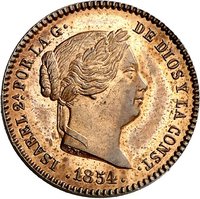
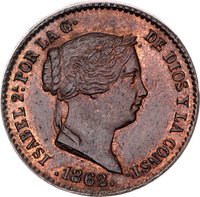
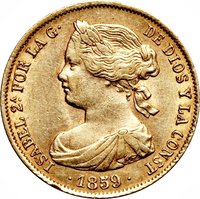
Obverse
Description:
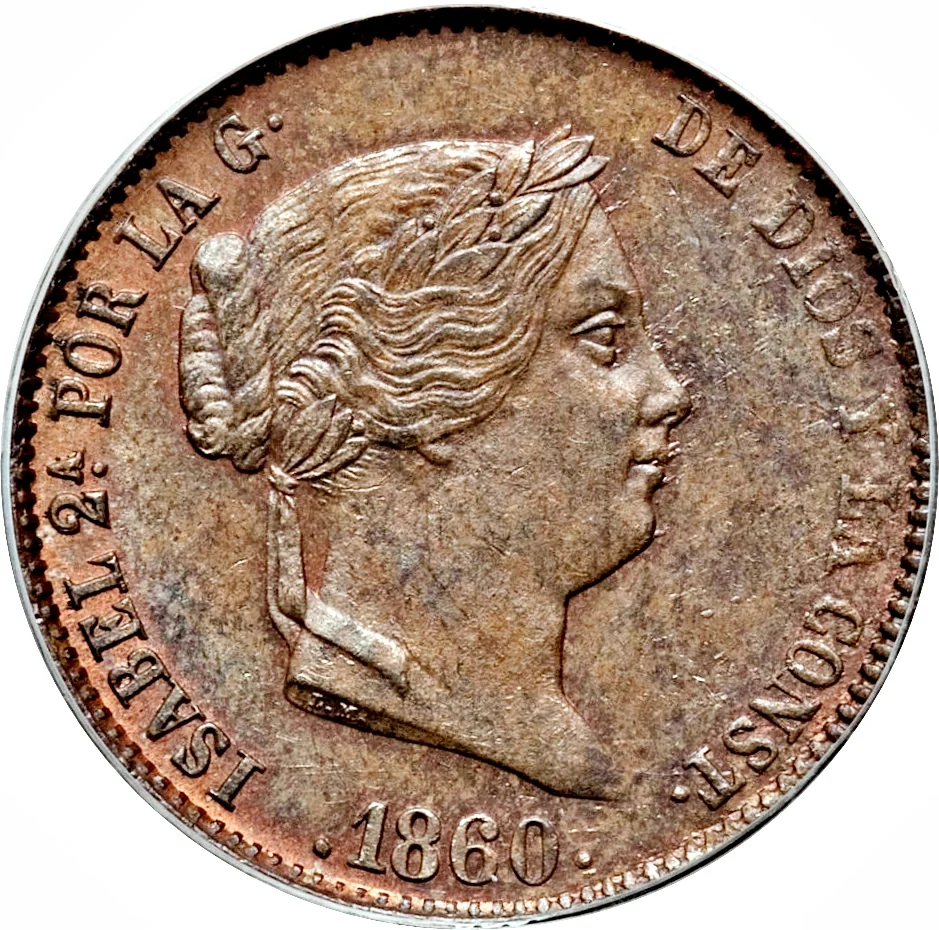
Queen Isabella II facing right.
Inscription:
ISABEL 2A. POR LA G· DE DIOS Y LA CONST·
.1860.
.1860.
Translation:
ISABELLA 2ND. BY THE GRACE OF GOD AND THE CONSTITUTION.
.1860.
.1860.
Script: Latin
Language: Spanish
Engraver: Luis Marchionni y Hombrón
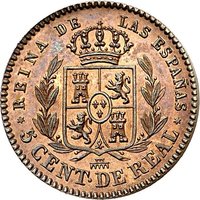
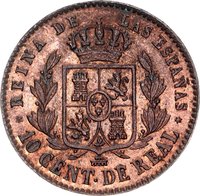
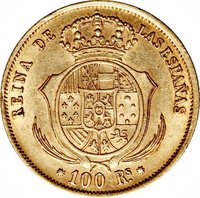
Reverse
Description:
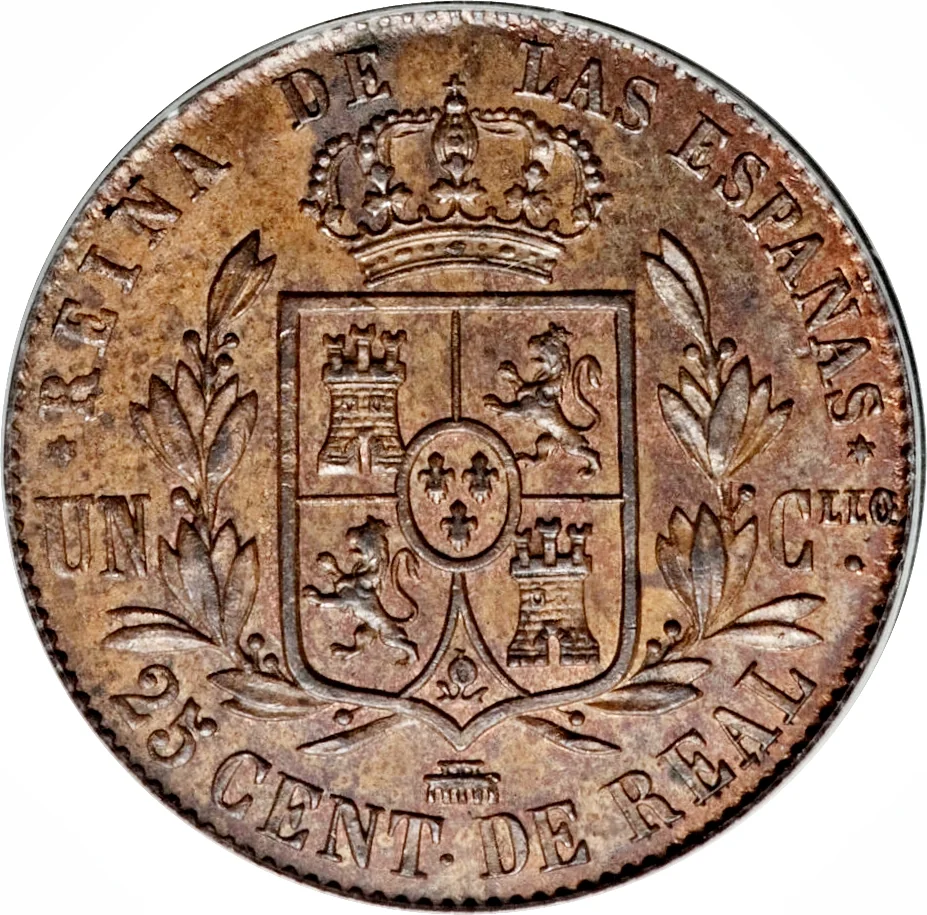
Spanish coat of arms crowned and wreathed.
Inscription:
REINA DE LAS ESPAÑAS
UN C.LLO
* 25 CENT· DE REAL *
UN C.LLO
* 25 CENT· DE REAL *
Translation:
Queen of the Spains
A C.LLO
* 25 Cents of a Real *
A C.LLO
* 25 Cents of a Real *
Script: Latin
Language: Spanish
Engraver: Luis Marchionni y Hombrón
Edge
Plain
Mints
| Name | Mark |
|---|---|
| Royal Mint of Segovia | — |
| Barcelona Mint / La Seca | (BA) |
Mintings
| Year | Mint Mark | Mintage | Quality | Collection |
|---|---|---|---|---|
| 1854 | — | — | ||
| 1855 | — | — | ||
| 1856 | — | — | ||
| 1857 | — | — | ||
| 1858 | — | — | ||
| 1859 | — | — | ||
| 1860 | — | — | ||
| 1861 | — | — | ||
| 1862 | — | — | ||
| 1863 | BA | — | ||
| 1863 | — | — | ||
| 1864 | — | — | ||
| 1864 | BA | — |
Historical background
In 1854, Spain's currency situation was characterized by profound instability and fragmentation, a legacy of the political and economic turmoil of the early 19th century. The nation operated on a bimetallic system in theory, but in practice, it suffered from a chaotic mix of coins. Circulating alongside official gold escudos and silver reales de vellón were a vast array of debased and worn older coins, as well as a multitude of foreign currencies, particularly French francs, which filled the void left by a chronic shortage of domestic specie. This monetary anarchy stifled commerce, created confusion in everyday transactions, and reflected the weak authority of the central state.
The financial strain of the Carlist Wars and ongoing political instability had led successive governments to repeatedly devalue the currency and resort to seigniorage. The primary unit, the real de vellón, had lost substantial value, and public trust in the coinage was low. Furthermore, the banking system was underdeveloped, with paper money issued by private banks like the Banco de San Fernando (soon to be the Banco de España in 1856) not yet widely accepted or trusted by the general populace, who preferred tangible, though often unreliable, metal.
This chaotic backdrop set the stage for significant monetary reforms later in the decade. The political revolution of 1854, which brought the Progresistas to power, initiated a period of economic liberalism. One of its key objectives was to modernize the financial system, culminating in the Law of 1856 that chartered the Banco de España and laid the groundwork for the eventual introduction of a unified national currency, the peseta, in 1868. Thus, the currency situation of 1854 represents the final, disordered chapter before a concerted push toward standardization and modernization.
The financial strain of the Carlist Wars and ongoing political instability had led successive governments to repeatedly devalue the currency and resort to seigniorage. The primary unit, the real de vellón, had lost substantial value, and public trust in the coinage was low. Furthermore, the banking system was underdeveloped, with paper money issued by private banks like the Banco de San Fernando (soon to be the Banco de España in 1856) not yet widely accepted or trusted by the general populace, who preferred tangible, though often unreliable, metal.
This chaotic backdrop set the stage for significant monetary reforms later in the decade. The political revolution of 1854, which brought the Progresistas to power, initiated a period of economic liberalism. One of its key objectives was to modernize the financial system, culminating in the Law of 1856 that chartered the Banco de España and laid the groundwork for the eventual introduction of a unified national currency, the peseta, in 1868. Thus, the currency situation of 1854 represents the final, disordered chapter before a concerted push toward standardization and modernization.
Series: 1854 Spain circulation coins
🌱 Common