

1 Qirsh – Mahdist State
Sudan

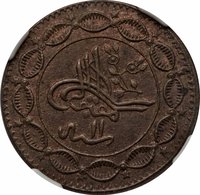
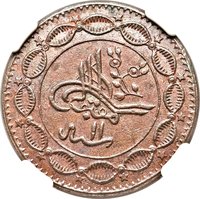
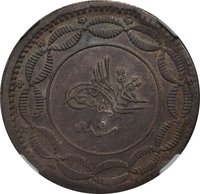
Obverse
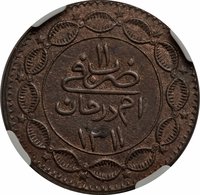
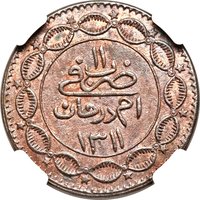
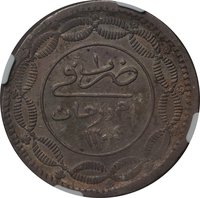
Reverse
Edge
Mints
| Name | Mark |
|---|---|
| Omdurman | — |
Mintings
| Year | Mint Mark | Mintage | Quality | Collection |
|---|---|---|---|---|
| 1887 | — | — | ||
| 1894 | — | — |
Historical background
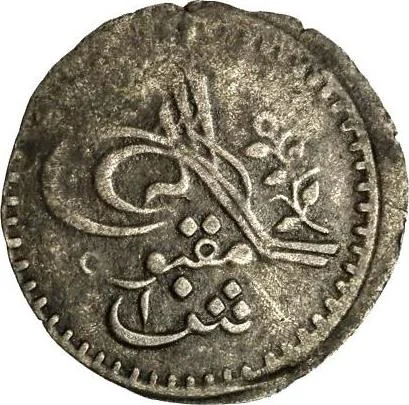
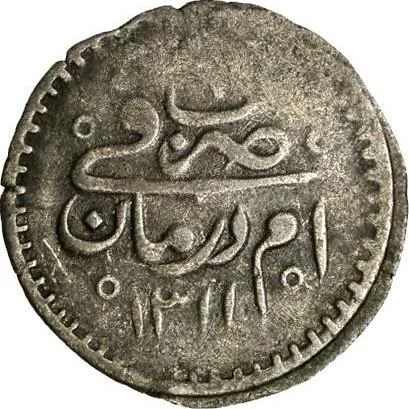
The Mahdist State in 1887 faced a severe and multifaceted currency crisis that fundamentally undermined its economy and governance. Having seized power from the Turco-Egyptian administration, the Mahdists inherited a depleted treasury and immediately rejected the use of Egyptian currency, which they associated with the former regime. This created a vacuum, as the state lacked the technical capacity, precious metals, and minting expertise to produce a reliable new coinage in sufficient volume. While some gold and silver coins were struck in Omdurman, their quality was poor, they were easily counterfeited, and their circulation was extremely limited, failing to meet the needs of a functioning state.
Consequently, the economy regressed to a chaotic system of barter and multiple, unstable currency forms. The most common medium became the despised "fulūs sūdā" (black copper coins), low-value tokens imported by foreign traders that were easily debased. Older Egyptian and Ottoman coins, Spanish silver dollars, and even Maria Theresa thalers circulated at fluctuating, arbitrary values set by market traders rather than state authority. This monetary anarchy stifered trade, crippled tax collection (as the state demanded payments in specific, scarce coins), and caused rampant inflation, particularly for imported goods like cloth and weapons.
The crisis was both a cause and a symptom of the state's broader isolation and ideological rigidity. The Mahdist leadership's focus on military jihad and religious purity came at the expense of sound economic administration. The inability to establish a trusted currency eroded public confidence, hampered the provisioning of armies and cities, and fostered a thriving black market. By 1887, the monetary chaos was a critical weakness, demonstrating that the Mahdist State, despite its military successes, lacked the bureaucratic and economic foundations for long-term stability, making it increasingly vulnerable to internal stress and external pressure.
Consequently, the economy regressed to a chaotic system of barter and multiple, unstable currency forms. The most common medium became the despised "fulūs sūdā" (black copper coins), low-value tokens imported by foreign traders that were easily debased. Older Egyptian and Ottoman coins, Spanish silver dollars, and even Maria Theresa thalers circulated at fluctuating, arbitrary values set by market traders rather than state authority. This monetary anarchy stifered trade, crippled tax collection (as the state demanded payments in specific, scarce coins), and caused rampant inflation, particularly for imported goods like cloth and weapons.
The crisis was both a cause and a symptom of the state's broader isolation and ideological rigidity. The Mahdist leadership's focus on military jihad and religious purity came at the expense of sound economic administration. The inability to establish a trusted currency eroded public confidence, hampered the provisioning of armies and cities, and fostered a thriving black market. By 1887, the monetary chaos was a critical weakness, demonstrating that the Mahdist State, despite its military successes, lacked the bureaucratic and economic foundations for long-term stability, making it increasingly vulnerable to internal stress and external pressure.
✨ Legendary