

Obverse
Description:
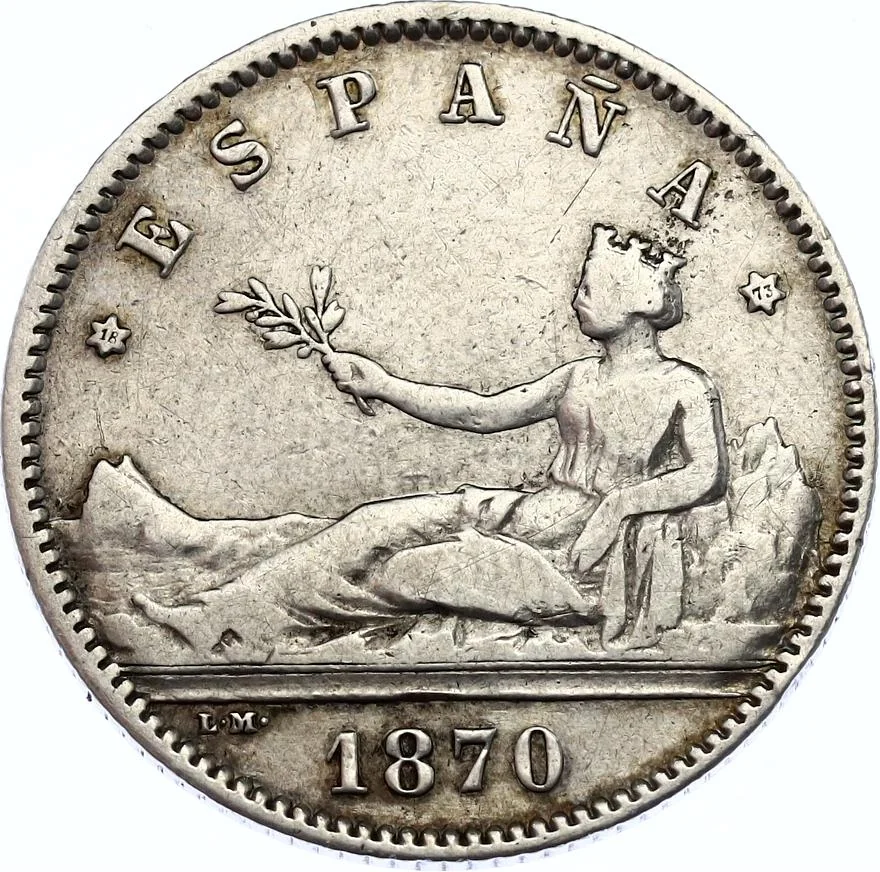
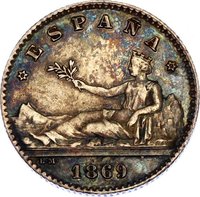
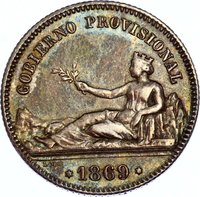
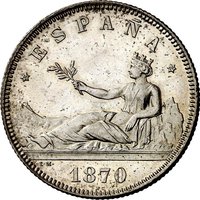
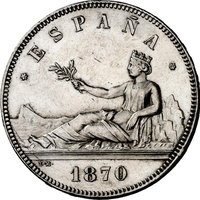
Hispania crowned, reclining against the Pyrenees, olive branch in hand, Gibraltar at her feet.
Inscription:
🟌 ESPAÑA 🟌
L· M·
1870
L· M·
1870
Translation:
Spain
L. M.
1870
L. M.
1870
Script: Latin
Engraver: Luis Marchionni y Hombrón
Reverse
Description:
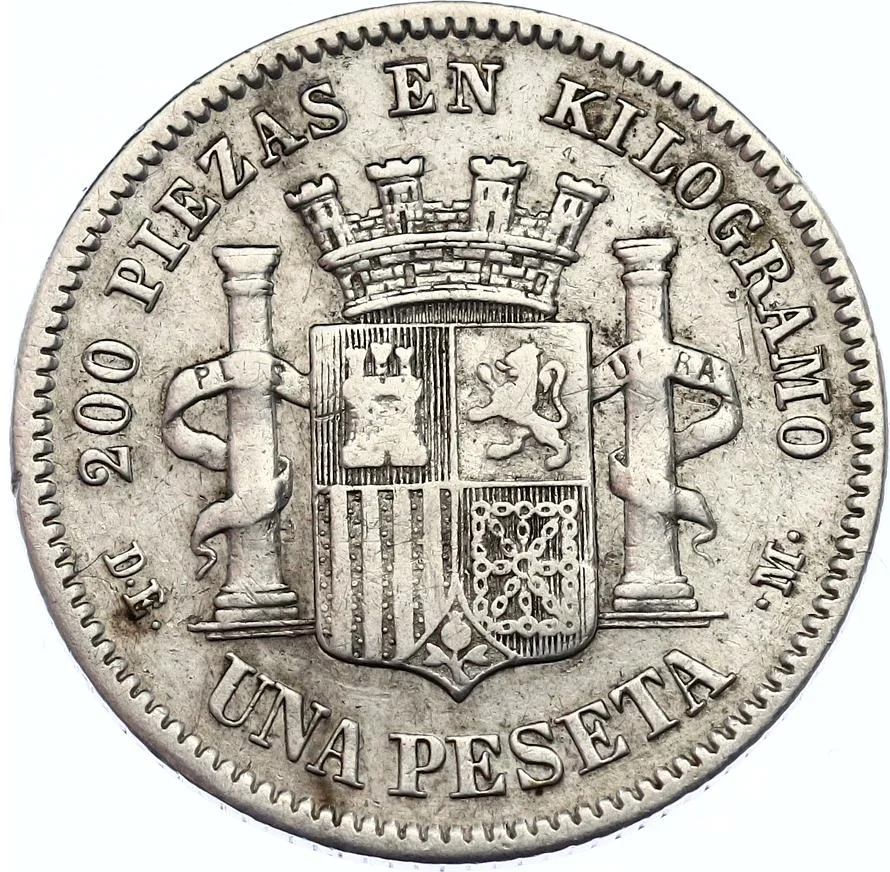
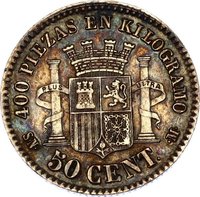
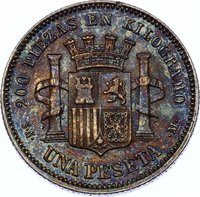
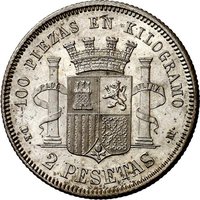
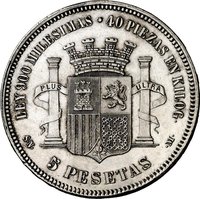
Spanish coat of arms with the Pillars of Hercules.
Inscription:
200 PIEZAS EN KILOGRAMO
PLUS ULTRA
S·N· UNA PESETA ·M·
PLUS ULTRA
S·N· UNA PESETA ·M·
Translation:
200 Pieces in a Kilogram
Further Beyond
S N One Peseta M
Further Beyond
S N One Peseta M
Script: Latin
Engraver: Luis Marchionni y Hombrón
Edge
Reeded
Categories
| Symbol> Allegory |
| Symbols> Coat of Arms |
Mints
| Name | Mark |
|---|---|
| Royal Mint of Madrid | (🟌) |
Mintings
| Year | Mint Mark | Mintage | Quality | Collection |
|---|---|---|---|---|
| 1869 | 🟌 | 367,000 | ||
| 1870 | 🟌 | 5,164,997 |
Historical background
In 1869, Spain was in a period of significant monetary transition and uncertainty following the Glorious Revolution of 1868, which had deposed Queen Isabella II. The new provisional government, led by progressive and liberal forces, sought to modernize the nation's economy and align it with European standards. A central pillar of this effort was the passage of the Law of the Peseta on October 19, 1868, which officially established the peseta as Spain's sole national currency, replacing the complex and archaic system of reales, escudos, and doubloons that had existed for centuries. The peseta was defined as a unit of the Latin Monetary Union, with a bimetallic standard equivalent to 4.5 grams of silver or 0.290322 grams of gold.
However, the practical currency situation on the ground in 1869 was one of duality and adjustment. While the new silver peseta coins began to be minted and circulated, the old coinage remained in widespread use, leading to a parallel circulation that caused confusion in commerce. Furthermore, the government's urgent need to finance itself resulted in the issuance of substantial amounts of paper money, known as "billetes de curso forzoso" (forced legal tender notes). These were not convertible to precious metal, leading to a de facto separation between the metallic peseta defined by law and the depreciating paper peseta used in daily transactions.
Thus, the currency landscape of 1869 was characterized by this tension between reform and instability. The government had successfully laid the legal foundation for a modern, decimal, and unified monetary system with the peseta, aiming for economic integration and stability. Yet, in the short term, the coexistence of old and new coins, coupled with inflationary paper money, created a fragmented and challenging financial environment that reflected the broader political and economic upheavals of the period.
However, the practical currency situation on the ground in 1869 was one of duality and adjustment. While the new silver peseta coins began to be minted and circulated, the old coinage remained in widespread use, leading to a parallel circulation that caused confusion in commerce. Furthermore, the government's urgent need to finance itself resulted in the issuance of substantial amounts of paper money, known as "billetes de curso forzoso" (forced legal tender notes). These were not convertible to precious metal, leading to a de facto separation between the metallic peseta defined by law and the depreciating paper peseta used in daily transactions.
Thus, the currency landscape of 1869 was characterized by this tension between reform and instability. The government had successfully laid the legal foundation for a modern, decimal, and unified monetary system with the peseta, aiming for economic integration and stability. Yet, in the short term, the coexistence of old and new coins, coupled with inflationary paper money, created a fragmented and challenging financial environment that reflected the broader political and economic upheavals of the period.
Series: 1869 Spain circulation coins
🌱 Common