

100 Francs (Germinal by Emile Zola) – France
Non-circulating coins
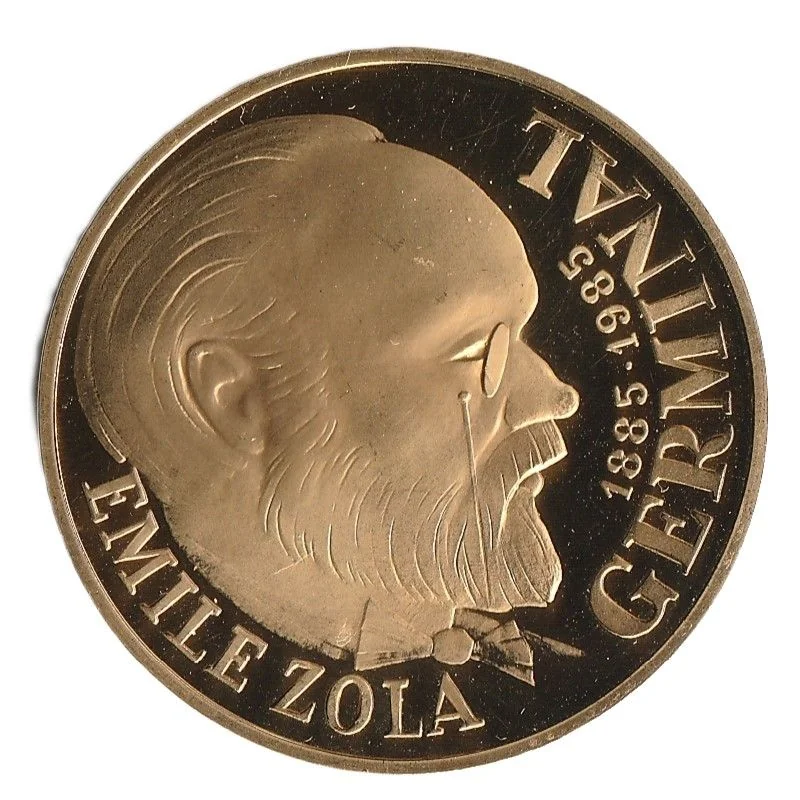
Commemoration: Centenary of the novel Germinal by Emile Zola (1885-1985).
Series: 100 Francs Émile Zola
France
Obverse
Description:
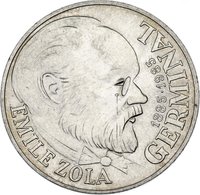
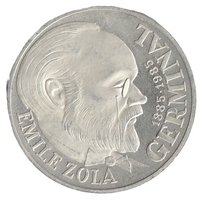
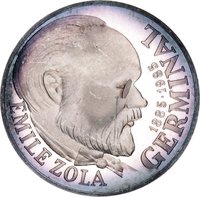
Zola's profile over his name, with "GERMINAL 1885 - 1985."
Inscription:
1885-1985
EMILE ZOLA GERMINAL
EMILE ZOLA GERMINAL
Translation:
EMILE ZOLA GERMINAL
Script: Latin
Language: French
Engravers: Atelier de Gravure (A.G.M.M.), Jean-Luc Coppin
Designer: Alain Le Breton
Reverse
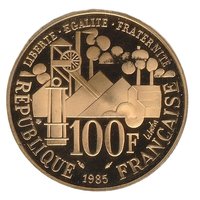
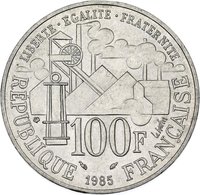
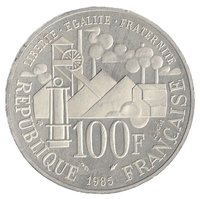
Description:
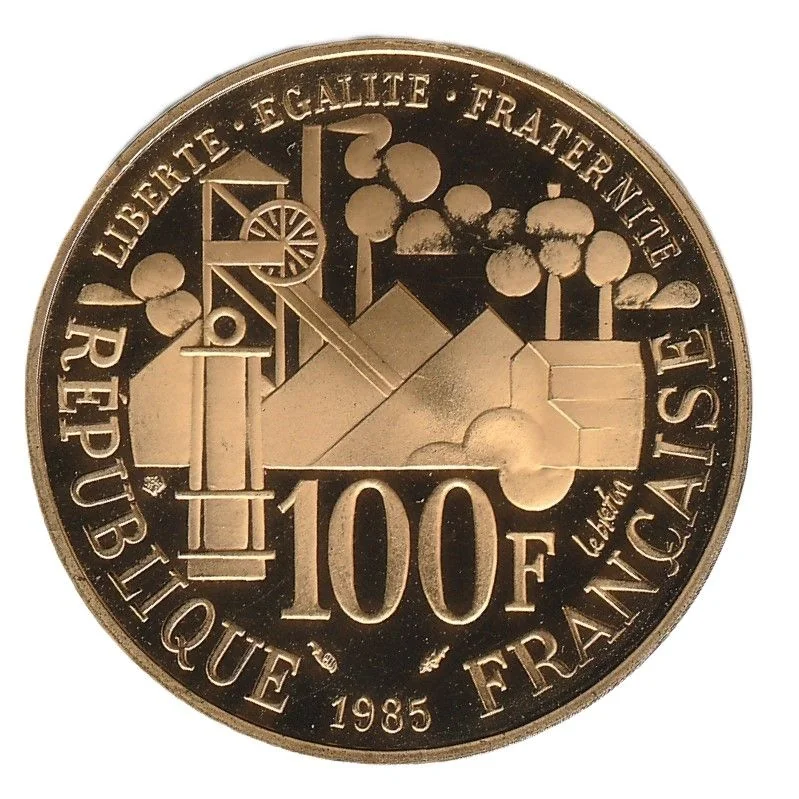
Go right
Inscription:
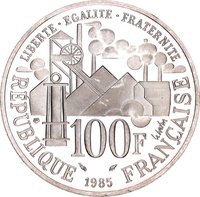
LIBERTE · EGALITE · FRATERNITE
100F
le breton
RÉPUBLIQUE 1985 FRANÇAISE
100F
le breton
RÉPUBLIQUE 1985 FRANÇAISE
Translation:
LIBERTY · EQUALITY · FRATERNITY
100F
the breton
FRENCH REPUBLIC 1985
100F
the breton
FRENCH REPUBLIC 1985
Script: Latin
Language: French
Engravers: Jean-Luc Maréchal, Atelier de Gravure (A.G.M.M.)
Designer: Alain Le Breton
Edge
Plain
Categories
| Art> Literature |
Mints
| Name | Mark |
|---|---|
| Monnaie de Paris | — |
Mintings
| Year | Mint Mark | Mintage | Quality | Collection |
|---|---|---|---|---|
| 1985 | — | 5,000 | Proof |
Historical background
In 1985, France's currency situation was defined by its pivotal role within the European Monetary System (EMS), established in 1979. The French franc was part of the Exchange Rate Mechanism (ERM), which aimed to reduce exchange rate variability and achieve monetary stability in Europe by pegging currencies within agreed fluctuation bands. This period was characterized by the "franc fort" (strong franc) policy, a deliberate strategy by the Socialist government of President François Mitterrand and Prime Minister Laurent Fabius to maintain a high parity with the Deutsche Mark. This policy marked a significant U-turn from the expansionist policies of the early 1980s, prioritizing anti-inflationary discipline and alignment with West Germany's Bundesbank to anchor credibility.
Domestically, this commitment came at a cost. Maintaining the franc's position within the ERM required high interest rates, which constrained economic growth and contributed to persistent unemployment. The strong franc also made French exports more expensive on the international market, hurting industrial competitiveness. However, the government viewed this as a necessary sacrifice to break the cycle of devaluation-inflation that had plagued the franc in the 1970s and early 1980s, and to firmly position France as a core architect of European economic integration.
The relative stability of 1985 was, in hindsight, a calm before the storm. The system faced inherent tensions, as the needs of the French economy did not always align with German monetary priorities. These strains would later erupt in the severe ERM crises of 1992-1993, which tested the franc fort policy to its limits. Nevertheless, in 1985, the framework was holding, solidifying France's commitment to a fixed exchange rate regime as the foundation for its European policy and the eventual launch of a single currency.
Domestically, this commitment came at a cost. Maintaining the franc's position within the ERM required high interest rates, which constrained economic growth and contributed to persistent unemployment. The strong franc also made French exports more expensive on the international market, hurting industrial competitiveness. However, the government viewed this as a necessary sacrifice to break the cycle of devaluation-inflation that had plagued the franc in the 1970s and early 1980s, and to firmly position France as a core architect of European economic integration.
The relative stability of 1985 was, in hindsight, a calm before the storm. The system faced inherent tensions, as the needs of the French economy did not always align with German monetary priorities. These strains would later erupt in the severe ERM crises of 1992-1993, which tested the franc fort policy to its limits. Nevertheless, in 1985, the framework was holding, solidifying France's commitment to a fixed exchange rate regime as the foundation for its European policy and the eventual launch of a single currency.
Series: 100 Francs Émile Zola

✨ Legendary