

20 Qirsh – Mahdist State
Sudan
Context
Year: 1898
Islamic (Hijri) Year: 1315
Country: Sudan 
Issuer: Mahdist State
Currency:
(1885—1898)
Demonetized: Yes
References
KM: #Click to copy to clipboard27
Numista: #114503
Obverse
Description:
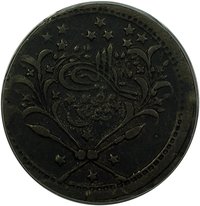
Tughra with maqbul and Arabic SH (value 20 omitted).
Reverse
Description:
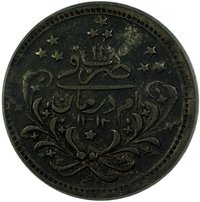
Struck in Omdurman, year 1 (AH 1315), no stars above the date.
Inscription:
١
١٣١٥
١٣١٥
Translation:
AH 1315
Language: Arabic
Edge
Mints
| Name | Mark |
|---|---|
| Omdurman | — |
Mintings
| Year | Mint Mark | Mintage | Quality | Collection |
|---|---|---|---|---|
| 1898 | — | — |
Historical background
By 1898, the Mahdist State in Sudan was in a state of severe economic and monetary crisis, a direct result of its isolation and prolonged warfare. The Khalifa Abdullahi's regime, having cut off most external trade and exhausted the gold and silver reserves captured during the early conquests, struggled to fund its vast military apparatus. The state primarily relied on a debased and heterogeneous currency system. The official coin, the Mahdist Riyal, was a low-quality silver coin minted in Omdurman, but its value and acceptance plummeted due to inconsistent silver content and widespread counterfeiting.
Alongside these official issues, the economy depended on a chaotic mix of older Ottoman and Egyptian coins, Maria Theresa thalers, and most critically, a vast and devalued paper money known as the jihadiyya. This promissory note, originally intended to pay soldiers and officials, became utterly discredited due to massive over-issuance without any precious metal backing. By 1898, the jihadiyya was virtually worthless, leading to rampant inflation and a collapse in public confidence. Transactions increasingly reverted to barter, with staples like grain and cloth becoming common mediums of exchange, especially outside the capital.
This monetary collapse was both a symptom and a cause of the state's fragility on the eve of its destruction. The inability to pay soldiers reliably eroded army morale, while the economic hardship fueled discontent among the civilian population. When the Anglo-Egyptian forces under Kitchener advanced in 1898, they encountered an economy already in ruins. The Battle of Omdurman in September 1898 not only ended the Mahdist State politically but also immediately nullified its monetary system, with the victorious Anglo-Egyptian administration swiftly reintroducing Egyptian currency to stabilize the region.
Alongside these official issues, the economy depended on a chaotic mix of older Ottoman and Egyptian coins, Maria Theresa thalers, and most critically, a vast and devalued paper money known as the jihadiyya. This promissory note, originally intended to pay soldiers and officials, became utterly discredited due to massive over-issuance without any precious metal backing. By 1898, the jihadiyya was virtually worthless, leading to rampant inflation and a collapse in public confidence. Transactions increasingly reverted to barter, with staples like grain and cloth becoming common mediums of exchange, especially outside the capital.
This monetary collapse was both a symptom and a cause of the state's fragility on the eve of its destruction. The inability to pay soldiers reliably eroded army morale, while the economic hardship fueled discontent among the civilian population. When the Anglo-Egyptian forces under Kitchener advanced in 1898, they encountered an economy already in ruins. The Battle of Omdurman in September 1898 not only ended the Mahdist State politically but also immediately nullified its monetary system, with the victorious Anglo-Egyptian administration swiftly reintroducing Egyptian currency to stabilize the region.
✨ Legendary