

20 centimes – France
Add to wishlist
France
Context
Years: 1867–1868
Issuer: France
Ruler: Napoleon III
Currency:
(1795—1959)
Demonetization: 22 March 1918
Total mintage: 9,368,721
Material
References
KM: #
Numista: #1145
Value
Bullion value: $2.04
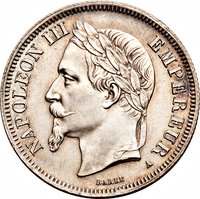
Obverse
Description:
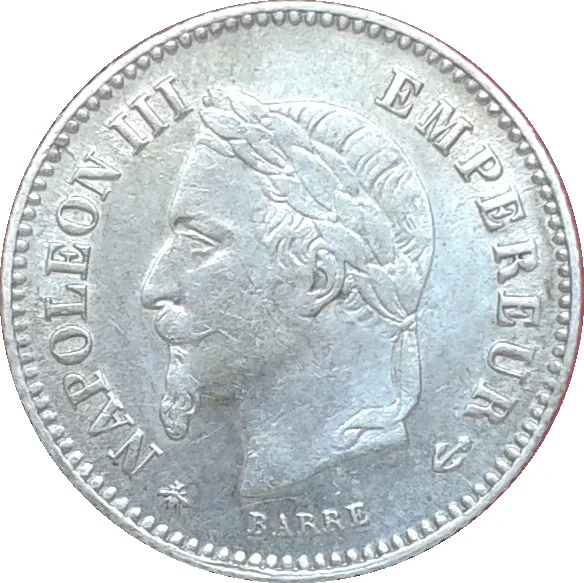
Napoleon III, left-facing bust.
Inscription:
NAPOLEON III EMPEREUR
BARRE
BARRE
Translation:
NAPOLEON III EMPEROR
BARRE
BARRE
Script: Latin
Language: French
Engraver: Désiré-Albert Barre
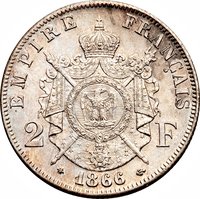
Reverse
Description:
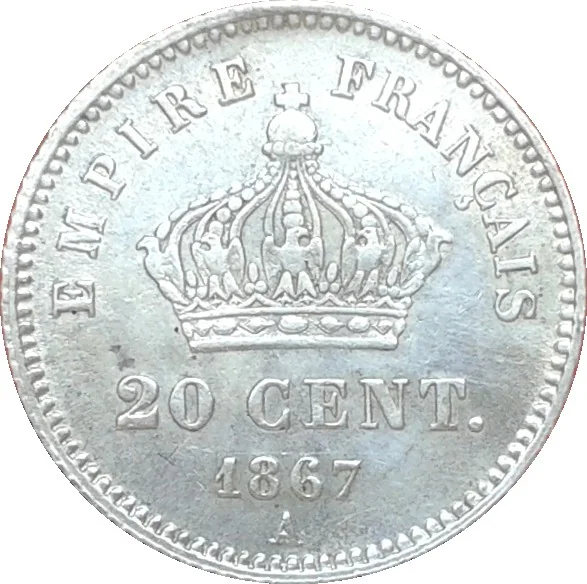
Crown above, value and date below.
Inscription:
EMPIRE FRANÇAIS
20 CENT.
1867
A
20 CENT.
1867
A
Translation:
FRENCH EMPIRE
20 CENTIMES
1867
20 CENTIMES
1867
Script: Latin
Language: French
Engraver: Désiré-Albert Barre
Edge
Reeded
Mints
| Name | Mark |
|---|---|
| Monnaie de Paris | A |
| Strasbourg | BB |
| Bordeaux | K |
Mintings
Historical background
In 1867, France operated under a bimetallic monetary system, established by the Franc Germinal law of 1803. This system fixed the value of the franc to both gold and silver at a legally defined ratio of 1:15.5, meaning one gram of gold was worth 15.5 grams of silver. The franc was a stable and internationally respected currency, facilitating trade and investment. However, this bimetallism was under growing strain due to global shifts in precious metal production, particularly the discovery of vast silver deposits in the Americas, which began to depress the market value of silver relative to the fixed legal ratio.
The core problem was Gresham's Law in action: "bad money drives out good." As the market value of silver fell below its official mint price, people increasingly used silver coins to pay debts while hoarding or exporting more valuable gold coins. This threatened to drain France of its gold reserves, the foundation of its financial strength and larger international transactions. Consequently, France, along with other Latin Monetary Union partners (Belgium, Italy, Switzerland), was forced to limit the minting of silver coins in 1867 to protect its gold stock, effectively moving toward a de facto gold standard despite its official bimetallic laws.
This period placed France at the center of a major international monetary debate. The French government hosted the International Monetary Conference in Paris in 1867, advocating for a universal gold standard to solve the instability of bimetallism. While the conference ultimately failed to establish a global agreement, it highlighted France's pivotal role in European finance and marked a critical transition point. The currency situation of 1867 was thus one of apparent stability masking underlying vulnerability, with France cautiously navigating the end of the bimetallic era and the inexorable shift toward gold.
The core problem was Gresham's Law in action: "bad money drives out good." As the market value of silver fell below its official mint price, people increasingly used silver coins to pay debts while hoarding or exporting more valuable gold coins. This threatened to drain France of its gold reserves, the foundation of its financial strength and larger international transactions. Consequently, France, along with other Latin Monetary Union partners (Belgium, Italy, Switzerland), was forced to limit the minting of silver coins in 1867 to protect its gold stock, effectively moving toward a de facto gold standard despite its official bimetallic laws.
This period placed France at the center of a major international monetary debate. The French government hosted the International Monetary Conference in Paris in 1867, advocating for a universal gold standard to solve the instability of bimetallism. While the conference ultimately failed to establish a global agreement, it highlighted France's pivotal role in European finance and marked a critical transition point. The currency situation of 1867 was thus one of apparent stability masking underlying vulnerability, with France cautiously navigating the end of the bimetallic era and the inexorable shift toward gold.
🌱 Very Common