

1 speciedaler – Denmark
Add to wishlist
Circulating commemorative coins
Commemoration: Death of King Christian VIII and Accession of Frederik VII to the throne of Denmark
Denmark
Context
Year: 1848
Issuer: Denmark
Ruler: Frederick VII
Currency:
(1813—1854)
Demonetized: Yes
Total mintage: 47,000
Material
References
KM: #
Numista: #85013
Value
Bullion value: $73.25
Obverse
Description:
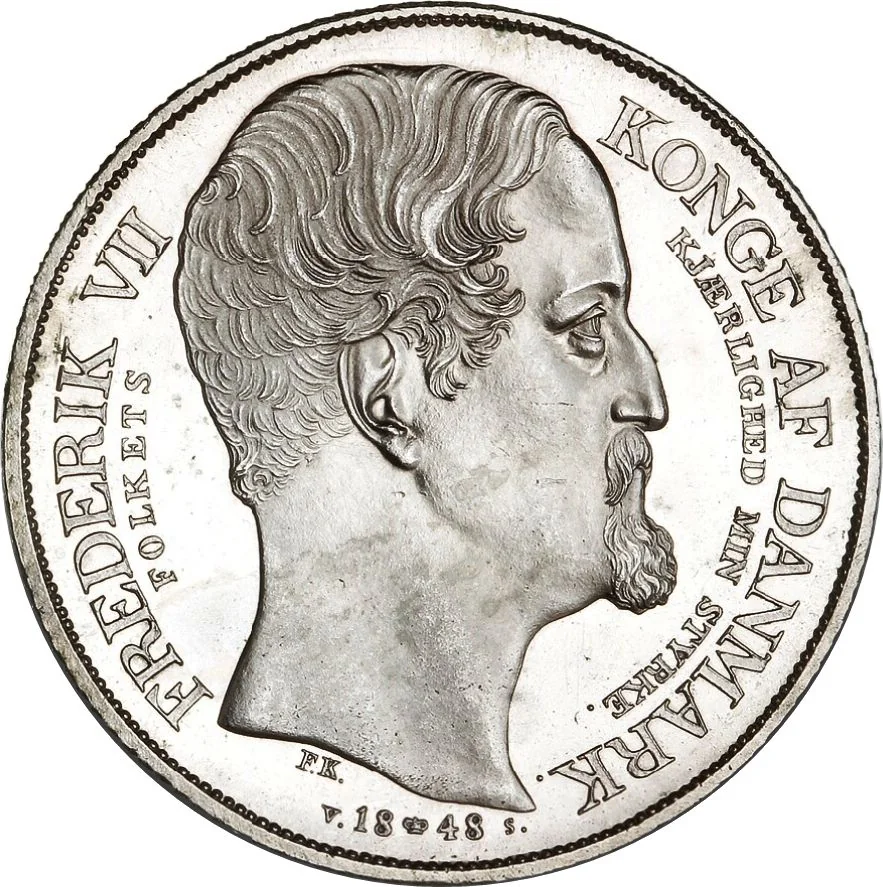
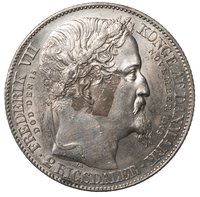
King Frederik VII facing right, with flanking text along the rim. The date below is split by the mintmark, which also separates the Mint Master's initials.
Inscription:
FREDERIK VII | KONGE AF DANMARK
Folkets | kjærlighed min styrke
F.K.
V. 18 ♔ 48 S.
Folkets | kjærlighed min styrke
F.K.
V. 18 ♔ 48 S.
Translation:
FREDERIK VII | KING OF DENMARK
The people's | love my strength
F.K.
V. 18 ♔ 48 S.
The people's | love my strength
F.K.
V. 18 ♔ 48 S.
Script: Latin
Language: Danish
Engraver: Federick Christopher Khorn
Reverse
Description:
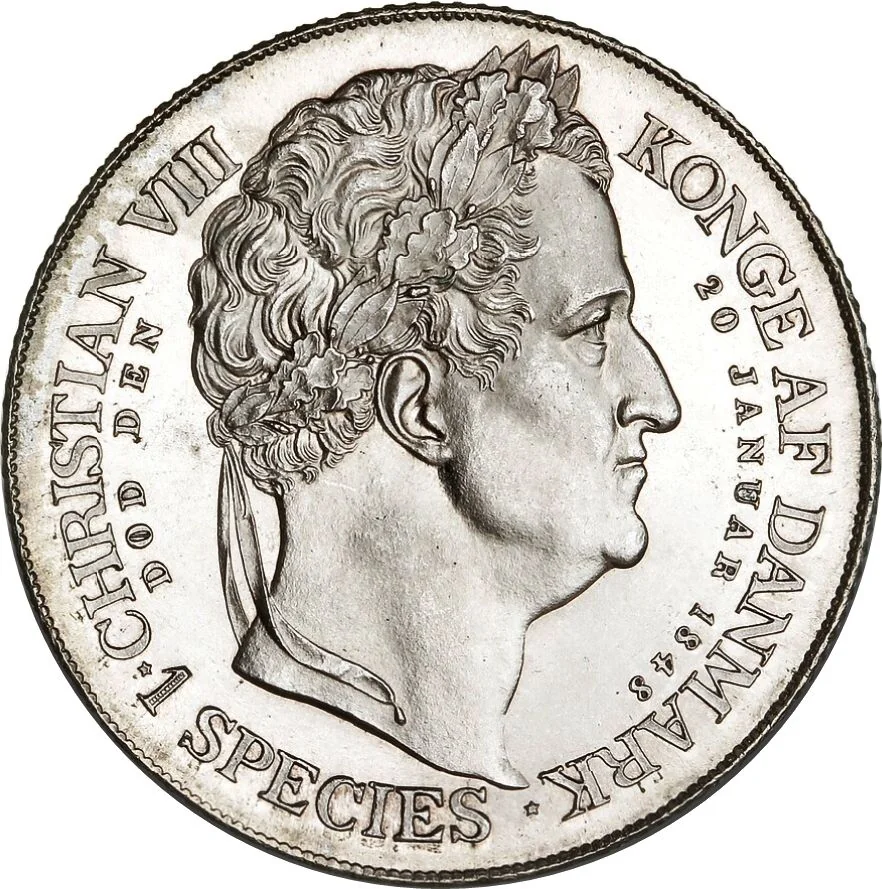
King Christian VIII facing right. Value below. Text along sides.
Inscription:
CHRISTIAN VIII | KONGE AF DANMARK
* 1 SPECIES *
Død den | 20 Januar 1848
* 1 SPECIES *
Død den | 20 Januar 1848
Translation:
CHRISTIAN VIII | KING OF DENMARK
* 1 SPECIES *
Died the | 20 January 1848
* 1 SPECIES *
Died the | 20 January 1848
Script: Latin
Language: Danish
Engraver: Federick Christopher Khorn
Edge
Mints
| Name | Mark |
|---|---|
| Royal Danish Mint | ♔ |
Mintings
| Year | Mint Mark | Mintage | Quality | Collection |
|---|---|---|---|---|
| 1848 | ♔ | 47,000 |
Historical background
In 1848, Denmark's currency system was in a state of transition, caught between old traditions and the pressures of modern finance. The official currency was the rigsdaler (rix-dollar), a silver-based coin that had been the standard for centuries. However, the system was complex and fragmented. The rigsdaler was divided into 96 skilling, and alongside the state-issued coins, there existed a parallel system of "bank money" – paper notes issued by private banks and the state-owned Nationalbanken, founded in 1818. These notes were theoretically convertible to silver, but public trust in paper currency fluctuated, especially in times of crisis.
The year 1848 itself was a moment of profound political and economic upheaval, which directly impacted the currency. Denmark became a constitutional monarchy in June, but was also embroiled in the First Schleswig War (1848-1851) against German-speaking rebels in the duchies of Schleswig and Holstein. The enormous cost of mobilizing and fighting a war placed severe strain on state finances. The government was forced to suspend the silver convertibility of the Nationalbank's notes, effectively placing Denmark on a fiat currency system for the duration of the conflict. This led to inflation and a decline in the value of paper money relative to silver coinage.
Consequently, a dual-currency system emerged in daily life, creating practical difficulties. Merchants and the public had to navigate between "current money" (the depreciating paper notes) and "species money" (the full-value silver coins), often with different exchange rates. This instability highlighted the urgent need for monetary reform, setting the stage for the major currency overhaul that would come in 1875 with the introduction of the modern krone and øre, a decimal-based system tied to the gold standard. Thus, 1848 was a pivotal year where war finance fundamentally disrupted the existing monetary order, exposing its weaknesses and accelerating the push for a unified, stable national currency.
The year 1848 itself was a moment of profound political and economic upheaval, which directly impacted the currency. Denmark became a constitutional monarchy in June, but was also embroiled in the First Schleswig War (1848-1851) against German-speaking rebels in the duchies of Schleswig and Holstein. The enormous cost of mobilizing and fighting a war placed severe strain on state finances. The government was forced to suspend the silver convertibility of the Nationalbank's notes, effectively placing Denmark on a fiat currency system for the duration of the conflict. This led to inflation and a decline in the value of paper money relative to silver coinage.
Consequently, a dual-currency system emerged in daily life, creating practical difficulties. Merchants and the public had to navigate between "current money" (the depreciating paper notes) and "species money" (the full-value silver coins), often with different exchange rates. This instability highlighted the urgent need for monetary reform, setting the stage for the major currency overhaul that would come in 1875 with the introduction of the modern krone and øre, a decimal-based system tied to the gold standard. Thus, 1848 was a pivotal year where war finance fundamentally disrupted the existing monetary order, exposing its weaknesses and accelerating the push for a unified, stable national currency.
💎 Very Rare