

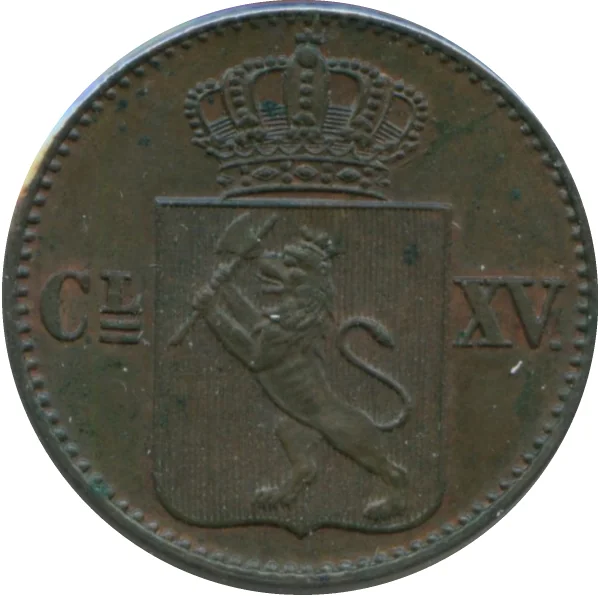
½ Skilling – Norway
Norway
Context
Year: 1867
Issuer: Norway 
Ruler: Charles IV
Currency:
(1816—1875)
Demonetized: Yes
Total mintage: 3,600,000
Material
References
KM: #Click to copy to clipboard329
Numista: #8498
Obverse
Reverse
Description:
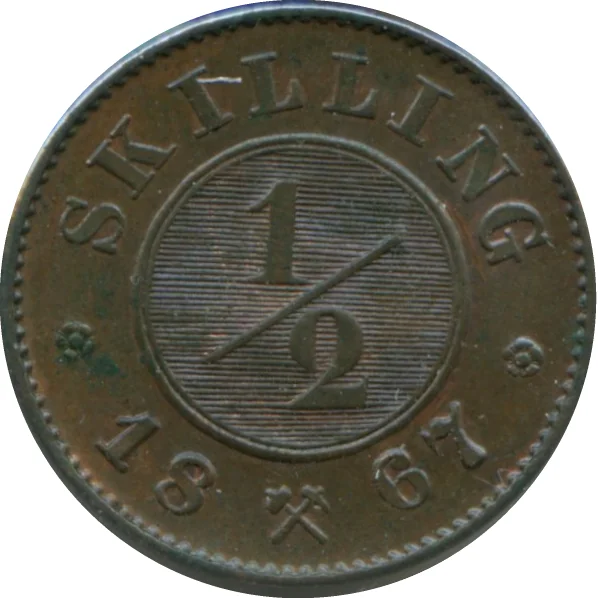
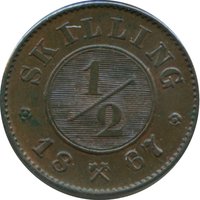
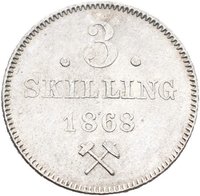
Solid ring with horizontal lines. Value above, date and mintmark below. Beaded rim.
Inscription:
🏵 SKILLING 🏵
½
18 ⚒ 67
½
18 ⚒ 67
Script: Latin
Edge
Plain
Mints
| Name | Mark |
|---|---|
| Norwegian Mint | — |
Mintings
| Year | Mint Mark | Mintage | Quality | Collection |
|---|---|---|---|---|
| 1867 | — | 3,600,000 |
Historical background
In 1867, Norway found itself in a complex monetary situation, operating under a dual currency system that was a legacy of its union with Sweden (since 1814). The country was officially on a silver standard, with the speciedaler as its primary unit. However, a parallel currency, the riksdaler, was also in widespread use, valued at four riksdaler to one speciedaler. This system was cumbersome and inefficient for daily commerce and national accounting, creating confusion and complicating trade both domestically and internationally.
Economically, the period was marked by significant deflation and a severe banking crisis. A post-Napoleonic Wars boom had led to speculative lending and a credit bubble, which burst in the late 1850s. By 1867, the aftermath was still being felt, with falling prices, bankruptcies, and a crisis of confidence in the paper notes issued by private banks. The value of these notes fluctuated wildly against the official silver coinage, further destabilizing the economy and highlighting the weaknesses of the existing financial architecture.
This turbulent context created a powerful consensus for reform. The events of 1867 served as a final catalyst, accelerating political efforts to establish a modern, unified, and stable monetary system. These efforts culminated just a few years later with the landmark Parliamentary decision in 1873 to adopt the gold standard and join the Scandinavian Monetary Union (with Sweden and Denmark), introducing the Norwegian krone as the new, single national currency in 1875.
Economically, the period was marked by significant deflation and a severe banking crisis. A post-Napoleonic Wars boom had led to speculative lending and a credit bubble, which burst in the late 1850s. By 1867, the aftermath was still being felt, with falling prices, bankruptcies, and a crisis of confidence in the paper notes issued by private banks. The value of these notes fluctuated wildly against the official silver coinage, further destabilizing the economy and highlighting the weaknesses of the existing financial architecture.
This turbulent context created a powerful consensus for reform. The events of 1867 served as a final catalyst, accelerating political efforts to establish a modern, unified, and stable monetary system. These efforts culminated just a few years later with the landmark Parliamentary decision in 1873 to adopt the gold standard and join the Scandinavian Monetary Union (with Sweden and Denmark), introducing the Norwegian krone as the new, single national currency in 1875.
🌱 Common