

50 colones – Costa Rica
Add to wishlist
Costa Rica
Context
Year: 2002
Issuer: Costa Rica
Issuing organization: Central Bank of Costa Rica
Period:
(since 1948)
Currency:
(since 1896)
Demonetization: 1 July 2025
Total mintage: 15,000,000
Material
Diameter: 27.5 mm
Weight: 7.92 g
Thickness: 2.02 mm
Shape: Round
Composition: Copper-aluminium-nickel
Standard: Silver quarter ounce
Technique: Milled
Alignment: Coin alignment
flip
References
KM: #
Numista: #8485
Value
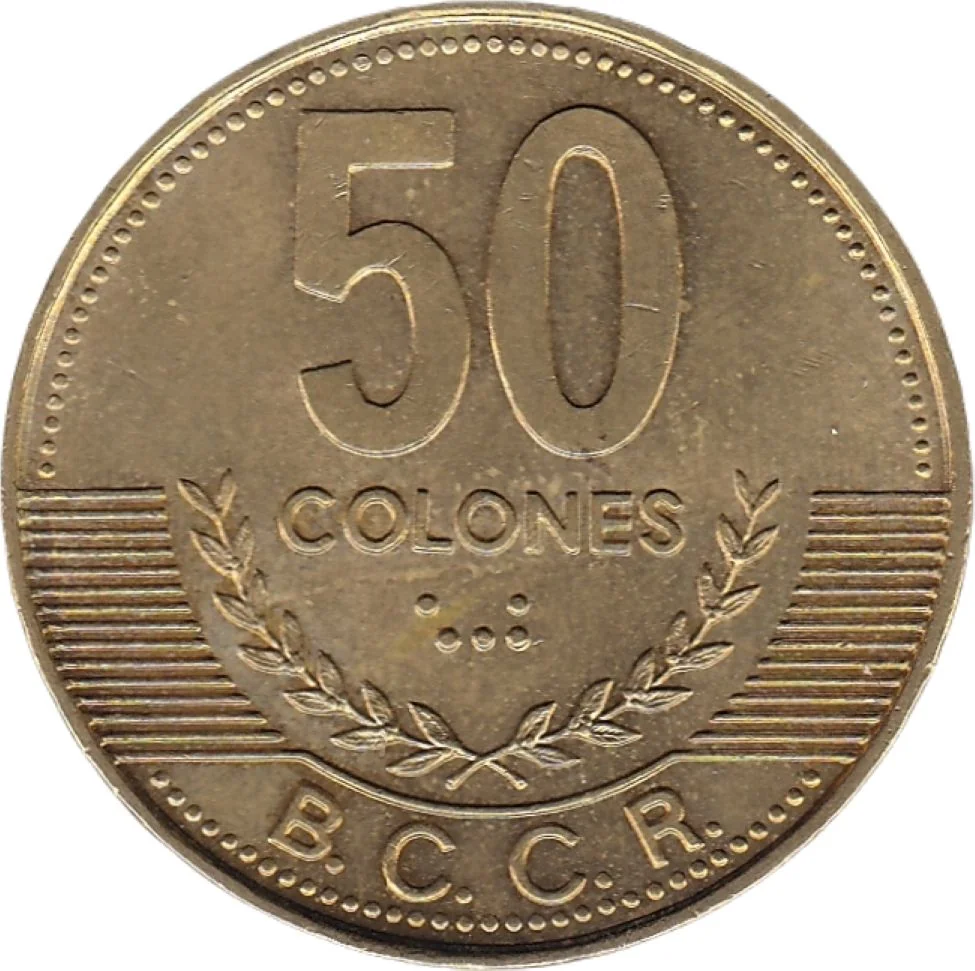
Exchange value: 50 CRC
Obverse
Description:
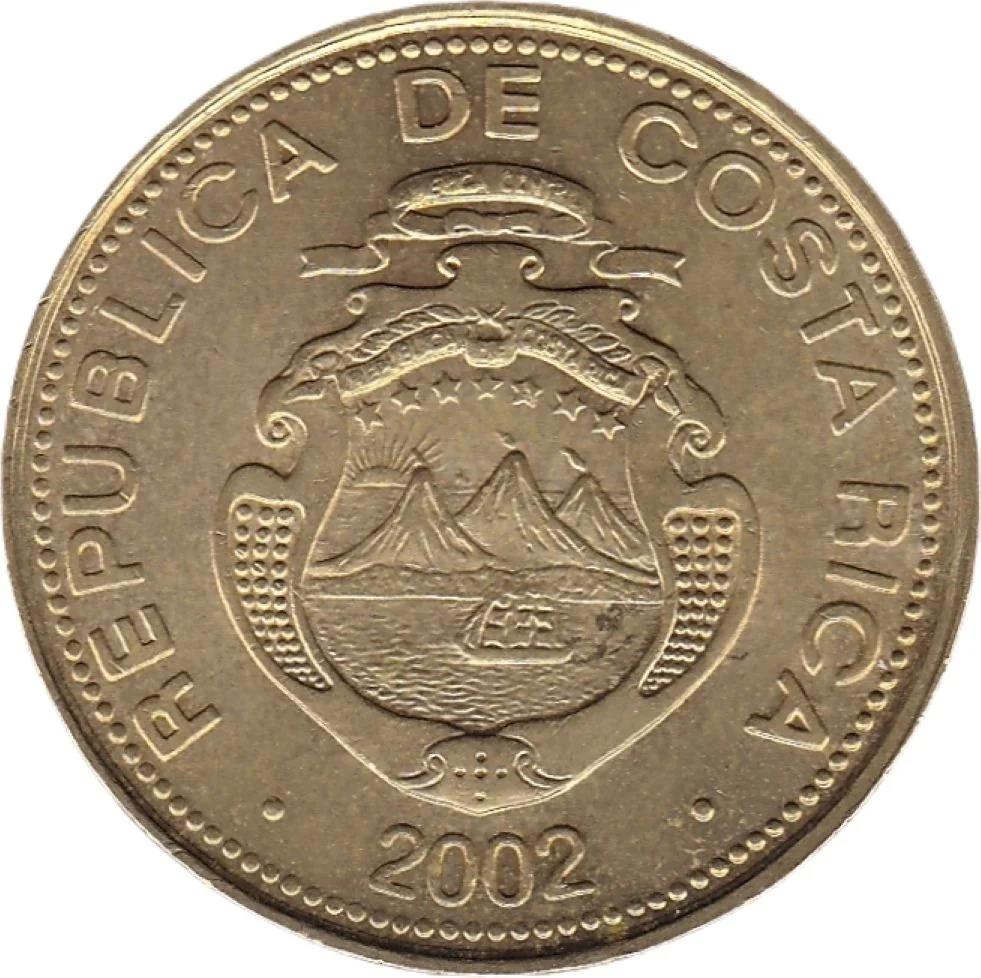
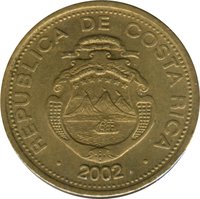
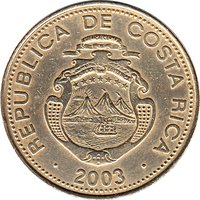
Costa Rica's coat of arms features seven stars for its provinces, three volcanoes for its mountain ranges, two ships for its position between oceans, and a rising sun.
Inscription:
REPUBLICA DE COSTA RICA
AMERICA CENTRAL
REPUBLICA DE COSTA RICA
· 2002 ·
AMERICA CENTRAL
REPUBLICA DE COSTA RICA
· 2002 ·
Translation:
REPUBLIC OF COSTA RICA
CENTRAL AMERICA
REPUBLIC OF COSTA RICA
· 2002 ·
CENTRAL AMERICA
REPUBLIC OF COSTA RICA
· 2002 ·
Script: Latin
Language: Spanish
Reverse
Edge
Segmented reeding
Categories
| Symbols> Coat of Arms |
| Symbol> Wreath |
Mints
| Name | Mark |
|---|---|
| Casa de Moneda de Chile | — |
Mintings
| Year | Mint Mark | Mintage | Quality | Collection |
|---|---|---|---|---|
| 2002 | — | 15,000,000 |
Historical background
In 2002, Costa Rica's currency situation was characterized by a managed exchange rate regime for the colón (₡) that was under significant pressure. The country operated a crawling peg system, where the Central Bank (BCCR) would allow the colón to depreciate against the US dollar at a pre-announced, gradual rate to control inflation and maintain export competitiveness. However, this system faced mounting challenges from large fiscal deficits, which were consistently above 3% of GDP, and growing public debt. These factors, combined with a widening current account deficit, fueled market uncertainty and led to persistent downward pressure on the colón, testing the central bank's ability to defend its official band.
The year was marked by a notable loss of international reserves as the BCCR intervened in the foreign exchange market to support the colón and smooth volatility. Despite these efforts, the currency experienced real appreciation due to inflation differentials with trading partners, hurting the competitiveness of key export sectors like agriculture and manufacturing. Furthermore, a political stalemate in the Legislative Assembly stalled crucial fiscal reforms, undermining investor confidence. This created a cycle where fears of a larger devaluation or a regime change prompted capital flight and increased dollarization, as residents and businesses sought safety in US dollars, thereby exacerbating the pressure on the colón.
By the end of 2002, the currency situation highlighted the unsustainable tension between the rigid exchange rate policy and loose fiscal policy. The BCCR's interventions were costly and increasingly ineffective, setting the stage for a major policy shift. This culminated in January 2003, when Costa Rica abandoned the crawling peg and introduced a dual-band exchange rate system, allowing for greater flexibility and marking the beginning of a transition towards a more market-determined exchange rate. Thus, 2002 served as the final year of a strained regime, exposing the critical need for fiscal discipline to support monetary stability.
The year was marked by a notable loss of international reserves as the BCCR intervened in the foreign exchange market to support the colón and smooth volatility. Despite these efforts, the currency experienced real appreciation due to inflation differentials with trading partners, hurting the competitiveness of key export sectors like agriculture and manufacturing. Furthermore, a political stalemate in the Legislative Assembly stalled crucial fiscal reforms, undermining investor confidence. This created a cycle where fears of a larger devaluation or a regime change prompted capital flight and increased dollarization, as residents and businesses sought safety in US dollars, thereby exacerbating the pressure on the colón.
By the end of 2002, the currency situation highlighted the unsustainable tension between the rigid exchange rate policy and loose fiscal policy. The BCCR's interventions were costly and increasingly ineffective, setting the stage for a major policy shift. This culminated in January 2003, when Costa Rica abandoned the crawling peg and introduced a dual-band exchange rate system, allowing for greater flexibility and marking the beginning of a transition towards a more market-determined exchange rate. Thus, 2002 served as the final year of a strained regime, exposing the critical need for fiscal discipline to support monetary stability.
🌱 Very Common