

500 colones – Costa Rica
Add to wishlist
Costa Rica
Context
Years: 2003–2005
Issuer: Costa Rica
Issuing organization: Central Bank of Costa Rica
Period:
(since 1948)
Currency:
(since 1896)
Demonetization: 1 July 2025
Total mintage: 25,000,000
Material
Diameter: 33 mm
Weight: 11 g
Thickness: 2 mm
Shape: Round
Composition: Copper-aluminium-nickel
Magnetic: No
Technique: Milled
Alignment: Coin alignment
flip
References
KM: #
Numista: #3589
Value
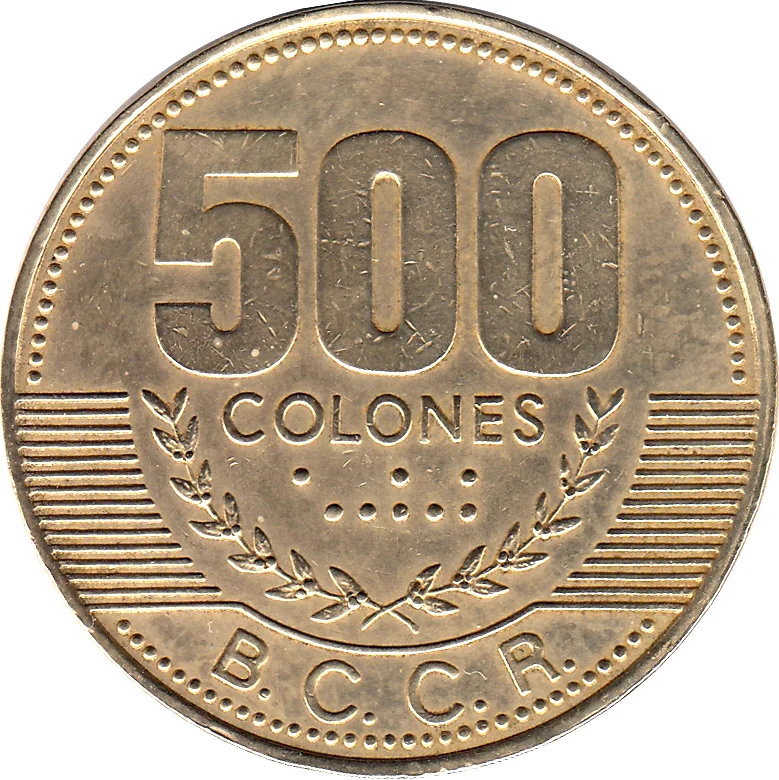
Exchange value: 500 CRC
Obverse
Description:
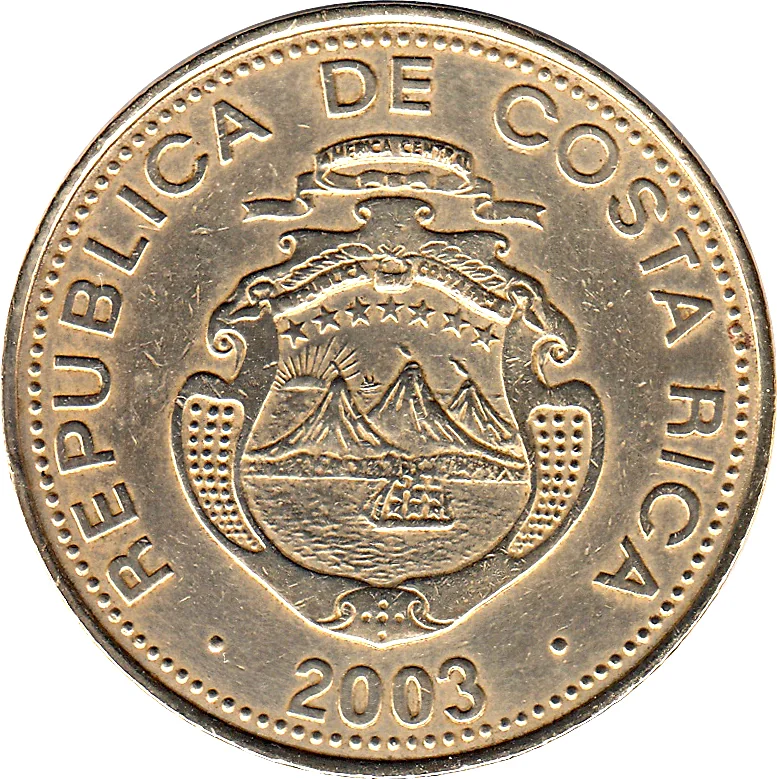
Costa Rica's coat of arms features seven stars for its provinces, three volcanoes for its mountain ranges, two ships for its position between oceans, and a sunrise.
Inscription:
REPUBLICA DE COSTA RICA
AMERICA CENTRAL
REPUBLICA DE COSTA RICA
. 2005 .
AMERICA CENTRAL
REPUBLICA DE COSTA RICA
. 2005 .
Translation:
REPUBLIC OF COSTA RICA
CENTRAL AMERICA
REPUBLIC OF COSTA RICA
. 2005 .
CENTRAL AMERICA
REPUBLIC OF COSTA RICA
. 2005 .
Script: Latin
Language: Spanish
Reverse
Edge
Segmented reeding
Categories
| Symbols> Coat of Arms |
| Symbol> Wreath |
Mints
| Name | Mark |
|---|---|
| Casa de Moneda de Chile | — |
Mintings
| Year | Mint Mark | Mintage | Quality | Collection |
|---|---|---|---|---|
| 2003 | — | 15,000,000 | ||
| 2005 | — | 10,000,000 |
Historical background
In 2003, Costa Rica's currency situation was defined by a prolonged and managed transition towards greater exchange rate flexibility. Following a balance of payments crisis in the early 1980s, the country had adopted a crawling peg system, where the colón was devalued at a pre-announced, gradual rate against the US dollar to maintain export competitiveness and control inflation. By 2003, this system had provided notable stability for nearly two decades, but it was increasingly seen as rigid and vulnerable to speculative pressures in a world of growing capital flows.
The year was marked by significant pressure on the colón and intense debate within the Central Bank of Costa Rica (BCCR). A widening fiscal deficit, coupled with rising public debt, fueled market uncertainty and led to periods where the colón traded outside its official band in the parallel market. The BCCR intervened heavily, spending substantial foreign reserves to defend the crawling peg. This defensive action highlighted the system's fragility and renewed calls from institutions like the International Monetary Fund (IMF) and domestic exporters for a more flexible regime to better absorb external shocks.
Consequently, 2003 served as a critical prelude to major reform. The mounting pressures culminated in a pivotal policy shift the following year. In October 2004, the BCCR officially abandoned the crawling peg and introduced a dual-band exchange rate system, allowing the colón to fluctuate within a wider range. Thus, the currency situation in 2003 was one of mounting strain on an outdated mechanism, setting the stage for Costa Rica's decisive move towards a more market-driven exchange rate by the decade's end.
The year was marked by significant pressure on the colón and intense debate within the Central Bank of Costa Rica (BCCR). A widening fiscal deficit, coupled with rising public debt, fueled market uncertainty and led to periods where the colón traded outside its official band in the parallel market. The BCCR intervened heavily, spending substantial foreign reserves to defend the crawling peg. This defensive action highlighted the system's fragility and renewed calls from institutions like the International Monetary Fund (IMF) and domestic exporters for a more flexible regime to better absorb external shocks.
Consequently, 2003 served as a critical prelude to major reform. The mounting pressures culminated in a pivotal policy shift the following year. In October 2004, the BCCR officially abandoned the crawling peg and introduced a dual-band exchange rate system, allowing the colón to fluctuate within a wider range. Thus, the currency situation in 2003 was one of mounting strain on an outdated mechanism, setting the stage for Costa Rica's decisive move towards a more market-driven exchange rate by the decade's end.
🌱 Very Common