

5 colones – Costa Rica
Add to wishlist
Costa Rica
Context
Year: 1993
Issuer: Costa Rica
Issuing organization: Central Bank of Costa Rica
Period:
(since 1948)
Currency:
(since 1896)
Demonetized: Yes
Total mintage: 20,000,000
Material
References
KM: #
Numista: #8470
Value
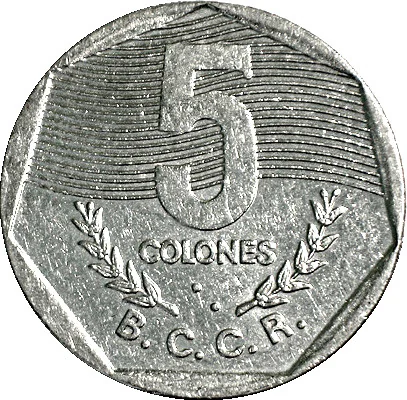
Exchange value: 5 CRC
Obverse
Description:
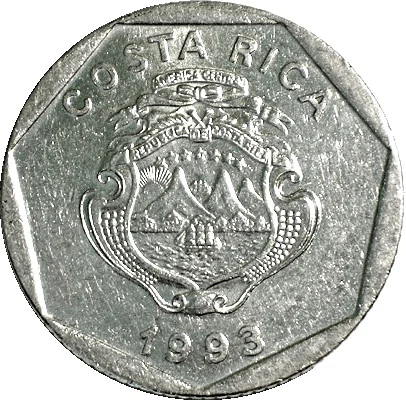
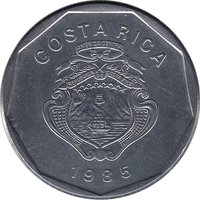
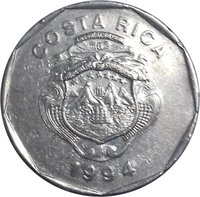
Costa Rica's coat of arms features a heptagonal rim, seven stars for its provinces, three volcanoes for its mountain ranges, two ships between two oceans, and a sunrise.
Inscription:
COSTA RICA
AMERICA CENTRAL
REPUBLICA DE COSTA RICA
1993
AMERICA CENTRAL
REPUBLICA DE COSTA RICA
1993
Translation:
COSTA RICA
CENTRAL AMERICA
REPUBLIC OF COSTA RICA
1993
CENTRAL AMERICA
REPUBLIC OF COSTA RICA
1993
Script: Latin
Language: Spanish
Reverse
Edge
Reeded
Categories
| Symbols> Coat of Arms |
| Symbol> Wreath |
Mintings
| Year | Mint Mark | Mintage | Quality | Collection |
|---|---|---|---|---|
| 1993 | — | 20,000,000 |
Historical background
In 1993, Costa Rica's currency situation was defined by a managed exchange rate system and ongoing tensions between monetary stability and economic pressures. Following the economic crises of the early 1980s, the country had moved away from a fixed exchange rate and adopted a crawling peg system. Under this framework, the Central Bank of Costa Rica (BCCR) allowed the colón to depreciate at a pre-announced, gradual rate ("la minidevaluación") against the US dollar. This policy aimed to provide predictability for trade and investment while maintaining export competitiveness by offsetting higher domestic inflation relative to trading partners.
However, this system operated under significant strain. Inflation, though reduced from the hyperinflationary peaks of the early 1980s, remained persistently high, often in the low 20% range, eroding purchasing power. The crawling peg required careful management of foreign reserves and interest rates to defend the colón, as consistent trade deficits and capital flight posed challenges. Furthermore, a large and thriving parallel foreign exchange market existed alongside the official market, with the black-market dollar commanding a significant premium. This disparity highlighted the pressure on the colón and the limitations of the controlled official rate.
The year 1993 fell within a period of cautious economic liberalization and adjustment. The government, adhering to structural adjustment programs from international lenders, was focused on reducing fiscal deficits and opening the economy. While the crawling peg provided a measure of stability, debates were intensifying about the sustainability of the system and the potential benefits of a more liberalized exchange regime. Thus, the currency situation in 1993 was one of controlled depreciation under a managed regime, but it was a stability under duress, foreshadowing the more significant financial liberalization and move towards greater exchange rate flexibility that would follow in the latter half of the decade.
However, this system operated under significant strain. Inflation, though reduced from the hyperinflationary peaks of the early 1980s, remained persistently high, often in the low 20% range, eroding purchasing power. The crawling peg required careful management of foreign reserves and interest rates to defend the colón, as consistent trade deficits and capital flight posed challenges. Furthermore, a large and thriving parallel foreign exchange market existed alongside the official market, with the black-market dollar commanding a significant premium. This disparity highlighted the pressure on the colón and the limitations of the controlled official rate.
The year 1993 fell within a period of cautious economic liberalization and adjustment. The government, adhering to structural adjustment programs from international lenders, was focused on reducing fiscal deficits and opening the economy. While the crawling peg provided a measure of stability, debates were intensifying about the sustainability of the system and the potential benefits of a more liberalized exchange regime. Thus, the currency situation in 1993 was one of controlled depreciation under a managed regime, but it was a stability under duress, foreshadowing the more significant financial liberalization and move towards greater exchange rate flexibility that would follow in the latter half of the decade.

🌱 Very Common