

20 Colones – Costa Rica
Costa Rica
Context
Year: 1994
Issuer: Costa Rica 
Issuing organization: Central Bank of Costa Rica
Period:
(since 1948)
Currency:
(since 1896)
Demonetized: Yes
Total mintage: 10,000,000
Material
References
KM: #Click to copy to clipboard216.3
Numista: #178736
Value
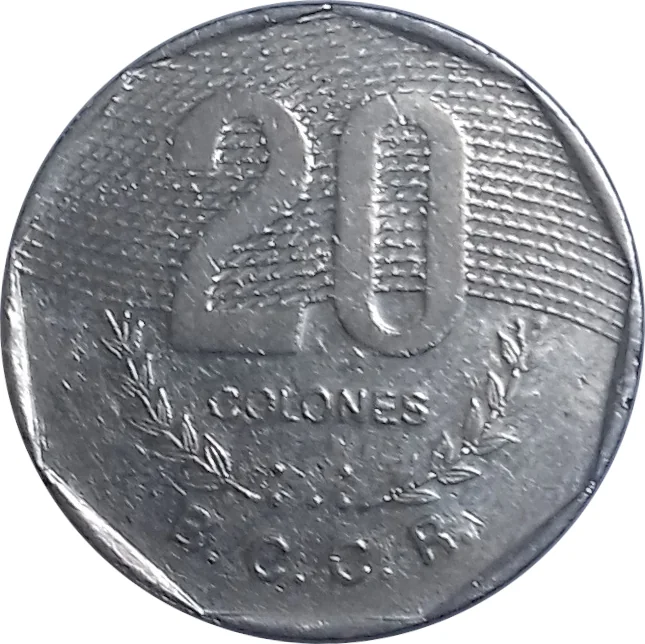
Exchange value: 20 CRC
Obverse
Description:
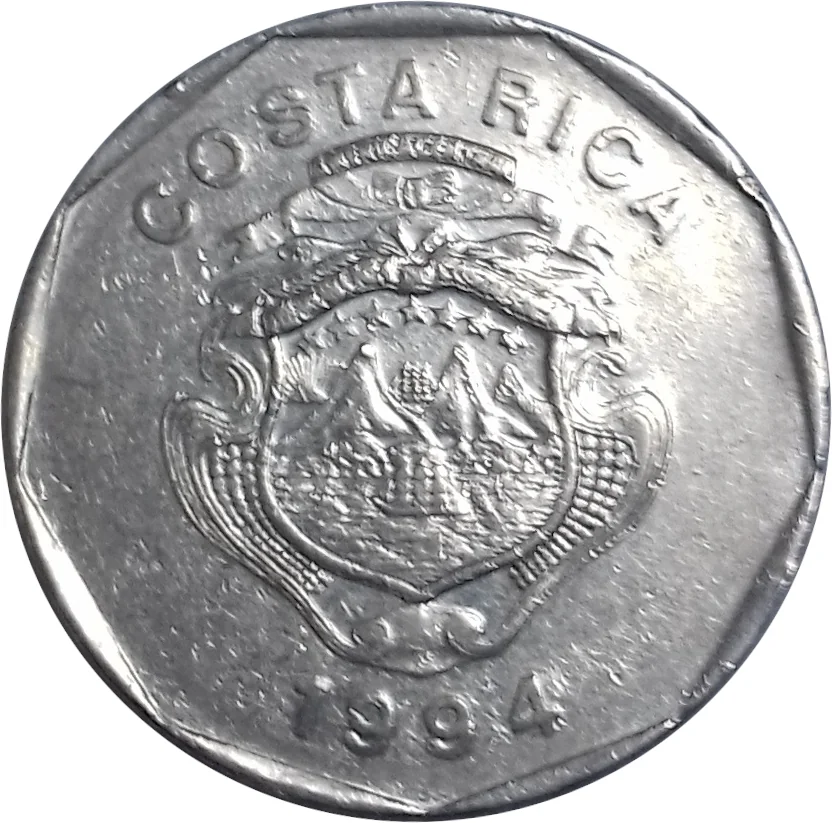
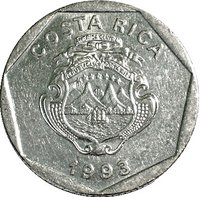
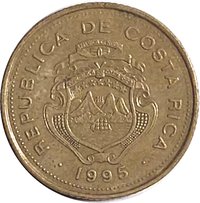
Costa Rica's nonagonal coat of arms features seven stars for its provinces, three volcanoes for its mountain ranges, two ships for its position between oceans, and a sunrise.
Inscription:
COSTA RICA
AMERICA CENTRAL
REPUBLICA DE COSTA RICA
1994
AMERICA CENTRAL
REPUBLICA DE COSTA RICA
1994
Translation:
COSTA RICA
CENTRAL AMERICA
REPUBLIC OF COSTA RICA
1994
CENTRAL AMERICA
REPUBLIC OF COSTA RICA
1994
Script: Latin
Language: Spanish
Reverse
Edge
Reeded
Categories
| Symbols> Coat of Arms |
| Symbol> Wreath |
Mints
| Name | Mark |
|---|---|
| Sherritt Mint | — |
Mintings
| Year | Mint Mark | Mintage | Quality | Collection |
|---|---|---|---|---|
| 1994 | — | 10,000,000 |
Historical background
In 1994, Costa Rica's currency situation was defined by a managed exchange rate regime, a legacy of the economic stabilization programs of the 1980s. Following a severe debt crisis earlier that decade, the country had implemented a series of adjustments under IMF guidance, moving from a fixed peg to a crawling peg system for the colón. This mechanism allowed for small, regular devaluations (the minidevaluaciones) intended to maintain export competitiveness by gradually adjusting for the inflation differential with major trading partners, primarily the United States. The Central Bank of Costa Rica (BCCR) tightly controlled the exchange rate within a narrow band, managing the supply of dollars to defend the official parity.
This system, while providing stability, created significant distortions. A persistent fiscal deficit, fueled by expansive public sector spending, contributed to domestic inflation that often outpaced the rate of devaluation. This led to a chronic overvaluation of the colón in real terms, hurting exporters of coffee and bananas who received fewer colones for their dollar earnings. Simultaneously, a parallel foreign exchange market existed, where the U.S. dollar traded at a premium to the official rate, reflecting market pressures and capital flight. This duality underscored a growing lack of confidence in the colón and highlighted the strain between official policy and economic reality.
The tensions of 1994 set the stage for a major shift in the coming years. Pressure from exporters and international institutions mounted for a more flexible and market-driven system to correct the overvaluation and reduce the fiscal imbalances that underpinned it. While the crawling peg provided short-term predictability, its inherent rigidity was increasingly seen as unsustainable. Consequently, 1994 can be viewed as the final phase of the tightly managed regime, preceding the significant liberalization reforms—including the move to a crawling band system—that would be implemented in the latter half of the 1990s to modernize the country's monetary framework.
This system, while providing stability, created significant distortions. A persistent fiscal deficit, fueled by expansive public sector spending, contributed to domestic inflation that often outpaced the rate of devaluation. This led to a chronic overvaluation of the colón in real terms, hurting exporters of coffee and bananas who received fewer colones for their dollar earnings. Simultaneously, a parallel foreign exchange market existed, where the U.S. dollar traded at a premium to the official rate, reflecting market pressures and capital flight. This duality underscored a growing lack of confidence in the colón and highlighted the strain between official policy and economic reality.
The tensions of 1994 set the stage for a major shift in the coming years. Pressure from exporters and international institutions mounted for a more flexible and market-driven system to correct the overvaluation and reduce the fiscal imbalances that underpinned it. While the crawling peg provided short-term predictability, its inherent rigidity was increasingly seen as unsustainable. Consequently, 1994 can be viewed as the final phase of the tightly managed regime, preceding the significant liberalization reforms—including the move to a crawling band system—that would be implemented in the latter half of the 1990s to modernize the country's monetary framework.

🌱 Fairly Common