

20 centimes – France
Add to wishlist
France
Context
Years: 1864–1866
Issuer: France
Ruler: Napoleon III
Currency:
(1795—1959)
Demonetization: 22 March 1918
Total mintage: 3,155,522
Material
References
KM: #
Numista: #1144
Value
Bullion value: $2.13
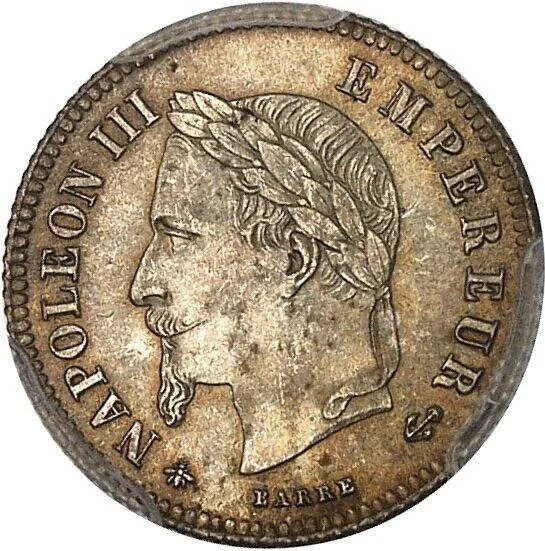
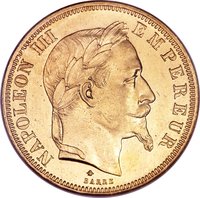
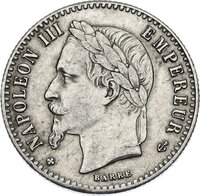
Obverse
Description:
Laureate facing left
Inscription:
NAPOLEON III EMPEREUR
BARRE
BARRE
Translation:
NAPOLEON III EMPEROR
BARRE
BARRE
Script: Latin
Language: French
Engraver: Désiré-Albert Barre
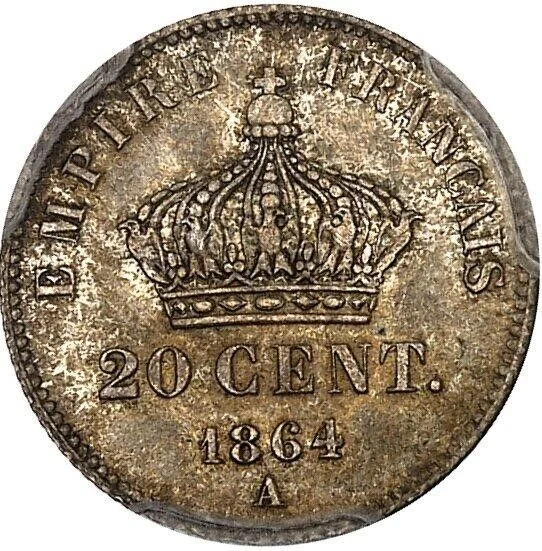
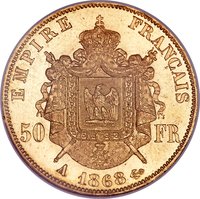
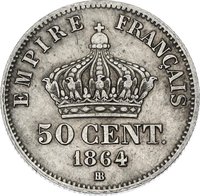
Reverse
Description:
Crown over value
Inscription:
EMPIRE FRANÇAIS
20 CENT.
1864
A
20 CENT.
1864
A
Translation:
FRENCH EMPIRE
20 CENTIMES.
1864
A
20 CENTIMES.
1864
A
Script: Latin
Language: French
Engraver: Désiré-Albert Barre
Edge
Reeded
Mints
| Name | Mark |
|---|---|
| Monnaie de Paris | A |
| Strasbourg | BB |
| Bordeaux | K |
Mintings
Historical background
In 1864, France operated under a bimetallic monetary system, a legacy of the revolutionary franc germinal established by Napoleon Bonaparte in 1803. This system legally fixed the values of both gold and silver coins at a ratio of 15.5 to 1, meaning one gram of gold was worth 15.5 grams of silver. The franc was thus defined by a specific weight of precious metal, and both gold and silver coins (like the 20-franc gold napoléon and the 5-franc silver écu) circulated as full legal tender. This system aimed to provide monetary stability and facilitate international trade, but it was increasingly strained by global market forces.
The mid-19th century saw significant shifts in global bullion supplies, particularly with major silver discoveries, which began to depress the market value of silver relative to gold. Because the French mint stood ready to coin both metals at the fixed legal ratio, it became profitable for arbitrageurs to exchange undervalued gold for overvalued silver at the mint, leading to a gradual but steady outflow of gold from France. This phenomenon, known as Gresham's Law ("bad money drives out good money"), meant that the more valuable gold coins were being hoarded or exported, while silver remained in circulation, threatening the nation's gold reserves and the stability of the dual standard.
Consequently, by 1864, France was at the centre of the Latin Monetary Union (LMU), a treaty formalized in 1865 with Belgium, Italy, and Switzerland. The LMU sought to standardise coinage across member nations to facilitate commerce, effectively extending France's bimetallic system across much of Western Europe. While this created a zone of monetary stability, it also magnified the systemic vulnerabilities. The year 1864 thus represents a pivotal moment just before the formalisation of the Union, where France's domestic currency challenges were being addressed through a ambitious, but ultimately precarious, multinational agreement that would dominate European finance for decades.
The mid-19th century saw significant shifts in global bullion supplies, particularly with major silver discoveries, which began to depress the market value of silver relative to gold. Because the French mint stood ready to coin both metals at the fixed legal ratio, it became profitable for arbitrageurs to exchange undervalued gold for overvalued silver at the mint, leading to a gradual but steady outflow of gold from France. This phenomenon, known as Gresham's Law ("bad money drives out good money"), meant that the more valuable gold coins were being hoarded or exported, while silver remained in circulation, threatening the nation's gold reserves and the stability of the dual standard.
Consequently, by 1864, France was at the centre of the Latin Monetary Union (LMU), a treaty formalized in 1865 with Belgium, Italy, and Switzerland. The LMU sought to standardise coinage across member nations to facilitate commerce, effectively extending France's bimetallic system across much of Western Europe. While this created a zone of monetary stability, it also magnified the systemic vulnerabilities. The year 1864 thus represents a pivotal moment just before the formalisation of the Union, where France's domestic currency challenges were being addressed through a ambitious, but ultimately precarious, multinational agreement that would dominate European finance for decades.
🌱 Common