

100 francos cfa – Equatorial Guinea
Add to wishlist
Equatorial Guinea
Context
Years: 1985–1986
Issuer: Equatorial Guinea
Issuing organization: Bank of Central African States
Period:
(since 1968)
Currency:
(since 1984)
Total mintage: 1,350,000
Material
References
KM: #
Numista: #8442
Value
Exchange value: 100 XAF
Obverse
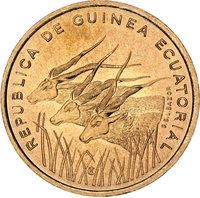
Description:
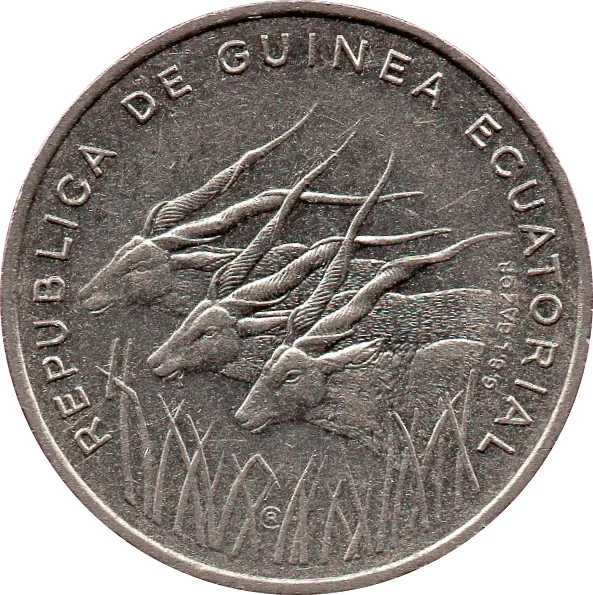
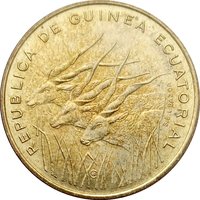
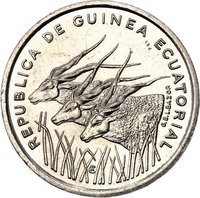
Three giant elands facing left.
Inscription:
REPUBLICA DE GUINEA ECUATORIAL
G.B.L. BAZOR
G.B.L. BAZOR
Translation:
Republic of Equatorial Guinea
G.B.L. Bazor
G.B.L. Bazor
Script: Latin
Engraver: Lucien Georges Bazor
Reverse
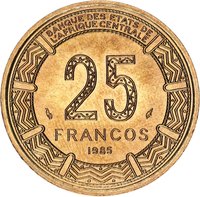
Description:
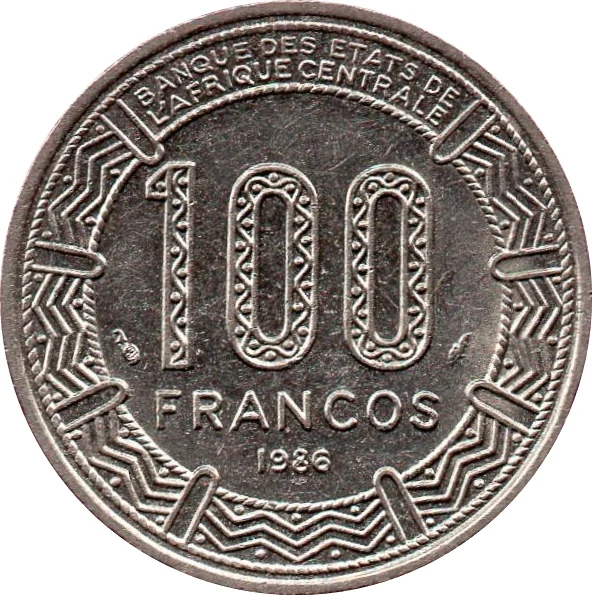
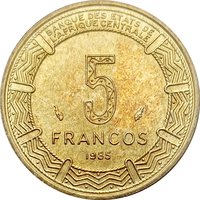
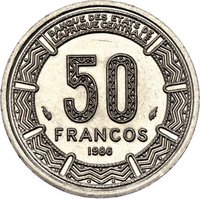
Denomination and borders.
Inscription:
BANQUE DES ETATS DE
L'AFRIQUE CENTRALE
100 FRANCOS
1986
L'AFRIQUE CENTRALE
100 FRANCOS
1986
Translation:
BANK OF THE STATES OF
CENTRAL AFRICA
100 FRANCOS
1986
CENTRAL AFRICA
100 FRANCOS
1986
Script: Latin
Languages: Portuguese, French
Engraver: Lucien Georges Bazor
Edge
Reeded
Mints
| Name | Mark |
|---|---|
| Monnaie de Paris | — |
Mintings
| Year | Mint Mark | Mintage | Quality | Collection |
|---|---|---|---|---|
| 1985 | — | 350,000 | ||
| 1986 | — | 1,000,000 |
Historical background
In 1985, Equatorial Guinea's currency situation was defined by its reliance on the Central African CFA franc (XAF), a colonial-era arrangement it maintained after independence from Spain in 1968. The country was, and remains, a member of the Central African Economic and Monetary Community (CEMAC). This meant its monetary policy was effectively outsourced to the Bank of Central African States (BEAC) in Yaoundé, Cameroon, which guaranteed the currency's convertibility and pegged it at a fixed rate to the French franc (FFr 1 = CFA 50). This provided rare monetary stability for the nation but also meant Equatorial Guinea had no independent control over its currency, interest rates, or money supply.
Economically, the context in 1985 was one of profound stagnation and poverty, despite the fixed exchange rate's stability. The country was not yet an oil producer (with significant discoveries still a few years away), and its economy relied on declining cocoa and coffee exports. The fixed CFA franc peg, while preventing hyperinflation, was often criticized for being overvalued, making the country's non-oil exports less competitive on the global market. This overvaluation, combined with systemic corruption and mismanagement under the regime of President Teodoro Obiang Nguema Mbasogo, stifled economic diversification and contributed to a severe lack of foreign exchange from legitimate exports.
Consequently, the formal currency situation belied a harsh reality on the ground. While the CFA franc was legally stable, the vast majority of the population experienced extreme hardship. Access to the currency itself was limited for many, and a vital parallel market for foreign exchange likely existed, though overshadowed by the country's isolation and tight controls. The stability of the CFA franc was a macroeconomic fact that did not translate into domestic prosperity, as Equatorial Guinea remained one of the world's poorest nations, with its monetary system offering stability but doing little to stimulate a bankrupt real economy.
Economically, the context in 1985 was one of profound stagnation and poverty, despite the fixed exchange rate's stability. The country was not yet an oil producer (with significant discoveries still a few years away), and its economy relied on declining cocoa and coffee exports. The fixed CFA franc peg, while preventing hyperinflation, was often criticized for being overvalued, making the country's non-oil exports less competitive on the global market. This overvaluation, combined with systemic corruption and mismanagement under the regime of President Teodoro Obiang Nguema Mbasogo, stifled economic diversification and contributed to a severe lack of foreign exchange from legitimate exports.
Consequently, the formal currency situation belied a harsh reality on the ground. While the CFA franc was legally stable, the vast majority of the population experienced extreme hardship. Access to the currency itself was limited for many, and a vital parallel market for foreign exchange likely existed, though overshadowed by the country's isolation and tight controls. The stability of the CFA franc was a macroeconomic fact that did not translate into domestic prosperity, as Equatorial Guinea remained one of the world's poorest nations, with its monetary system offering stability but doing little to stimulate a bankrupt real economy.
🌱 Fairly Common