

25 rupees – Nepal
Add to wishlist
Circulating commemorative coins
Commemoration: Silver Jubilee of "Nepal Netra Jyoti Sangh" – National Society for Comprehensive Eye Care
Nepal
Context
Year: 2003
Vikram Samvat Year:: 2060
Issuer: Nepal
Ruler: Gyanendra Bir Bikram Shah
Currency:
(since 1932)
Material
Diameter: 29.1 mm
Weight: 8.6 g
Shape: Round
Composition: Copper-nickel
Technique: Milled
Alignment: Medal alignment
flip
References
KM: #
Numista: #83904
Value
Exchange value: 25 NPR
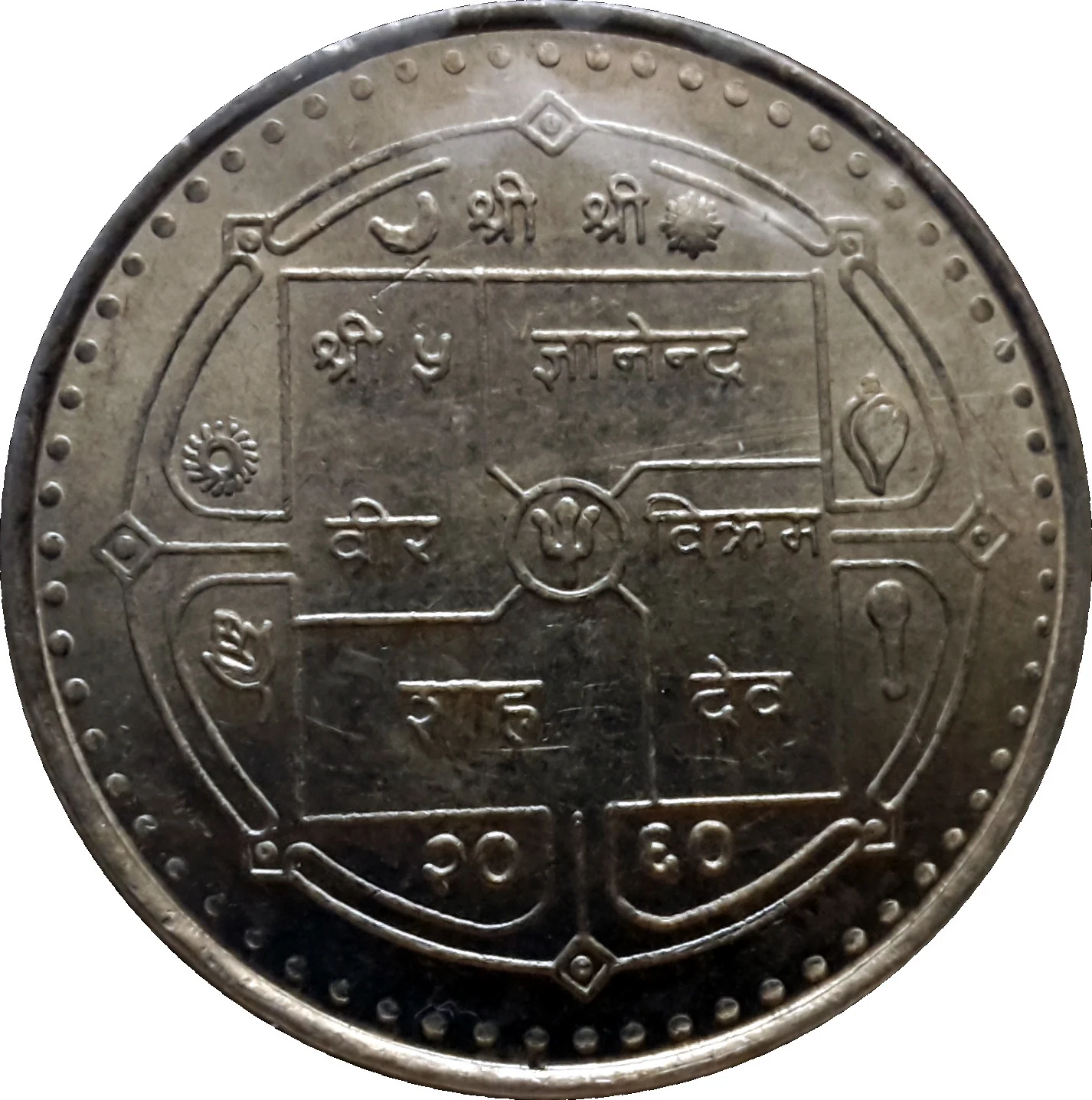
Obverse
Description:
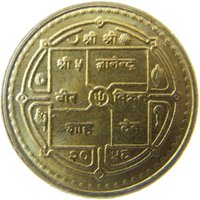
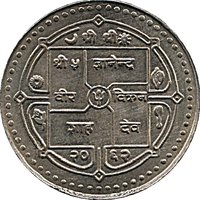
Classic style
Script: Devanagari
Reverse
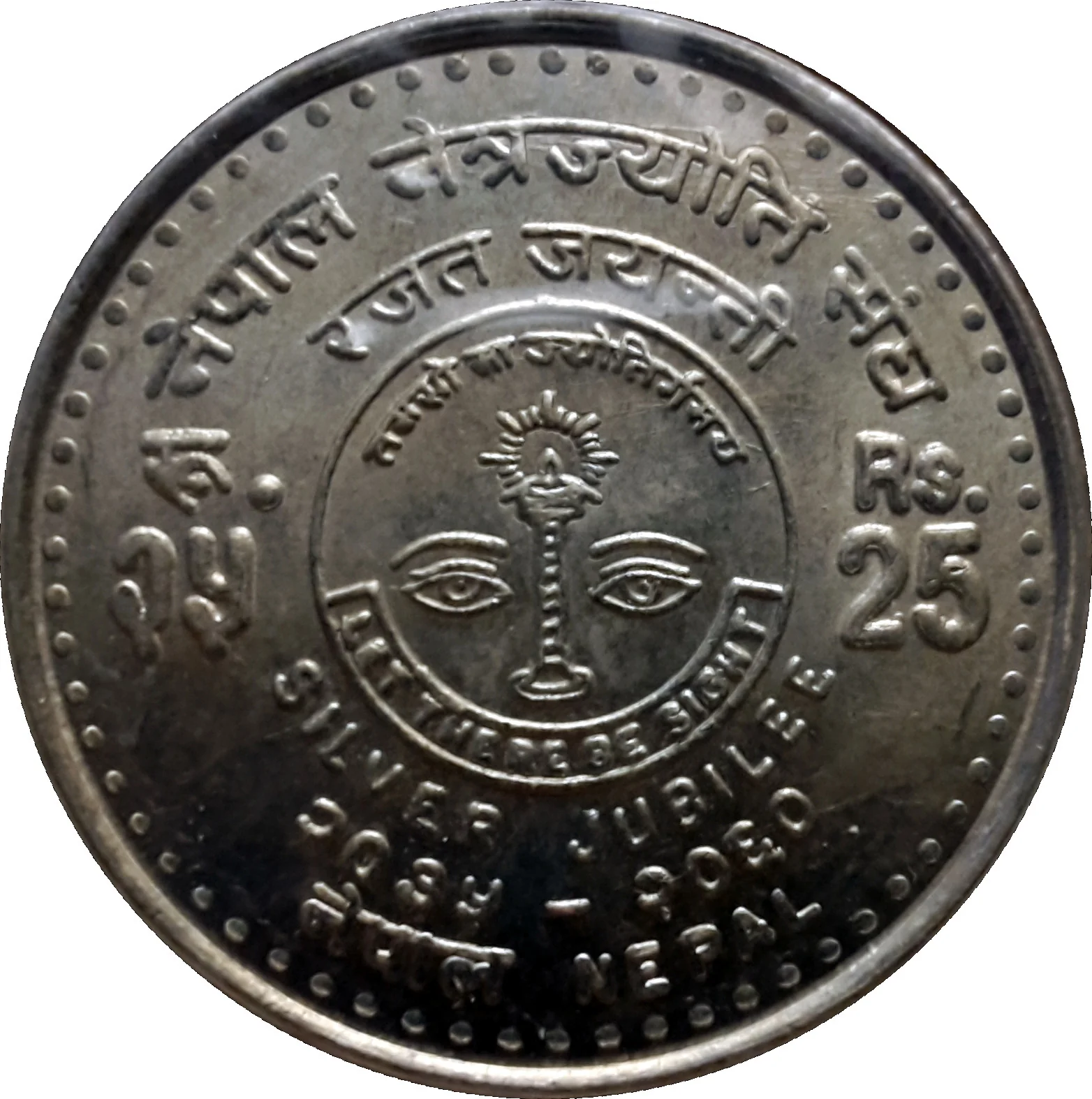
Description:
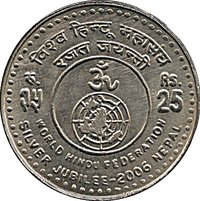
Stylized face
Inscription:
LET THERE BE SIGHT
SILVER JUBILEE
Rs.25
NEPAL
SILVER JUBILEE
Rs.25
NEPAL
Scripts: Devanagari, Latin
Edge
Mints
| Name | Mark |
|---|---|
| Mint Division of the Central Bank of Nepal | — |
Mintings
| Year | Mint Mark | Mintage | Quality | Collection |
|---|---|---|---|---|
| 2003 | — | — |
Historical background
In 2003, Nepal's currency situation was characterized by relative stability but underlying vulnerabilities, largely managed by its peg to the Indian Rupee (INR). The Nepalese Rupee (NPR) had been formally pegged at a rate of NPR 1.60 = INR 1 since 1993, a policy crucial for a landlocked economy with immense cross-border trade. This peg provided predictability for trade and remittances, anchoring inflation and simplifying transactions for the millions of Nepalese working in India. The exchange rate against other major currencies, like the US Dollar, therefore moved in tandem with the Indian Rupee's own fluctuations in the international market.
However, this stability was maintained amidst significant political and economic turmoil. The nation was in the eighth year of a violent Maoist insurgency, which had severely disrupted economic activity, damaged infrastructure, and strained public finances. Furthermore, a period of political instability followed the dissolution of parliament in 2002. These factors pressured foreign exchange reserves and constrained economic growth, though not catastrophically in the short term. Remittances, already a vital lifeline, began their steady rise, helping to finance a growing trade deficit with India and bolster the country's balance of payments.
Overall, the currency regime in 2003 functioned as a stabilizing mechanism in an otherwise turbulent environment. The central bank, Nepal Rastra Bank, prioritized defending the peg, which required maintaining adequate reserves and broadly aligning monetary policy with that of India's Reserve Bank. The primary challenges were not acute currency crises but rather the broader economic strains from the conflict, which threatened long-term fiscal health and investor confidence, posing indirect risks to the sustainability of the fixed exchange rate system.
However, this stability was maintained amidst significant political and economic turmoil. The nation was in the eighth year of a violent Maoist insurgency, which had severely disrupted economic activity, damaged infrastructure, and strained public finances. Furthermore, a period of political instability followed the dissolution of parliament in 2002. These factors pressured foreign exchange reserves and constrained economic growth, though not catastrophically in the short term. Remittances, already a vital lifeline, began their steady rise, helping to finance a growing trade deficit with India and bolster the country's balance of payments.
Overall, the currency regime in 2003 functioned as a stabilizing mechanism in an otherwise turbulent environment. The central bank, Nepal Rastra Bank, prioritized defending the peg, which required maintaining adequate reserves and broadly aligning monetary policy with that of India's Reserve Bank. The primary challenges were not acute currency crises but rather the broader economic strains from the conflict, which threatened long-term fiscal health and investor confidence, posing indirect risks to the sustainability of the fixed exchange rate system.
💎 Very Rare