

25 rupees (World Hindu Federation) – Nepal
Add to wishlist
Circulating commemorative coins
Commemoration: 25th Anniversary of the World Hindu Federation
Nepal
Context
Year: 2005
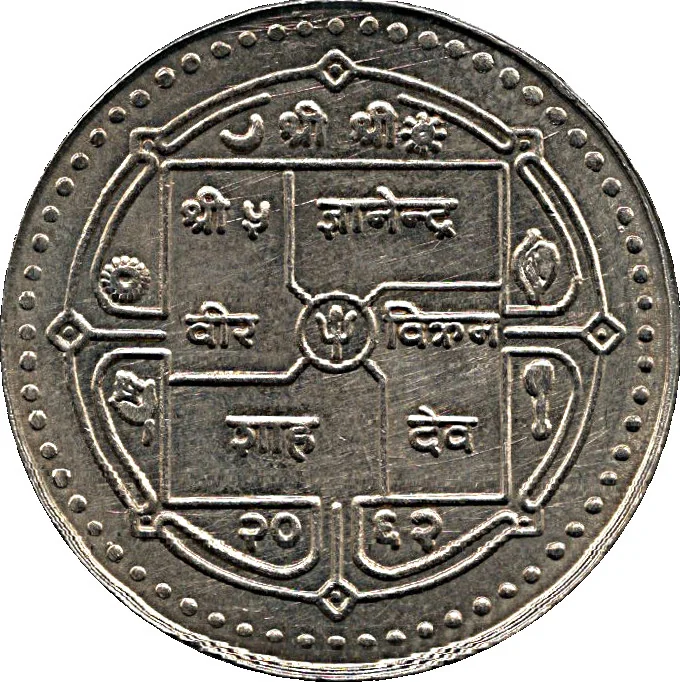
Vikram Samvat Year:: 2062
Issuer: Nepal
Ruler: Gyanendra Bir Bikram Shah
Currency:
(since 1932)
Total mintage: 10,000
Material
Diameter: 29 mm
Weight: 8.5 g
Shape: Round
Composition: Copper-nickel
Technique: Milled
Alignment: Medal alignment
flip
References
KM: #
Numista: #41673
Value
Exchange value: 25 NPR
Obverse
Description:
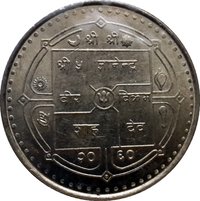
Trident in square above date.
Script: Devanagari
Reverse
Description:
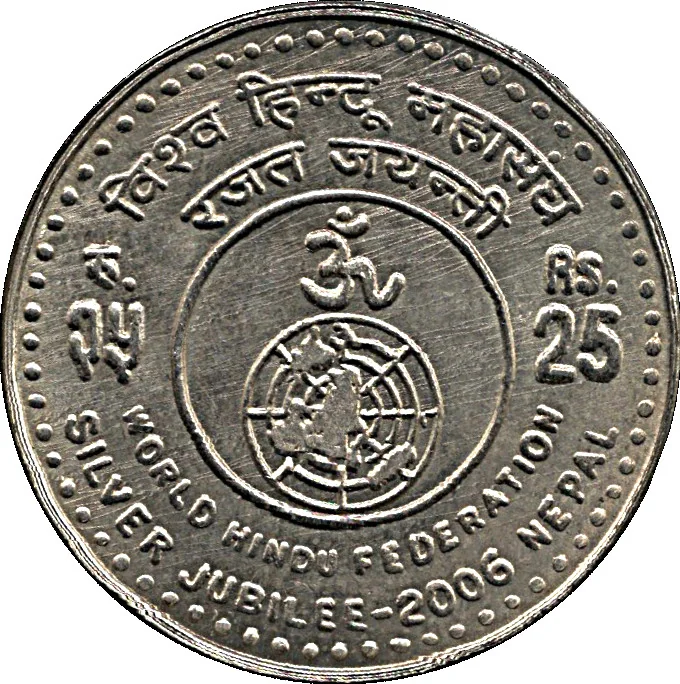
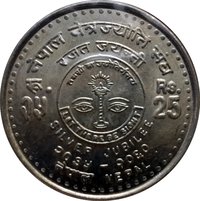
World Hindu Federation Silver Jubilee 2006, 25 Rupees, bilingual (English/Nepali), central globe.
Scripts: Devanagari, Latin
Edge
Mints
| Name | Mark |
|---|---|
| Mint Division of the Central Bank of Nepal | — |
Mintings
| Year | Mint Mark | Mintage | Quality | Collection |
|---|---|---|---|---|
| 2005 | — | 10,000 |
Historical background
In 2005, Nepal's currency situation was characterized by relative stability of the Nepalese Rupee (NPR) against the Indian Rupee (INR), but underlying vulnerabilities and political instability posed significant risks. The NPR was, and remains, pegged to the INR at a fixed rate of 1.6 NPR to 1 INR, a cornerstone of monetary policy due to Nepal's extensive open border and overwhelming trade dependence on India. This peg provided crucial stability for trade, remittances, and price levels, preventing the wild fluctuations seen in fully floating currencies. The Nepal Rastra Bank (NRB) maintained sufficient foreign exchange reserves, largely bolstered by growing remittance inflows from Nepalese workers abroad, which helped defend the peg and ensure macroeconomic stability on the surface.
However, this stability was fragile and set against a backdrop of intense political crisis. The year 2005 was defined by King Gyanendra's direct seizure of power in February, his dismissal of the government, and the imposition of a state of emergency. This political shock severely undermined investor confidence, strained international relations, and led to a reduction in foreign aid and investment—key sources of foreign exchange. While the currency peg held, the real economy suffered, with economic growth stagnating and the climate for business and tourism deteriorating. The NRB's ability to manage monetary policy was constrained by the fixed exchange rate regime and the need to prioritize maintaining the peg above other potential economic stimuli.
Furthermore, the country's financial health was becoming increasingly reliant on remittances, which were rising but also creating a form of dependency and masking deeper structural issues like low domestic productivity and a narrow export base. Inflation, though moderate by regional standards, was a persistent concern, often imported via the peg with India. In essence, the currency situation in 2005 was one of artificial calm maintained by the INR peg and remittance inflows, but it was acutely vulnerable to the severe political instability and lacked a foundation in a robust, diversified domestic economy. The political turmoil threatened to unravel the very conditions that allowed the fixed exchange rate to function smoothly.
However, this stability was fragile and set against a backdrop of intense political crisis. The year 2005 was defined by King Gyanendra's direct seizure of power in February, his dismissal of the government, and the imposition of a state of emergency. This political shock severely undermined investor confidence, strained international relations, and led to a reduction in foreign aid and investment—key sources of foreign exchange. While the currency peg held, the real economy suffered, with economic growth stagnating and the climate for business and tourism deteriorating. The NRB's ability to manage monetary policy was constrained by the fixed exchange rate regime and the need to prioritize maintaining the peg above other potential economic stimuli.
Furthermore, the country's financial health was becoming increasingly reliant on remittances, which were rising but also creating a form of dependency and masking deeper structural issues like low domestic productivity and a narrow export base. Inflation, though moderate by regional standards, was a persistent concern, often imported via the peg with India. In essence, the currency situation in 2005 was one of artificial calm maintained by the INR peg and remittance inflows, but it was acutely vulnerable to the severe political instability and lacked a foundation in a robust, diversified domestic economy. The political turmoil threatened to unravel the very conditions that allowed the fixed exchange rate to function smoothly.

⭐ Rare