

Obverse
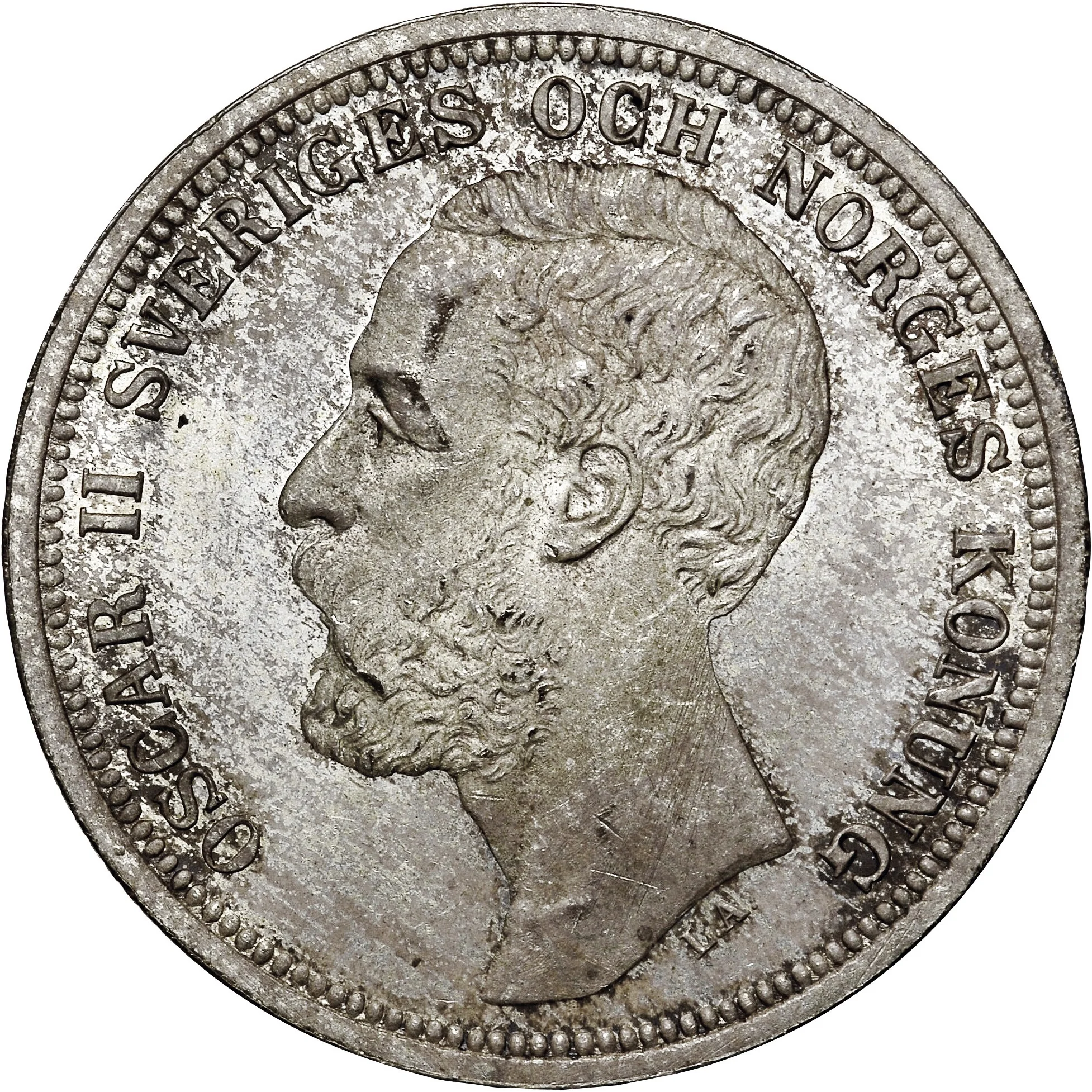
Description:
King Oscar II facing left, engraver initials below neck, legend around rim.
Inscription:
OSCAR II SVERIGES OCH NORGES KONUNG
L.A.
L.A.
Translation:
OSCAR II KING OF SWEDEN AND NORWAY
L.A.
L.A.
Script: Latin
Engraver: Lea Ahlborn
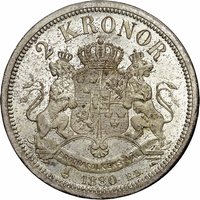
Reverse
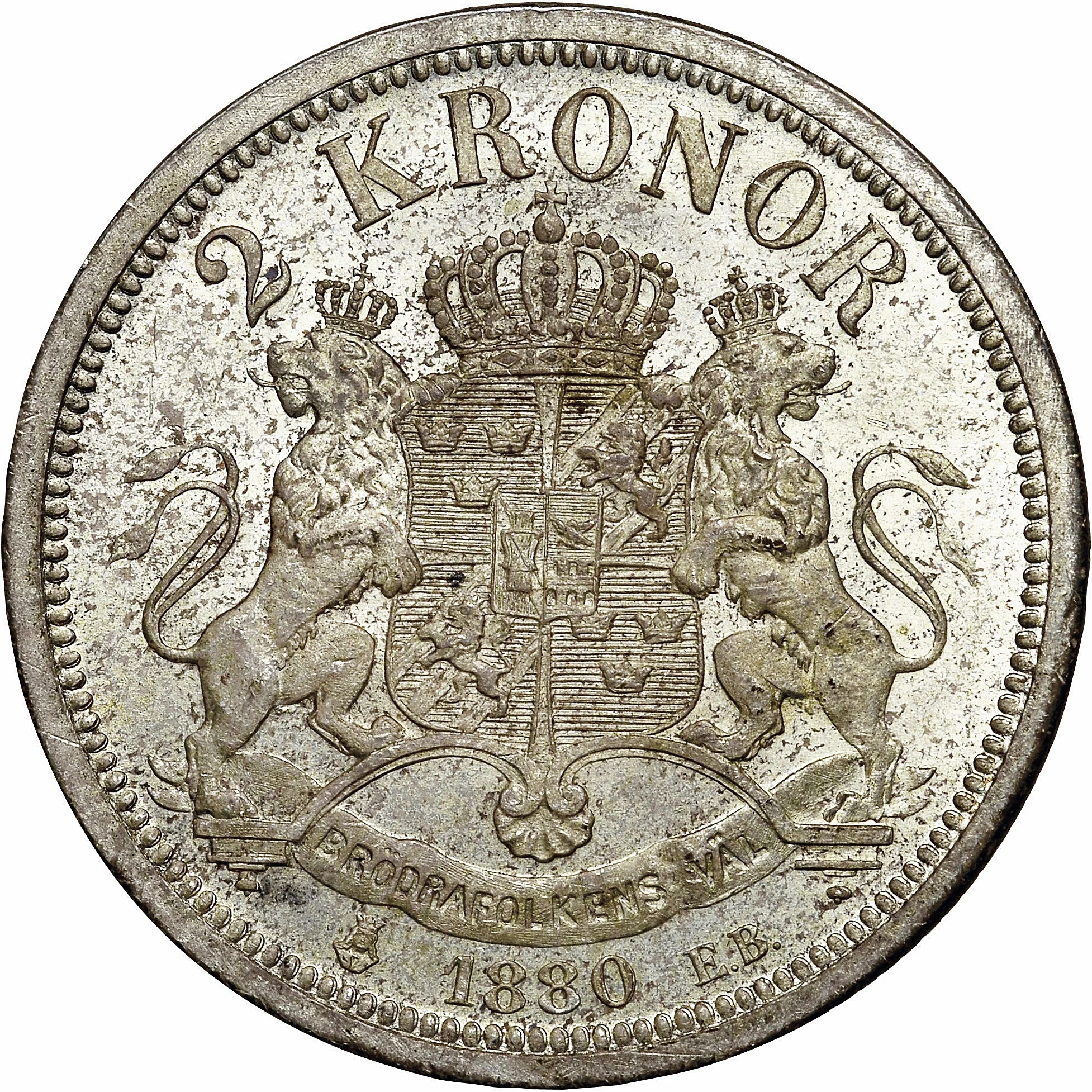
Description:
Crowned coat of arms flanked by lions, with the King's motto below. The value is above and the date below, flanked by mintmarks.
Inscription:
2 KRONOR
BRÖDRAFOLKENS VÄL
1880 E.B.
BRÖDRAFOLKENS VÄL
1880 E.B.
Translation:
2 CROWNS
THE WELFARE OF THE BROTHER PEOPLES
1880 E.B.
THE WELFARE OF THE BROTHER PEOPLES
1880 E.B.
Script: Latin
Language: Swedish
Engraver: Lea Ahlborn
Edge
Milled
Mints
| Name | Mark |
|---|---|
| Kungliga Myntet | — |
Mintings
| Year | Mint Mark | Mintage | Quality | Collection |
|---|---|---|---|---|
| 1878 | — | 22,300 | ||
| 1880 | — | 64,684 |
Historical background
In 1878, Sweden stood at a pivotal moment in its monetary history, transitioning from a centuries-old silver standard to the gold standard. This shift was part of a broader European trend, driven by the discovery of vast silver deposits which caused the metal's value to fall relative to gold, creating instability for nations on silver. Sweden, having used a de facto silver-based riksdaler since 1776, found its currency increasingly isolated and its international trade complicated by fluctuating exchange rates with its major trading partners, most of whom were on gold.
The decisive move came with the Currency Act of 1878, which established the Swedish krona (plural: kronor) as the new unit of account, replacing the riksdaler riksmynt at a rate of 1 krona = ½ riksdaler. Critically, the krona was defined as 0.4032258 grams of pure gold, formally aligning Sweden with the international gold standard. This reform was not undertaken in isolation; it was part of a coordinated Scandinavian effort, resulting in the formation of the Scandinavian Monetary Union with Denmark and Norway in 1873 (implemented in Sweden in 1875 for accounting, with physical coins circulating by 1878).
The immediate background to 1878, therefore, was one of implementation and stabilization. The new gold-backed kronor coins entered circulation, replacing the old silver riksdaler, and the Riksbank adjusted its reserves accordingly. The reform was largely successful, providing Sweden with a stable, modern currency that facilitated trade and investment. This stability, anchored by the gold standard, would underpin Sweden's rapid industrial expansion in the late 19th and early 20th centuries until the pressures of World War I ultimately led to the Monetary Union's effective dissolution and the eventual abandonment of the gold standard itself.
The decisive move came with the Currency Act of 1878, which established the Swedish krona (plural: kronor) as the new unit of account, replacing the riksdaler riksmynt at a rate of 1 krona = ½ riksdaler. Critically, the krona was defined as 0.4032258 grams of pure gold, formally aligning Sweden with the international gold standard. This reform was not undertaken in isolation; it was part of a coordinated Scandinavian effort, resulting in the formation of the Scandinavian Monetary Union with Denmark and Norway in 1873 (implemented in Sweden in 1875 for accounting, with physical coins circulating by 1878).
The immediate background to 1878, therefore, was one of implementation and stabilization. The new gold-backed kronor coins entered circulation, replacing the old silver riksdaler, and the Riksbank adjusted its reserves accordingly. The reform was largely successful, providing Sweden with a stable, modern currency that facilitated trade and investment. This stability, anchored by the gold standard, would underpin Sweden's rapid industrial expansion in the late 19th and early 20th centuries until the pressures of World War I ultimately led to the Monetary Union's effective dissolution and the eventual abandonment of the gold standard itself.
🌟 Limited