

500 lei – Romania
Add to wishlist
Non-circulating coins
Commemoration: History of Gold - Treasure of Pietroasa
Series: History of Gold
Romania
Context
Year: 2001
Issuer: Romania
Issuing organization: National Bank of Romania
Period:
(since 1989)
Currency:
(1952—2005)
Demonetized: Yes
Total mintage: 250
Material
References
KM: #
Numista: #83734
Value
Exchange value: 500 ROL
Bullion value: $954.04
Inflation-adjusted value: 2756.95 ROL
Obverse
Description:
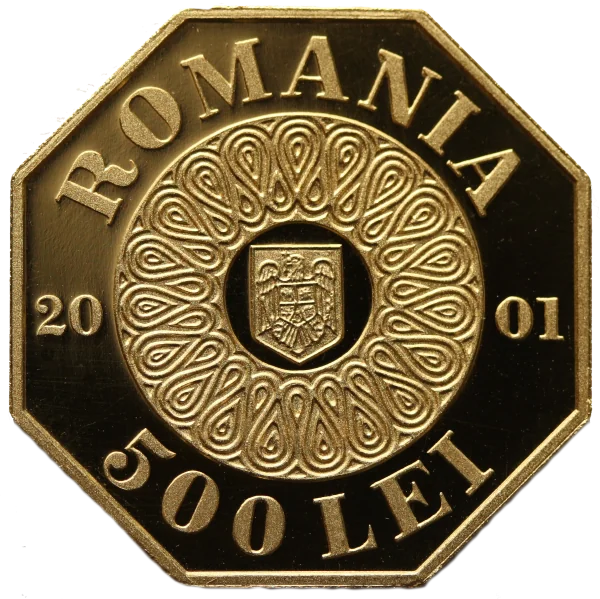
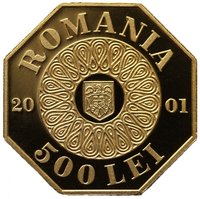
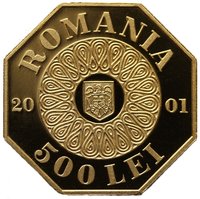
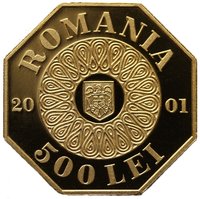
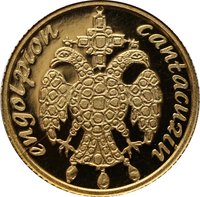
A round medallion featuring Romania's Coat of Arms in the center, encircled by "ROMANIA," with the year "2001" and face value "500 LEI."
Inscription:
ROMANIA
2001
500 LEI
2001
500 LEI
Script: Latin
Reverse
Description:
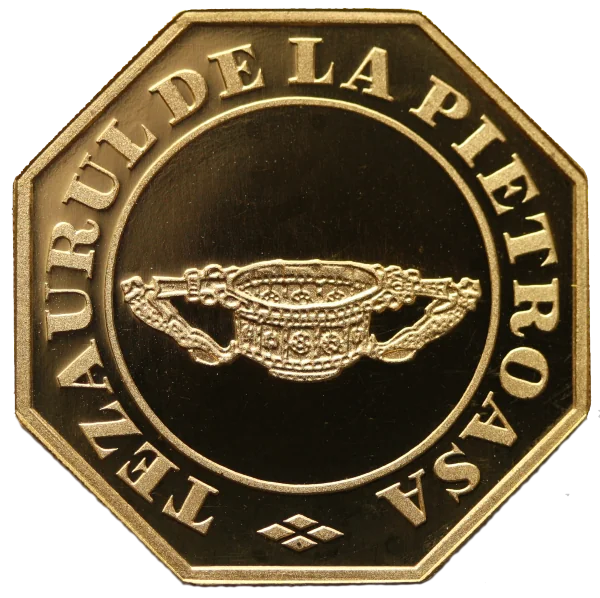
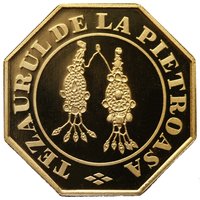
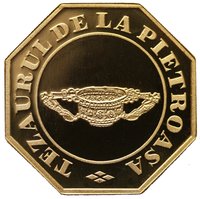
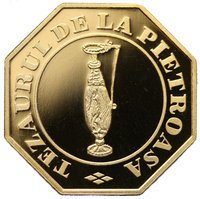
A twelve-sided gold bowl inscribed "TEZAURUL DE LA PIETROASA".
Inscription:
TEZAURUL DE LA PIETROASA
Script: Latin
Edge
Plain
Mintings
| Year | Mint Mark | Mintage | Quality | Collection |
|---|---|---|---|---|
| 2001 | — | 250 | Proof |
Historical background
In 2001, Romania was navigating a critical juncture in its post-communist economic transition, characterized by a dual currency environment and persistent macroeconomic instability. The national currency, the leu (ROL), had suffered from chronic high inflation and devaluation throughout the 1990s, severely eroding public confidence. As a result, many large transactions, real estate prices, and durable goods were unofficially priced in or pegged to stable foreign currencies, particularly the Deutsche Mark and, increasingly, the Euro (which entered physical circulation in 2002). This dollarization (or euro-ization) of the economy reflected a deep-seated lack of trust in the leu and complicated monetary policy.
The government, under Prime Minister Adrian Năstase, and the National Bank of Romania (BNR) were implementing a stabilization program aligned with International Monetary Fund (IMF) agreements. Their central focus was on taming inflation, which had fallen from hyperinflationary levels but remained high at approximately 34% at the end of 2000. Key policies included maintaining a tight monetary policy and allowing a managed float of the leu. A significant reform was enacted in July 2001: the "lopping off of four zeros," a technical re-denomination that created a new leu (RON) equivalent to 10,000 old lei (ROL), aimed at simplifying transactions and symbolizing a break with the inflationary past, though the physical new banknotes would not be introduced until 2005.
Overall, the currency situation in 2001 was one of cautious transition from crisis management toward stabilization. The authorities were laying the groundwork for future stability through fiscal consolidation, inflation targeting, and preparing for European Union integration, which required a stable currency. However, the enduring legacy of inflation and the widespread practice of using foreign currencies as a store of value underscored that restoring full confidence in the leu would be a prolonged process dependent on sustained economic discipline.
The government, under Prime Minister Adrian Năstase, and the National Bank of Romania (BNR) were implementing a stabilization program aligned with International Monetary Fund (IMF) agreements. Their central focus was on taming inflation, which had fallen from hyperinflationary levels but remained high at approximately 34% at the end of 2000. Key policies included maintaining a tight monetary policy and allowing a managed float of the leu. A significant reform was enacted in July 2001: the "lopping off of four zeros," a technical re-denomination that created a new leu (RON) equivalent to 10,000 old lei (ROL), aimed at simplifying transactions and symbolizing a break with the inflationary past, though the physical new banknotes would not be introduced until 2005.
Overall, the currency situation in 2001 was one of cautious transition from crisis management toward stabilization. The authorities were laying the groundwork for future stability through fiscal consolidation, inflation targeting, and preparing for European Union integration, which required a stable currency. However, the enduring legacy of inflation and the widespread practice of using foreign currencies as a store of value underscored that restoring full confidence in the leu would be a prolonged process dependent on sustained economic discipline.
Series: History of Gold


✨ Legendary