

5 centimes – Congo Free State
Add to wishlist
Democratic Republic of the Congo
Context
Years: 1887–1894
Country: Democratic Republic of the Congo
Issuer: Congo Free State
Ruler: Leopold II
Currency:
(1885—1908)
Demonetized: Yes
Total mintage: 325,000
Material
Diameter: 30 mm
Weight: 10 g
Shape: Round with a round hole
Composition: Copper
Magnetic: No
Technique: Milled
Alignment: Coin alignment
flip
References
KM: #
Numista: #11422
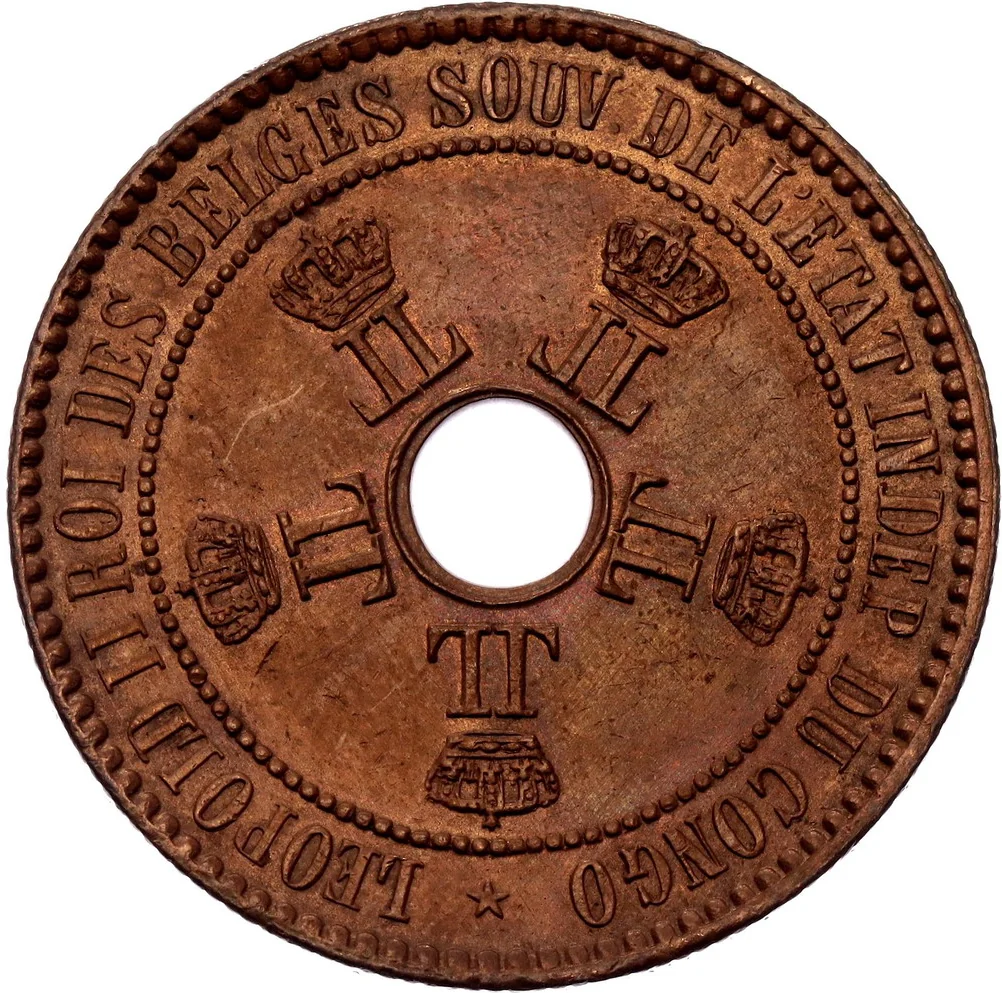
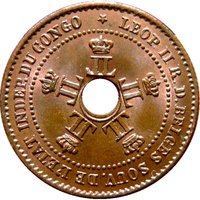
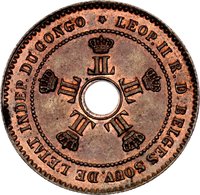
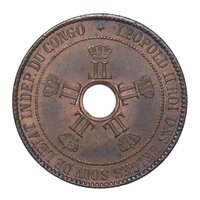
Obverse
Description:
Monogrammed crown encircles center hole.
Inscription:
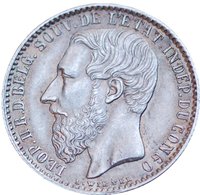
LEOPOLD II ROI DES BELGES SOUV.DE L'ETAT INDEP.DU CONGO
Translation:
LEOPOLD II KING OF THE BELGIANS SOVEREIGN OF THE INDEPENDENT STATE OF THE CONGO
Script: Latin
Language: French
Engraver: Léopold Wiener
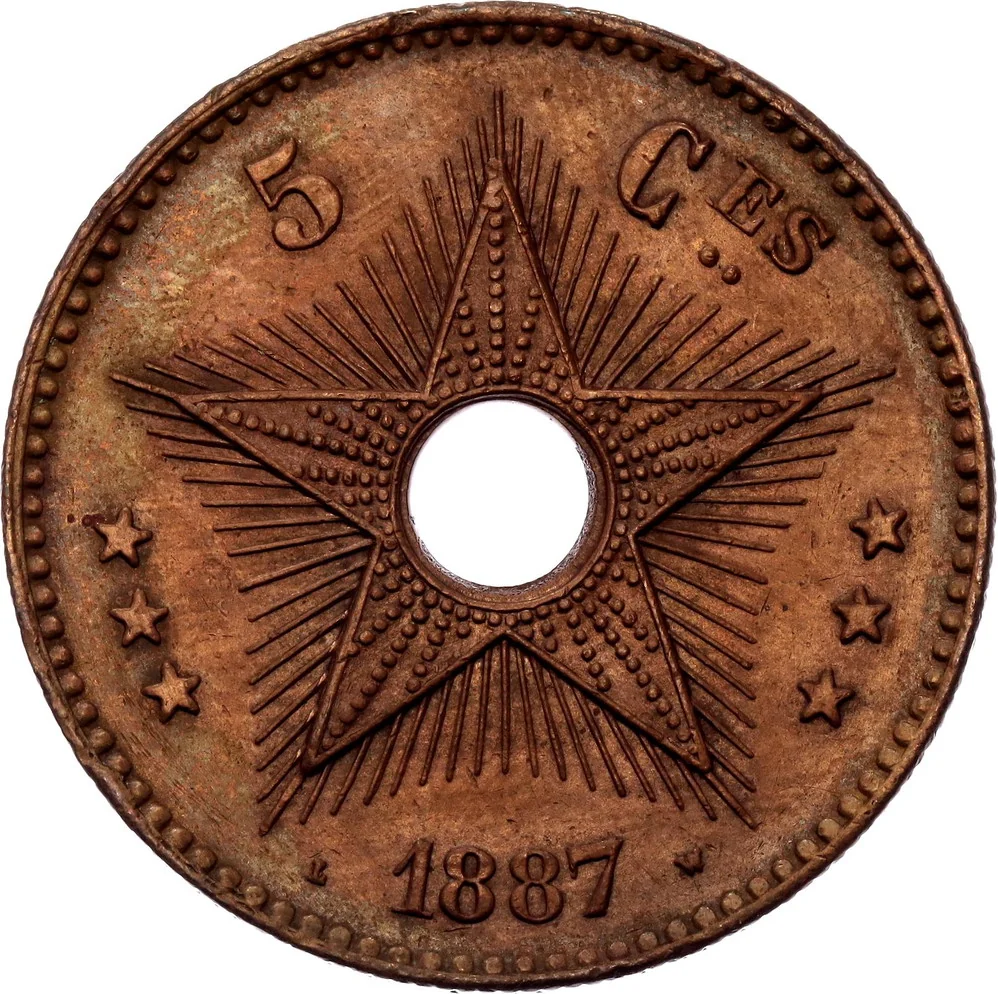
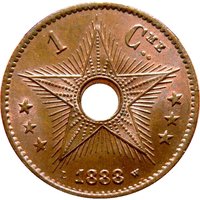
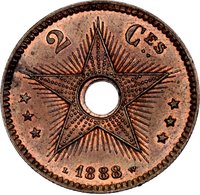
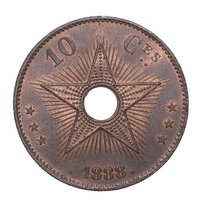
Reverse
Description:
Star's center hole
Inscription:
*** 5 Ces ***
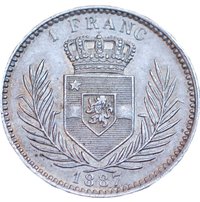
L 1887 W
L 1887 W
Script: Latin
Engraver: Léopold Wiener
Edge
Milled
Mints
| Name | Mark |
|---|---|
| Royal Mint of Belgium | — |
Mintings
| Year | Mint Mark | Mintage | Quality | Collection |
|---|---|---|---|---|
| 1887 | — | 175,000 | ||
| 1888 | — | — | ||
| 1894 | — | 150,000 |
Historical background
In 1887, the Congo Free State, the personal colonial possession of King Leopold II of Belgium, was in the midst of a severe and chaotic currency crisis. The territory lacked a unified, trusted monetary system. Officially, transactions were conducted in metallic currencies—primarily the Belgian franc and other European coins—but these were scarce and concentrated in the hands of European administrators and a few large trading companies. For the vast majority of the Congolese population and for day-to-day local trade, the economy operated through barter or traditional mediums like brass rods, cloth, and salt, which were cumbersome and inefficient for the expanding extractive state.
The crisis was exacerbated by Leopold II’s urgent need for revenue to service the debts of his venture and fund its brutal expansion. His solution, formalized in an 1887 decree, was the introduction of copper mitakos (singular likuta). These were not coins in the traditional sense but heavy, poorly minted copper pieces intended to replace traditional currencies and force the population into a cash economy controlled by the state. The mitako was arbitrarily overvalued and made legal tender for tax payments and trade with state posts, creating a captive demand. However, it was widely despised for its weight, low intrinsic value, and the coercive system it represented.
Consequently, 1887 represents a pivotal moment where economic policy became a direct tool of oppression. The forced introduction of the mitako, alongside the simultaneous imposition of hut taxes and rubber quotas payable in this currency, was designed to compel Congolese people into the cash economy and, by extension, into the exploitative labor system of rubber collection. This monetary manipulation was not for economic development but to facilitate extraction, tightening Leopold’s control and deepening the exploitation that would soon become synonymous with the horrors of the Congo Free State.
The crisis was exacerbated by Leopold II’s urgent need for revenue to service the debts of his venture and fund its brutal expansion. His solution, formalized in an 1887 decree, was the introduction of copper mitakos (singular likuta). These were not coins in the traditional sense but heavy, poorly minted copper pieces intended to replace traditional currencies and force the population into a cash economy controlled by the state. The mitako was arbitrarily overvalued and made legal tender for tax payments and trade with state posts, creating a captive demand. However, it was widely despised for its weight, low intrinsic value, and the coercive system it represented.
Consequently, 1887 represents a pivotal moment where economic policy became a direct tool of oppression. The forced introduction of the mitako, alongside the simultaneous imposition of hut taxes and rubber quotas payable in this currency, was designed to compel Congolese people into the cash economy and, by extension, into the exploitative labor system of rubber collection. This monetary manipulation was not for economic development but to facilitate extraction, tightening Leopold’s control and deepening the exploitation that would soon become synonymous with the horrors of the Congo Free State.
🌱 Fairly Common