

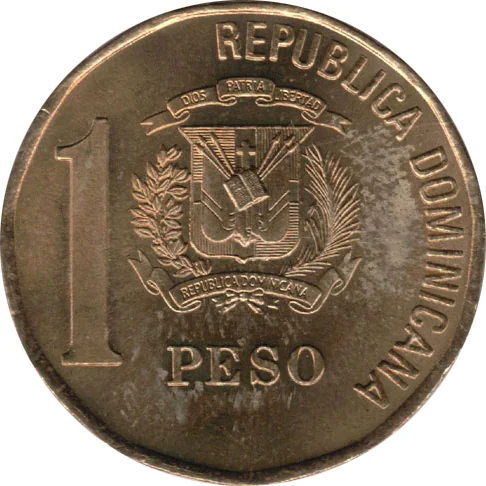
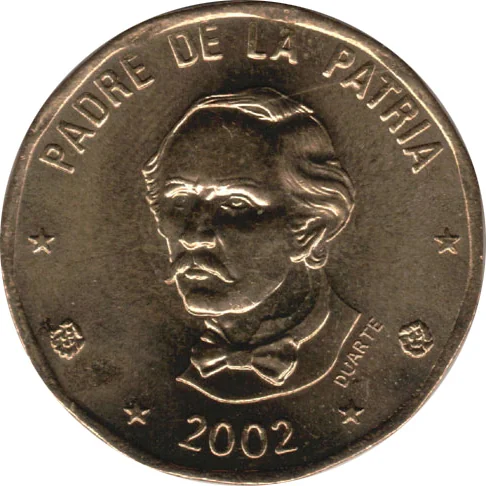
1 peso – Dominican Republic
Add to wishlist
Dominican Republic
Context
Years: 1991–2008
Issuer: Dominican Republic
Period:
(since 1966)
Currency:
(since 1937)
Total mintage: 295,000,000
Material
Diameter: 25 mm
Weight: 6.5 g
Thickness: 2 mm
Shape: Hendecagonal
Composition: Brass
Magnetic: No
Technique: Milled
Alignment: Coin alignment
flip
References
KM: #
Numista: #836
Value
Exchange value: 1 DOP
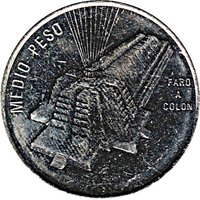
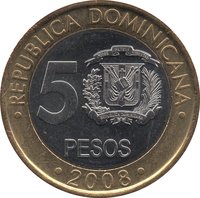
Obverse
Reverse
Edge
Plain with 11 angles.
Categories
| Person> Politician |
| Symbols> Coat of Arms |
Mints
| Name | Mark |
|---|---|
| Mint of Poland | — |
| Royal Canadian Mint of Winnipeg | — |
Mintings
| Year | Mint Mark | Mintage | Quality | Collection |
|---|---|---|---|---|
| 1991 | — | 40,000,000 | BU | |
| 1992 | — | 35,000,000 | BU | |
| 1993 | — | 40,000,000 | BU | |
| 1997 | — | 20,000,000 | BU | |
| 2000 | — | 30,000,000 | BU | |
| 2002 | — | 80,000,000 | BU | |
| 2005 | — | 10,000,000 | BU | |
| 2008 | — | 40,000,000 | BU |
Historical background
In 1991, the Dominican Republic was navigating a period of significant economic transition and stabilization following the turbulent "Lost Decade" of the 1980s. The country was operating under a managed exchange rate regime, with the Dominican peso (DOP) pegged to the US dollar. This peg was a cornerstone of the stabilization program initiated by President Joaquín Balaguer, who returned to office in 1986, aiming to curb the hyperinflation and severe devaluations that had plagued the previous decade. The Central Bank maintained strict control over foreign exchange, with a fixed official rate for essential imports and a slightly depreciated secondary rate for other transactions, creating a de facto dual exchange system.
The primary economic challenge in 1991 was maintaining this peg in the face of persistent fiscal pressures. The government relied heavily on monetary financing of public sector deficits, which created constant inflationary pressure and threatened the stability of the fixed exchange rate. While the peg had succeeded in reducing inflation from its triple-digit peaks, it remained in the high single digits, and the overvaluation of the peso began to strain the country's trade balance. This environment required continuous intervention by the Central Bank to support the currency, leading to a gradual erosion of international reserves.
Ultimately, the currency regime of 1991 proved to be unsustainable in the long term. The pressures from fiscal deficits, combined with a growing black market for US dollars where the peso traded at a significant discount, highlighted the underlying weaknesses. This set the stage for a major economic crisis later in the decade, culminating in a deep devaluation and a shift to a floating exchange rate system in the early 2000s. Thus, 1991 represents a critical point of apparent but fragile stability, where the policies of the past were struggling to address the structural economic challenges of the present.
The primary economic challenge in 1991 was maintaining this peg in the face of persistent fiscal pressures. The government relied heavily on monetary financing of public sector deficits, which created constant inflationary pressure and threatened the stability of the fixed exchange rate. While the peg had succeeded in reducing inflation from its triple-digit peaks, it remained in the high single digits, and the overvaluation of the peso began to strain the country's trade balance. This environment required continuous intervention by the Central Bank to support the currency, leading to a gradual erosion of international reserves.
Ultimately, the currency regime of 1991 proved to be unsustainable in the long term. The pressures from fiscal deficits, combined with a growing black market for US dollars where the peso traded at a significant discount, highlighted the underlying weaknesses. This set the stage for a major economic crisis later in the decade, culminating in a deep devaluation and a shift to a floating exchange rate system in the early 2000s. Thus, 1991 represents a critical point of apparent but fragile stability, where the policies of the past were struggling to address the structural economic challenges of the present.


🌱 Very Common