

5 pesos – Dominican Republic
Add to wishlist
Dominican Republic
Context
Years: 2002–2020
Issuer: Dominican Republic
Period:
(since 1966)
Currency:
(since 1937)
Total mintage: 88,000,000
Material
References
KM: #
Numista: #2504
Value
Exchange value: 5 DOP
Obverse
Description:
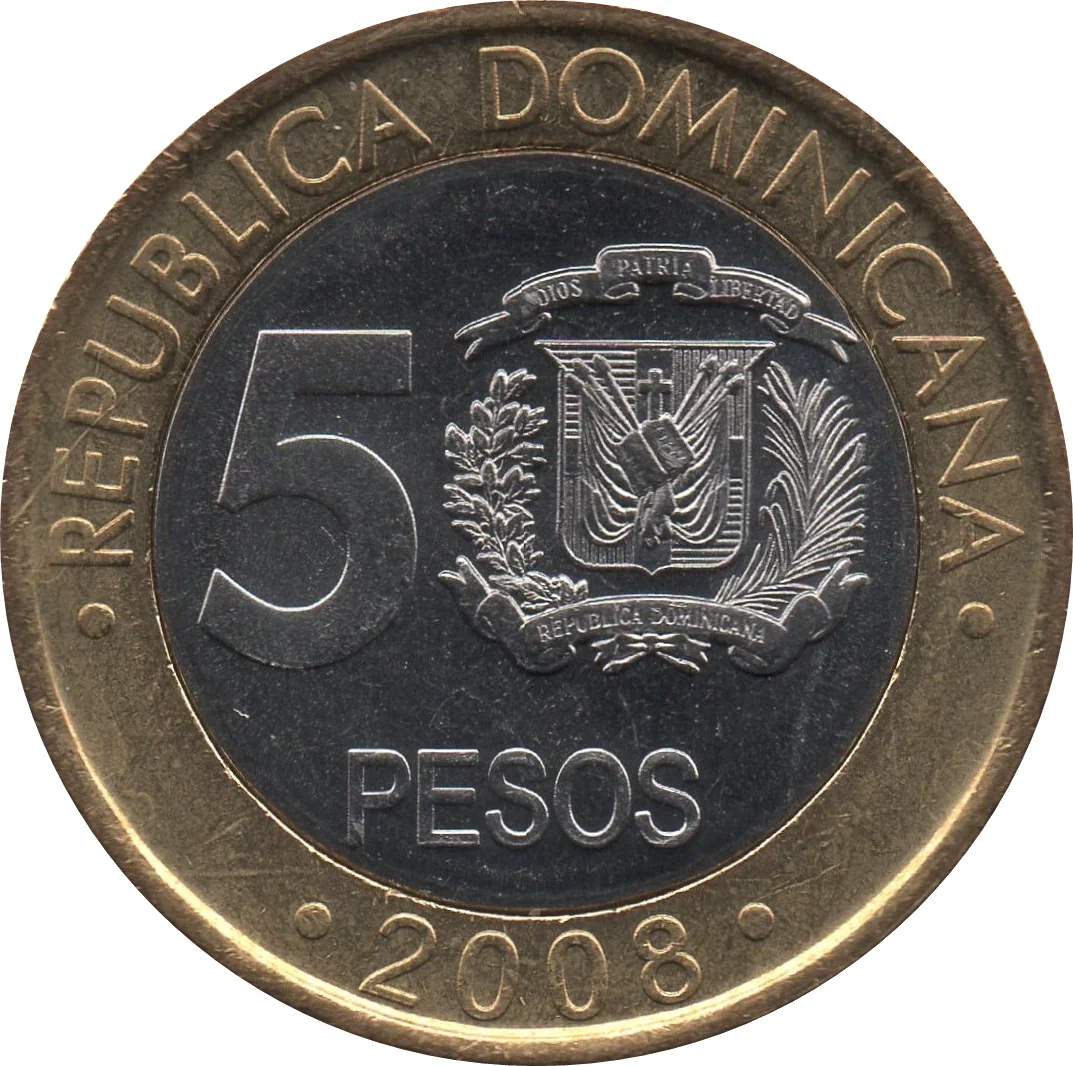
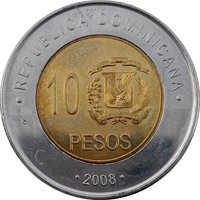
Country and year on outer ring; coat of arms and denomination on inner ring.
Inscription:
· REPUBLICA DOMINICANA ·
DIOS PATRIA LIBERTAD
5
REPUBLICA DOMINICANA
PESOS
· 2008 ·
DIOS PATRIA LIBERTAD
5
REPUBLICA DOMINICANA
PESOS
· 2008 ·
Translation:
· DOMINICAN REPUBLIC ·
GOD FATHERLAND LIBERTY
5
DOMINICAN REPUBLIC
PESOS
· 2008 ·
GOD FATHERLAND LIBERTY
5
DOMINICAN REPUBLIC
PESOS
· 2008 ·
Script: Latin
Language: Spanish
Reverse
Edge
5 reeded segments
Categories
| Symbols> Coat of Arms |
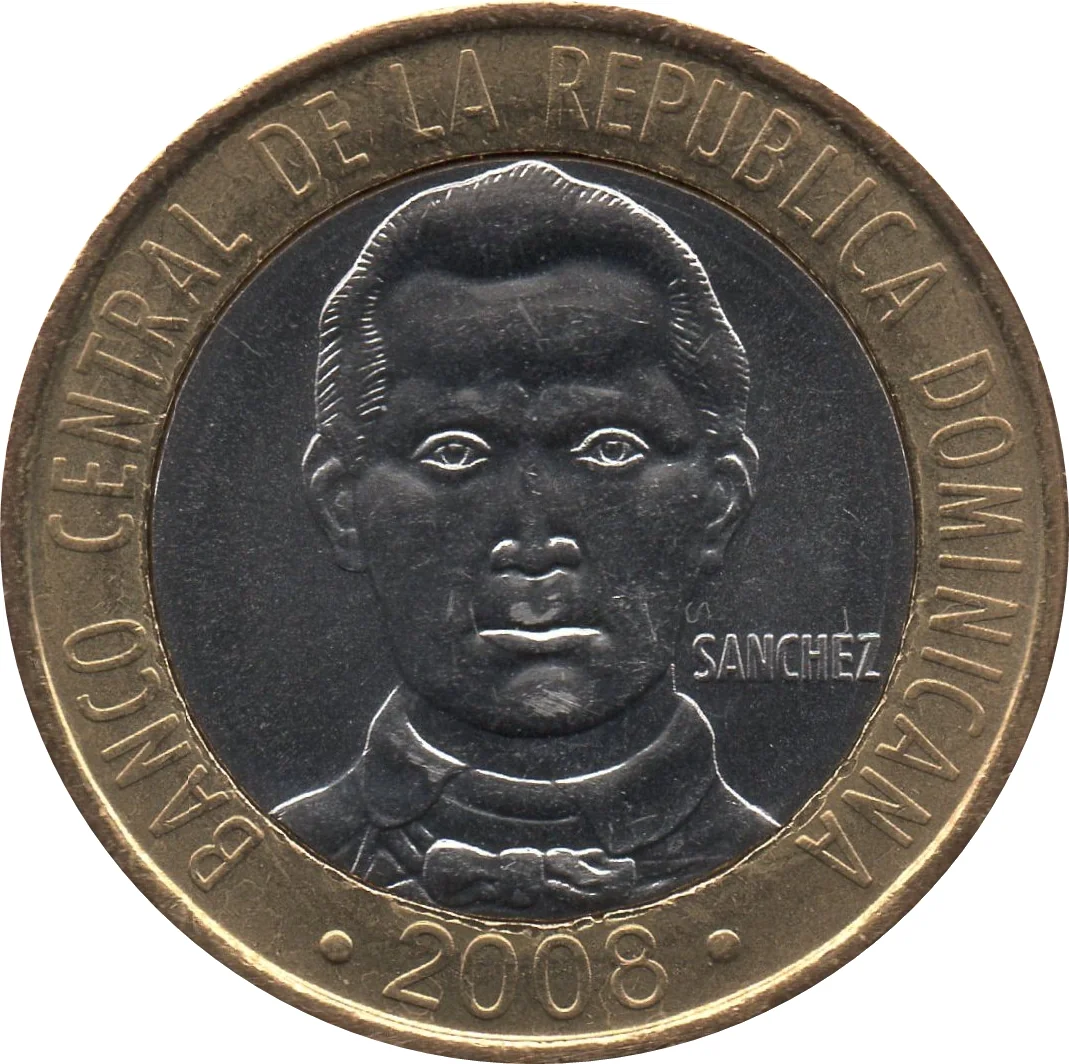
| Person> Politician |
Mints
| Name | Mark |
|---|---|
| Mint of Poland | — |
| Royal Canadian Mint of Winnipeg | — |
| Royal Mint of Madrid | — |
Mintings
| Year | Mint Mark | Mintage | Quality | Collection |
|---|---|---|---|---|
| 2002 | — | 40,000,000 | ||
| 2005 | — | — | ||
| 2007 | — | — | ||
| 2008 | — | 23,000,000 | ||
| 2010 | — | — | ||
| 2016 | — | — | ||
| 2017 | — | 25,000,000 | ||
| 2020 | — | — |
Historical background
In 2002, the Dominican Republic was navigating a period of relative monetary stability, but one underpinned by significant economic vulnerabilities. Following a severe banking crisis in 2003, the country had adopted a managed float exchange rate regime for its currency, the Dominican Peso (DOP). The Central Bank (Banco Central de la República Dominicana) actively intervened in the foreign exchange market to control volatility and maintain a stable, though not fixed, value against the US dollar. This policy aimed to foster confidence, control inflation, and support an economy heavily reliant on imports, tourism, and remittances.
However, this stability was fragile. The year 2002 was marked by growing fiscal and external imbalances. A large fiscal deficit, fueled by expansive public spending and subsidies to the struggling energy sector, was increasingly financed by the Central Bank. This practice of monetary expansion created persistent inflationary pressures and raised concerns about the sustainability of the peso's value. Furthermore, a widening current account deficit, driven by a high import bill and rising oil prices, put steady pressure on the country's foreign reserves.
Consequently, while the official exchange rate remained relatively stable around 16-17 pesos per US dollar throughout much of 2002, a parallel foreign exchange market existed, where the peso traded at a slight discount. This disparity signaled underlying market skepticism. The accumulating macroeconomic imbalances of 2002 set the stage for the severe financial crisis that would erupt the following year, when the country faced a massive banking collapse, a sharp devaluation of the peso, and a surge in inflation, revealing the precarity of the currency's apparent calm.
However, this stability was fragile. The year 2002 was marked by growing fiscal and external imbalances. A large fiscal deficit, fueled by expansive public spending and subsidies to the struggling energy sector, was increasingly financed by the Central Bank. This practice of monetary expansion created persistent inflationary pressures and raised concerns about the sustainability of the peso's value. Furthermore, a widening current account deficit, driven by a high import bill and rising oil prices, put steady pressure on the country's foreign reserves.
Consequently, while the official exchange rate remained relatively stable around 16-17 pesos per US dollar throughout much of 2002, a parallel foreign exchange market existed, where the peso traded at a slight discount. This disparity signaled underlying market skepticism. The accumulating macroeconomic imbalances of 2002 set the stage for the severe financial crisis that would erupt the following year, when the country faced a massive banking collapse, a sharp devaluation of the peso, and a surge in inflation, revealing the precarity of the currency's apparent calm.
🌱 Very Common