

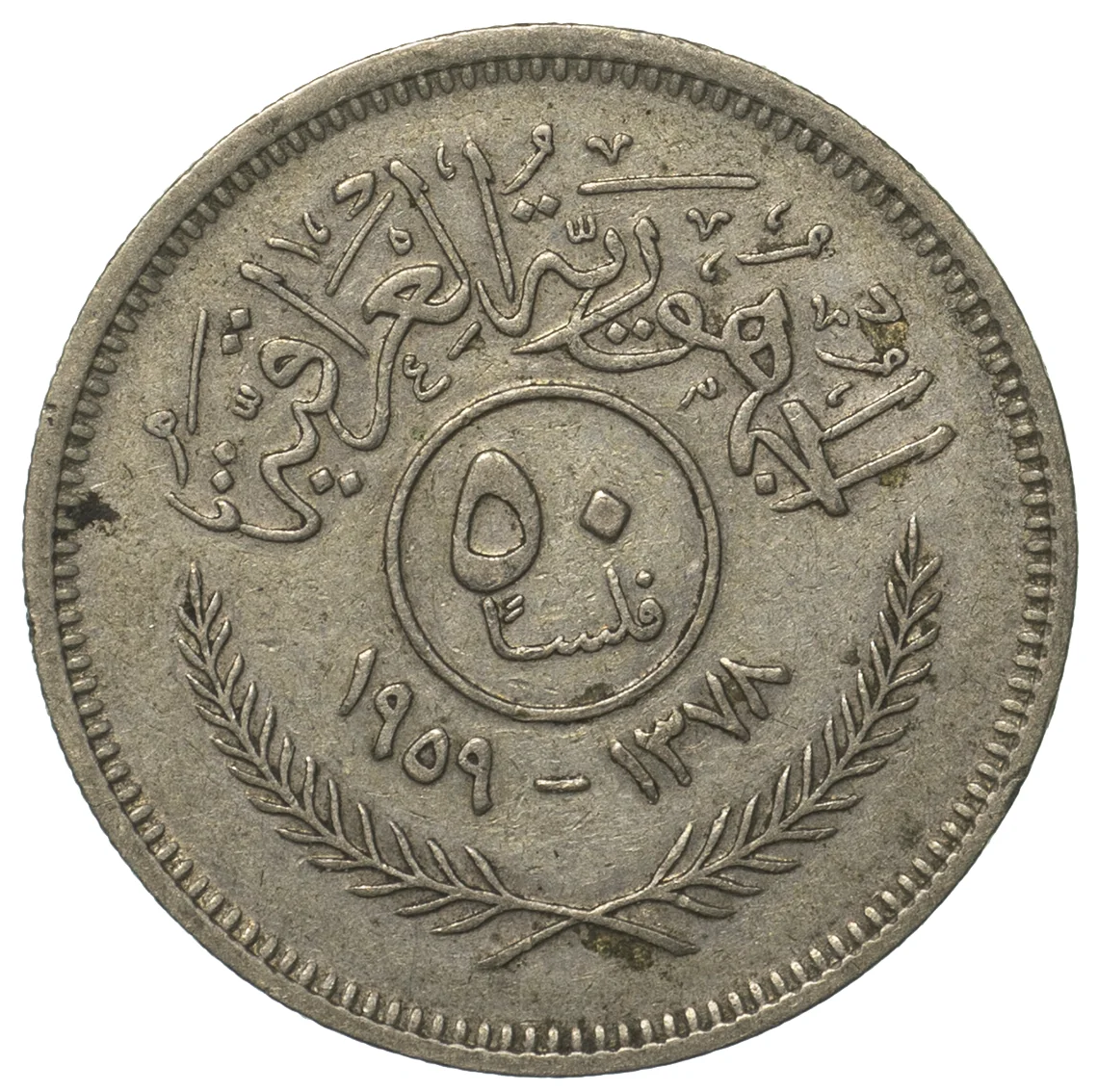
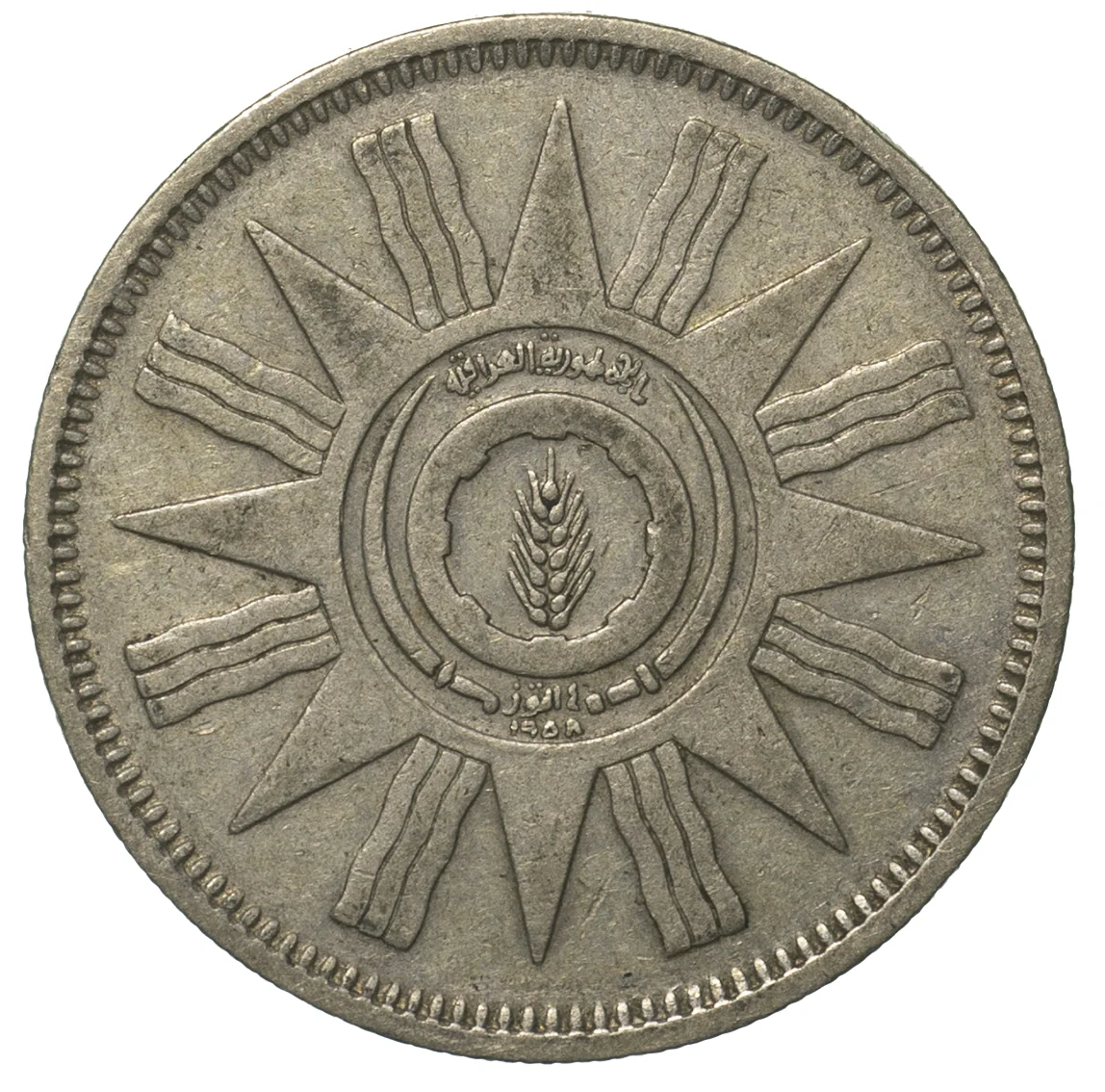
50 fils – Iraq
Add to wishlist
Iraq
Context
Year: 1959
Islamic (Hijri) Year:: 1378
Issuer: Iraq
Period:
(since 1958)
Currency:
(since 1931)
Demonetization: 6 January 1961
Total mintage: 24,000,400
Material
References
KM: #
Numista: #8357
Value
Exchange value: 0.050 IQD
Bullion value: $6.39
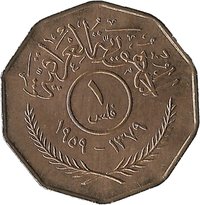
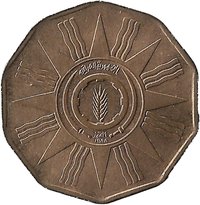
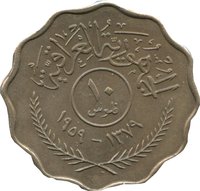
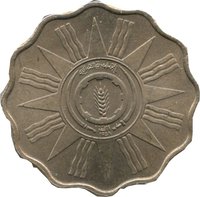
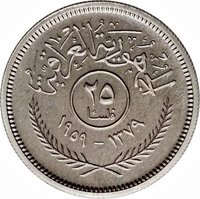
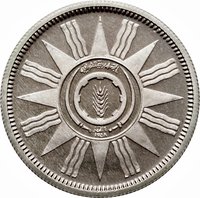
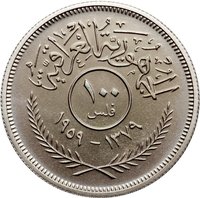
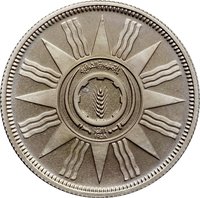
Obverse
Reverse
Edge
Reeded
Mints
| Name | Mark |
|---|---|
| Royal Mint (Tower Hill) | — |
Mintings
| Year | Mint Mark | Mintage | Quality | Collection |
|---|---|---|---|---|
| 1959 | — | 24,000,000 | ||
| 1959 | — | 400 | Proof |
Historical background
In 1959, Iraq's currency situation was fundamentally defined by the continued use of the Iraqi dinar (ID), which was introduced in 1932 to replace the Indian rupee. The dinar was pegged to the British pound sterling at a fixed rate of 1 ID = 1 GBP, a legacy of the British Mandate period. This peg provided a high degree of stability and international credibility, as the currency was fully backed by sterling reserves held in London. The Iraqi Currency Board, established earlier, managed this system, ensuring convertibility and limiting the government's ability to finance spending through money printing, thus imposing fiscal discipline.
Politically, the year fell within a turbulent period following the 1958 revolution that overthrew the Hashemite monarchy. The new republican government, led by General Abdul Karim Qasim, was focused on consolidating power and pursuing nationalist and socialist policies. Despite this political upheaval, there was no immediate radical change to the currency system in 1959. Maintaining the sterling peg was seen as crucial for preserving economic stability, facilitating ongoing oil exports—the country's primary revenue source—and ensuring smooth international trade. The currency itself still bore the image of the deposed King Faisal II, a symbolic anachronism the new regime would not address until new banknotes were issued in the 1960s.
However, underlying pressures were building. The government's expanding economic ambitions and increased public spending began to strain the conservative Currency Board system. Furthermore, the sterling peg indirectly tied Iraq's economy to the fortunes of the British pound, which itself faced periodic pressures. While 1959 did not see a currency crisis, the established monetary order was beginning to clash with the new regime's dirigiste economic aspirations. This tension would ultimately lead to the dissolution of the Iraqi Currency Board in 1964 and the establishment of a central bank, marking the end of the classic currency board era and opening the door to greater state control over monetary policy.
Politically, the year fell within a turbulent period following the 1958 revolution that overthrew the Hashemite monarchy. The new republican government, led by General Abdul Karim Qasim, was focused on consolidating power and pursuing nationalist and socialist policies. Despite this political upheaval, there was no immediate radical change to the currency system in 1959. Maintaining the sterling peg was seen as crucial for preserving economic stability, facilitating ongoing oil exports—the country's primary revenue source—and ensuring smooth international trade. The currency itself still bore the image of the deposed King Faisal II, a symbolic anachronism the new regime would not address until new banknotes were issued in the 1960s.
However, underlying pressures were building. The government's expanding economic ambitions and increased public spending began to strain the conservative Currency Board system. Furthermore, the sterling peg indirectly tied Iraq's economy to the fortunes of the British pound, which itself faced periodic pressures. While 1959 did not see a currency crisis, the established monetary order was beginning to clash with the new regime's dirigiste economic aspirations. This tension would ultimately lead to the dissolution of the Iraqi Currency Board in 1964 and the establishment of a central bank, marking the end of the classic currency board era and opening the door to greater state control over monetary policy.
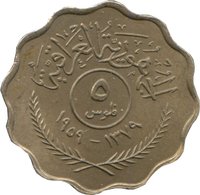
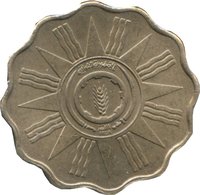
Series: 1959 Iraq circulation coins
🌱 Common