

10 Cents – South Africa
South Africa
Context
Years: 1970–1989
Issuer: South Africa 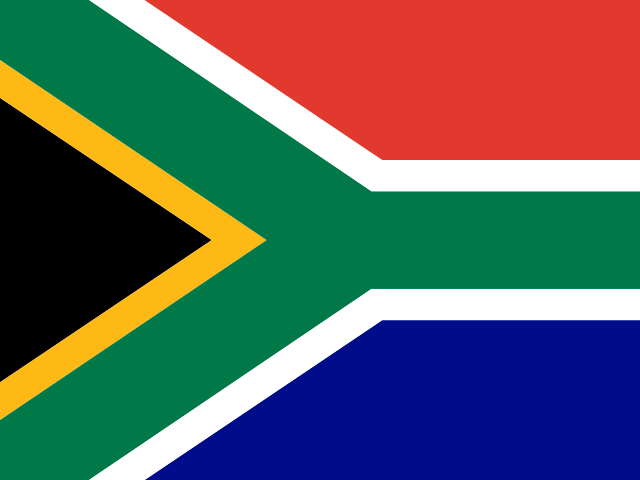
Period:
(since 1961)
Currency:
(since 1961)
Total mintage: 324,613,840
Material
References
KM: #Click to copy to clipboard85
Numista: #833
Value
Exchange value: 0.10 ZAR = $0.01
Inflation-adjusted value: 9.22 ZAR
Obverse
Description:
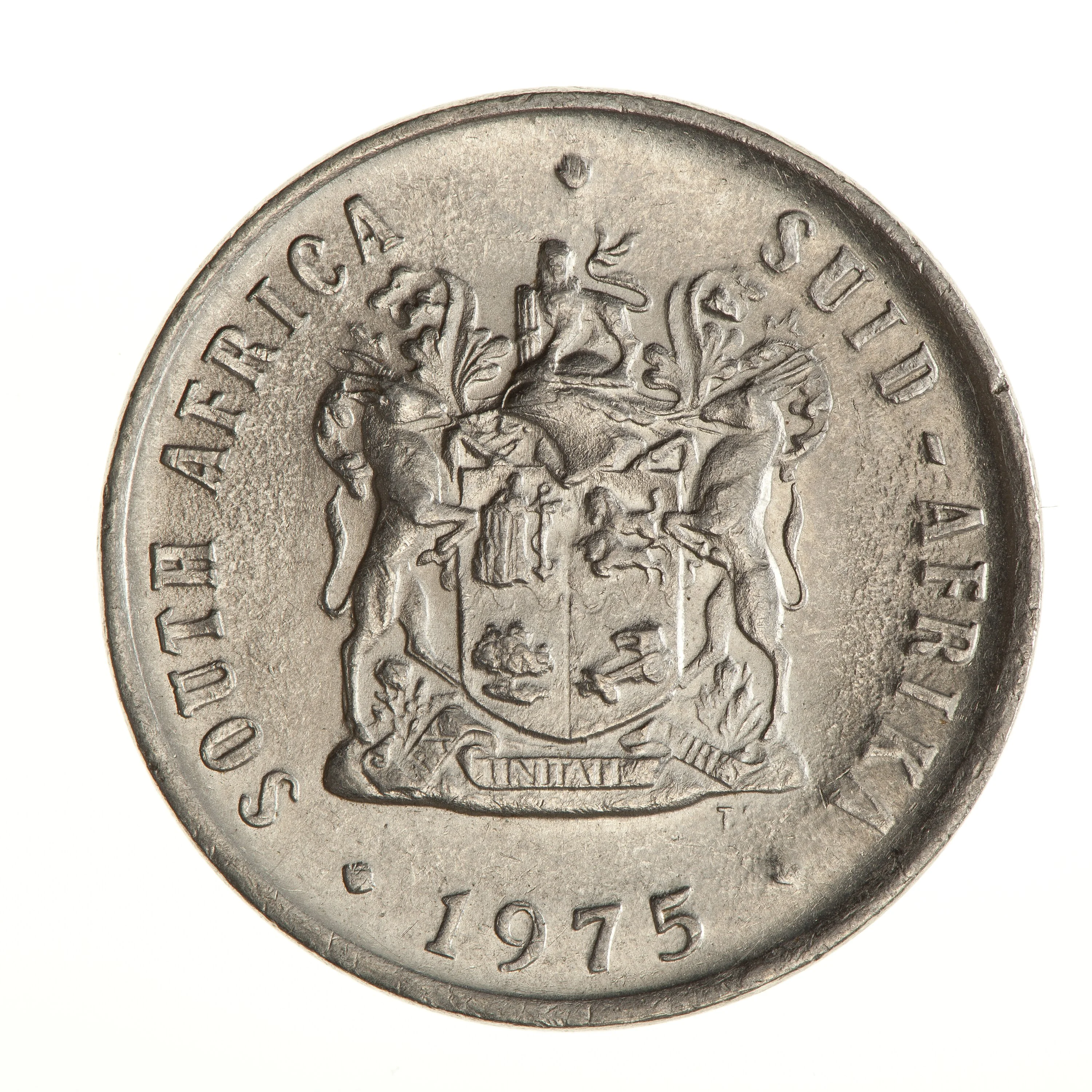
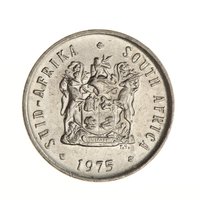
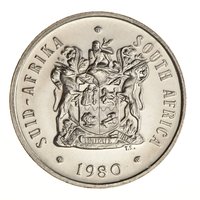
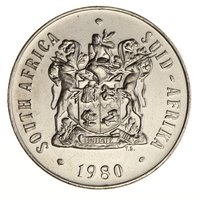
South African coat of arms with bilingual motto.
Inscription:
SOUTH AFRICA
SUID-AFRIKA
EX UNITATE VIRES
A L S
1988
SUID-AFRIKA
EX UNITATE VIRES
A L S
1988
Translation:
SOUTH AFRICA
SOUTH AFRICA
STRENGTH FROM UNITY
A L S
1988
SOUTH AFRICA
STRENGTH FROM UNITY
A L S
1988
Script: Latin
Engraver: Arthur Sutherland
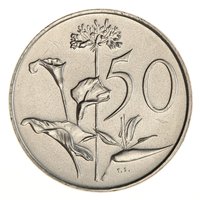
Reverse
Description:
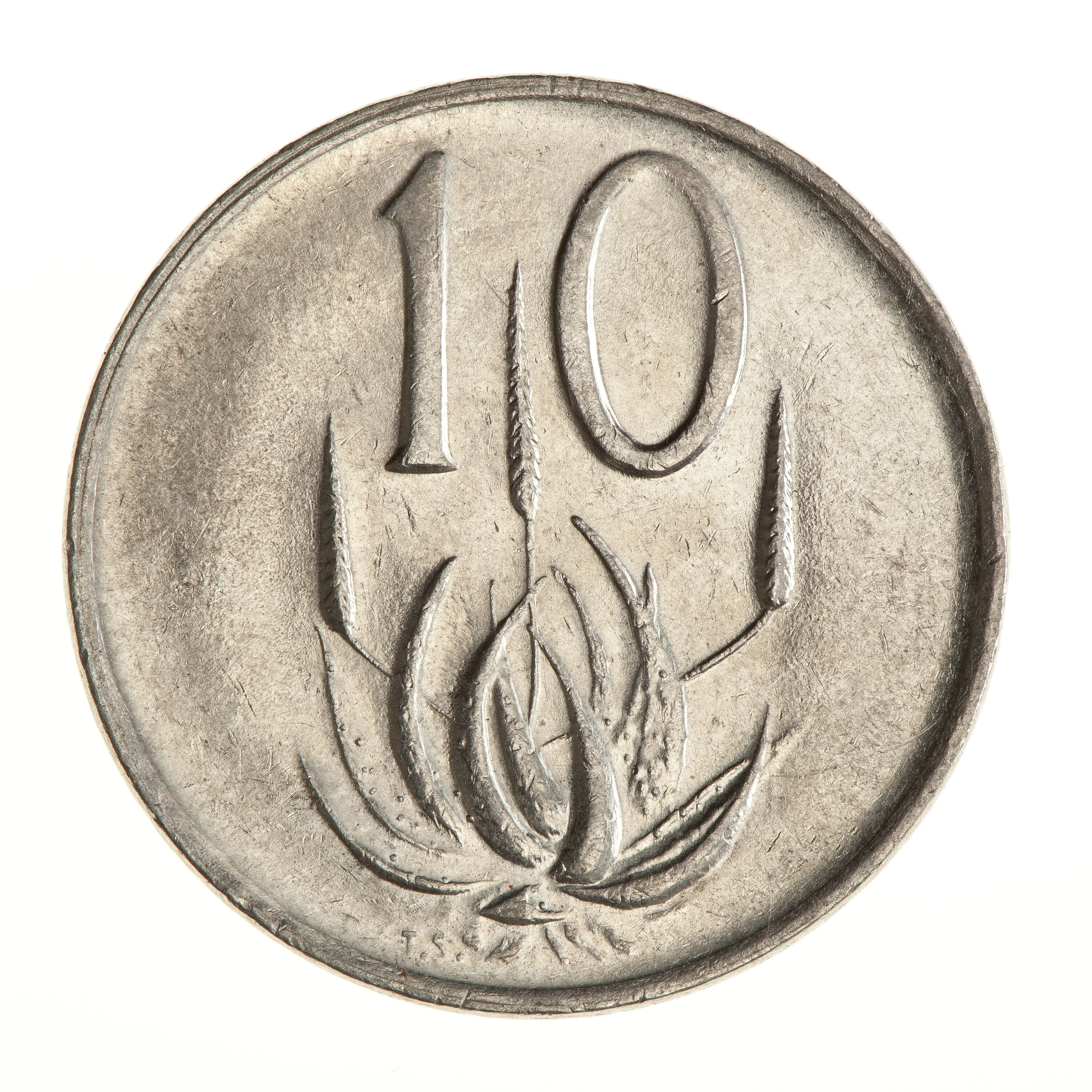
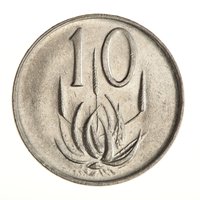
Cape Aloe (Aloe ferox), a South African native from the Asphodelaceae family.
Inscription:
10
T.S.
T.S.
Script: Latin
Engraver: Tommy Sasseen
Edge
Plain
Categories
| Symbols> Coat of Arms |
| Plants> Flower |
Mints
| Name | Mark |
|---|---|
| Pretoria | — |
Mintings
| Year | Mint Mark | Mintage | Quality | Collection |
|---|---|---|---|---|
| 1970 | — | 7,598,000 | ||
| 1970 | — | 10,000 | Proof | |
| 1971 | — | 6,440,000 | ||
| 1971 | — | 12,000 | Proof | |
| 1972 | — | 10,000 | Proof | |
| 1972 | — | 10,028,000 | ||
| 1973 | — | 10,850 | Proof | |
| 1973 | — | 1,760,000 | ||
| 1974 | — | 9,897,000 | ||
| 1974 | — | 15,000 | Proof | |
| 1975 | — | 12,982,000 | ||
| 1975 | — | 18,000 | Proof | |
| 1977 | — | 28,851,000 | ||
| 1977 | — | 19,000 | Proof | |
| 1978 | — | 25,008,000 | ||
| 1978 | — | 19,000 | Proof | |
| 1980 | — | 5,040,000 | ||
| 1980 | — | 15,000 | Proof | |
| 1981 | — | 9,604,000 | ||
| 1981 | — | 10,000 | Proof | |
| 1983 | — | 14,000 | Proof | |
| 1983 | — | 26,495,000 | ||
| 1984 | — | 35,465,000 | ||
| 1984 | — | 11,000 | Proof | |
| 1985 | — | 29,270,000 | ||
| 1985 | — | 9,859 | Proof | |
| 1986 | — | 24,480,000 | ||
| 1986 | — | 7,100 | Proof | |
| 1987 | — | 6,781 | Proof | |
| 1987 | — | 43,234,000 | ||
| 1988 | — | 7,250 | Proof | |
| 1988 | — | 48,267,000 | ||
| 1989 | — | — | Proof | |
| 1989 | — | — |
Historical background
In 1970, South Africa's currency situation was defined by its position within the Sterling Area and the enduring legacy of the 1948-established two-tier exchange rate system. The country maintained a fixed exchange rate, with the South African Rand pegged at R2 = £1 Sterling. This formal link to Sterling provided stability for trade and capital flows with Britain, still a major economic partner, but also tied the Rand's fortunes to the Pound's strength. Domestically, the apartheid government strictly enforced exchange controls to manage the balance of payments, prevent capital flight from the isolated regime, and conserve foreign reserves.
The dual-currency system was a critical feature, distinguishing between "Commercial Rand" for current account transactions (like trade) and "Financial Rand" for capital movements. This mechanism aimed to insulate the country's foreign reserves and exchange rate from the volatility of capital flows, particularly outflows driven by increasing international condemnation of apartheid. While effective in control, it created complexity and a disconnect, often resulting in the Financial Rand trading at a significant discount to the Commercial Rand, reflecting a market-imposed risk premium on the political climate.
Overall, the 1970 currency regime was one of managed stability but underlying vulnerability. The fixed peg to a weakening Sterling (which would be abandoned in 1972) and the reliance on stringent controls highlighted an economy increasingly out of step with global financial trends. This rigid structure would face severe tests in the coming decade, as the gold price boom provided temporary relief but soaring inflation, growing internal dissent, and intensified international sanctions eventually necessitated a fundamental overhaul of the financial system.
The dual-currency system was a critical feature, distinguishing between "Commercial Rand" for current account transactions (like trade) and "Financial Rand" for capital movements. This mechanism aimed to insulate the country's foreign reserves and exchange rate from the volatility of capital flows, particularly outflows driven by increasing international condemnation of apartheid. While effective in control, it created complexity and a disconnect, often resulting in the Financial Rand trading at a significant discount to the Commercial Rand, reflecting a market-imposed risk premium on the political climate.
Overall, the 1970 currency regime was one of managed stability but underlying vulnerability. The fixed peg to a weakening Sterling (which would be abandoned in 1972) and the reliance on stringent controls highlighted an economy increasingly out of step with global financial trends. This rigid structure would face severe tests in the coming decade, as the gold price boom provided temporary relief but soaring inflation, growing internal dissent, and intensified international sanctions eventually necessitated a fundamental overhaul of the financial system.
🌱 Very Common