

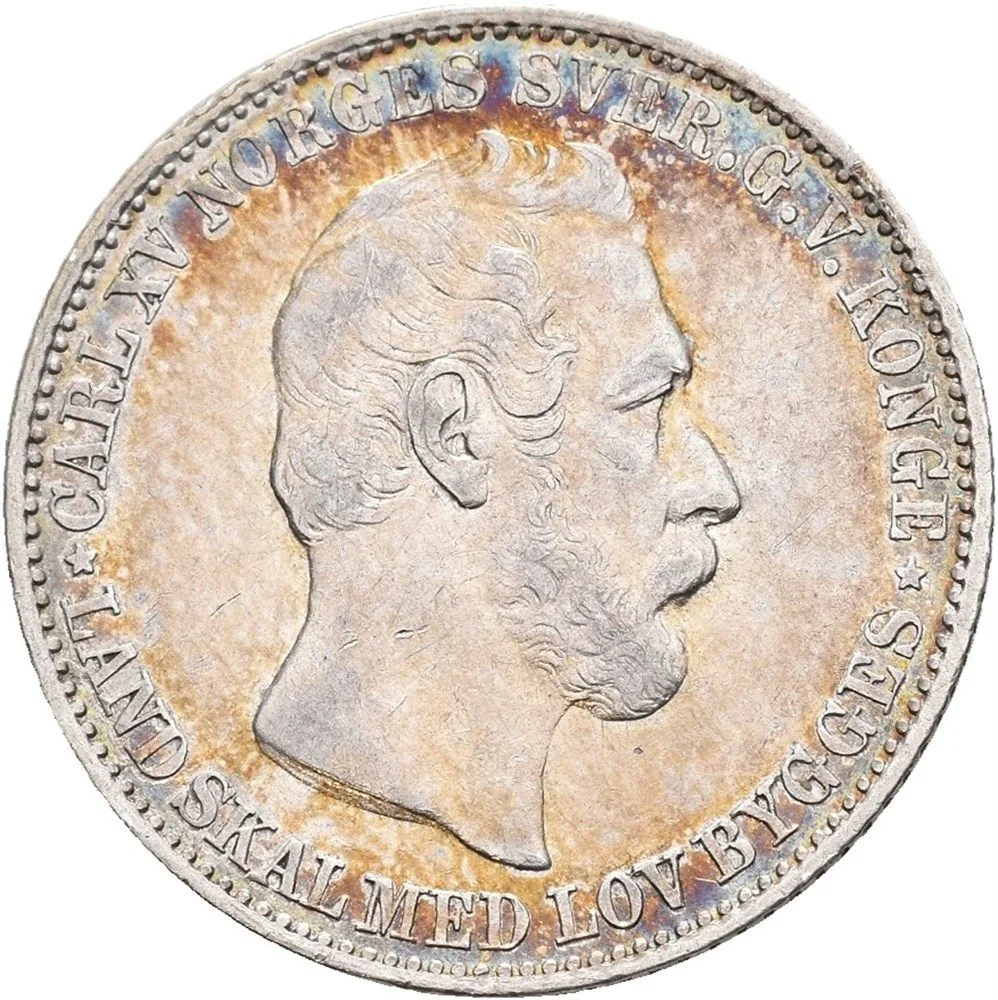
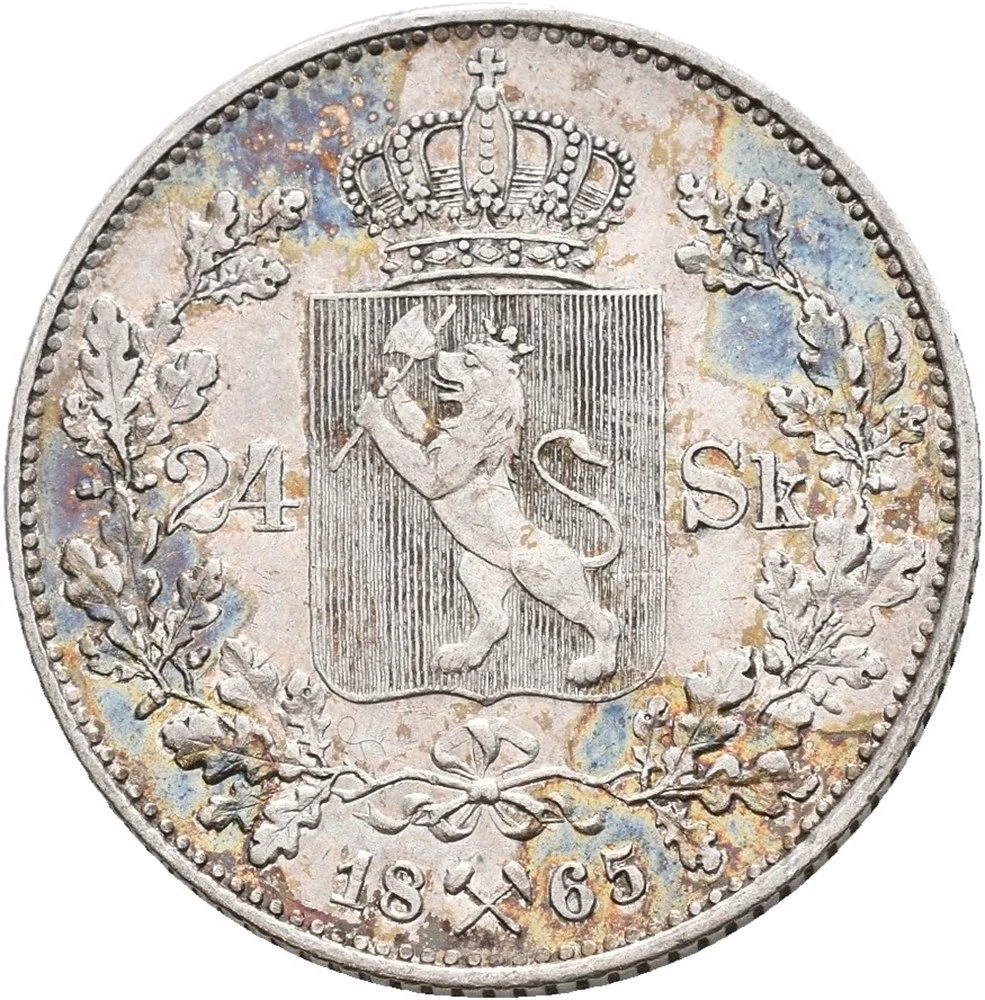
24 skilling – Norway
Add to wishlist
Norway
Context
Year: 1865
Issuer: Norway
Ruler: Charles IV
Currency:
(1816—1875)
Demonetized: Yes
Total mintage: 79,200
Material
References
KM: #
Numista: #83050
Value
Bullion value: $12.87
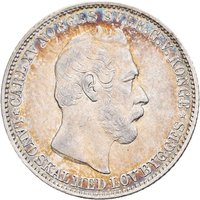
Obverse
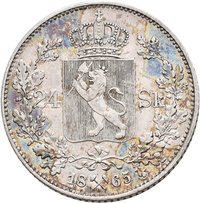
Reverse
Description:
Crowned shield with Norwegian lion holding a halberd, on vertical lines. Value flanking shield, within wreath. Date below, split by mintmark. Beaded rim.
Inscription:
24 | Sk
18 ⚒ 65
18 ⚒ 65
Script: Latin
Edge
Mints
| Name | Mark |
|---|---|
| Norwegian Mint | — |
Mintings
| Year | Mint Mark | Mintage | Quality | Collection |
|---|---|---|---|---|
| 1865 | — | 79,200 |
Historical background
In 1865, Norway's currency situation was characterized by its participation in the Scandinavian Monetary Union (SMU), established just two years prior with Sweden and Denmark. This agreement created a unified system where the gold-backed krone/krona became the common currency, replacing the former speciedaler. The union guaranteed the free circulation and acceptance of each member's coins within all three nations, facilitating trade and economic integration across Scandinavia. Norway's adoption of the krone (NOK) on a gold standard was a definitive step toward modern, stable, and internationally recognized finance.
However, this move to the gold standard came during a period of significant international monetary debate and strain. The global price of silver was falling, which would have devalued Norway's previous silver-based currency. While the gold standard provided stability, it also tied Norway's money supply to its gold reserves, limiting the government's ability to adjust monetary policy during economic downturns. Furthermore, the union was inherently asymmetric, as Norway was the smallest and economically weakest partner, leaving its currency system somewhat dependent on the policies and economic health of its larger neighbours.
Despite these underlying tensions, the system functioned smoothly in 1865. The immediate effect was a period of monetary stability and predictability, which was welcomed by merchants and the state. The Norwegian krone, backed by gold and interchangeable with its Swedish and Danish counterparts, fostered confidence in both domestic and international transactions. This stability provided a crucial foundation for Norway's ongoing industrial and commercial development, even as the long-term vulnerabilities of the fixed system and the political union with Sweden (which would dissolve in 1905) loomed in the background.
However, this move to the gold standard came during a period of significant international monetary debate and strain. The global price of silver was falling, which would have devalued Norway's previous silver-based currency. While the gold standard provided stability, it also tied Norway's money supply to its gold reserves, limiting the government's ability to adjust monetary policy during economic downturns. Furthermore, the union was inherently asymmetric, as Norway was the smallest and economically weakest partner, leaving its currency system somewhat dependent on the policies and economic health of its larger neighbours.
Despite these underlying tensions, the system functioned smoothly in 1865. The immediate effect was a period of monetary stability and predictability, which was welcomed by merchants and the state. The Norwegian krone, backed by gold and interchangeable with its Swedish and Danish counterparts, fostered confidence in both domestic and international transactions. This stability provided a crucial foundation for Norway's ongoing industrial and commercial development, even as the long-term vulnerabilities of the fixed system and the political union with Sweden (which would dissolve in 1905) loomed in the background.
✨ Legendary